
The clutch master disk is fixed to the flywheel, which in turn is fixed to the engine crankshaft flange. The master disk and slave disk are located at the engine flywheel.
The gearbox bell houses the clutch fork. It holds a maintenance-free release bearing that exerts pressure on the driven disk when the clutch is released. The clutch fork houses the hydraulic system's slave cylinder. The hydraulic clutch drive operates on brake fluid, which it is supplied with from an expansion tank shared with the brake system.
When the clutch pedal is released, the driven disk is pressed by the driving disk against the flywheel under the force of the diaphragm springs, creating a transmission of torque from the crankshaft to the input shaft of the gearbox.
When the clutch pedal is pressed, the movement of the master cylinder piston creates pressure, which is transmitted through the pipeline to the clutch slave cylinder, which is secured with a flange on the gearbox. The slave cylinder piston exerts pressure through the clutch fork on the release bearing and, overcoming the force of the diaphragm springs of the drive disk, moves it slightly. Thus, the slave disk between the drive disk and the flywheel is released, and the transmission of torque from the engine to the gearbox is interrupted.
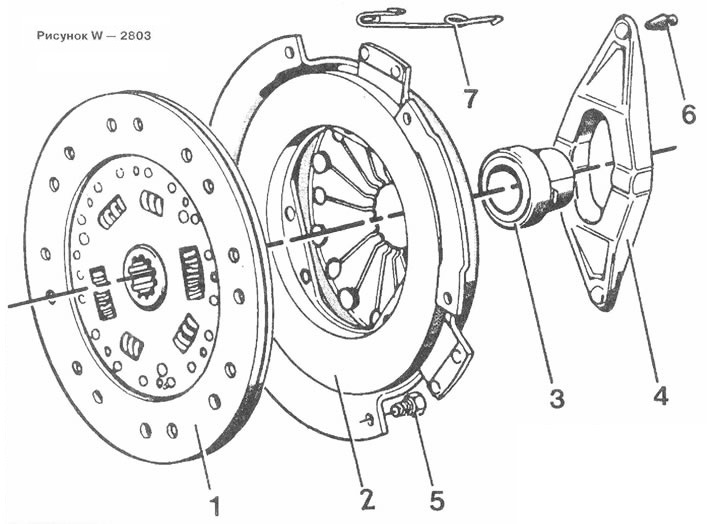
1 Slave disk
2 Leading disk
3 Release bearing
4 Clutch fork
5 Bolt
6 Ball pin
7 Spring clamp
The original text can be read on the website «BMWMAN.ru»