
Table of contents: Removal ↓ Installation ↓
- Home
- BMW 3 Series
- E36
- Chassis
- Brake system
- Removal and installation front brake pads
Removal and installation front brake pads (BMW 3 Series E36)
Removal
Remove the decorative wheel cap. Loosen the wheel bolts with the vehicle on the ground.
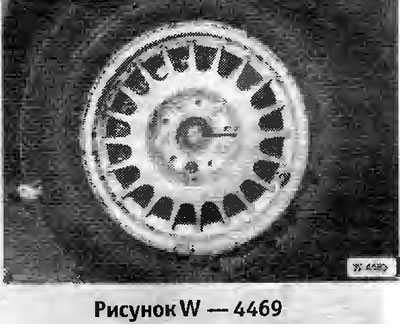
Mark the position of the wheel rims on the front wheel hubs with paint. This will allow the balanced wheel to be installed in the same position later.
Raise the front of the car.
Remove the wheel.
Caution: Do not swap the pads from the inside to the outside and vice versa, or from the right wheel to the left and vice versa. Swapping may cause uneven braking. Always replace all front brake pads at the same time, even if only one pad has reached the wear limit. When reinstalling brake pads, they must be marked when removed.
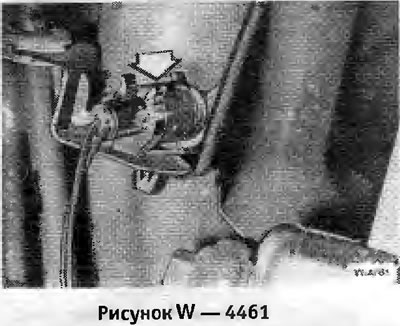
On the left wheel brake caliper, remove the wear sensor connector "arrow", but do not pull on the wire.
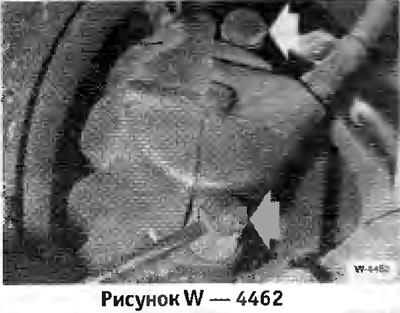
Use a screwdriver to press down the plastic caps of the "arrow" mounting bolts.
Press the brake hose out of the mount.
Caution: Do not unscrew the brake hose, otherwise you will have to bleed air from the brake system after installing it.
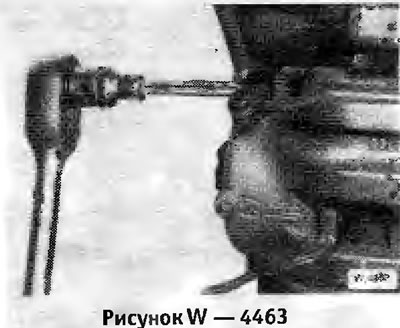
Using a 7 mm spanner, loosen both mounting bolts located under the plastic plugs.
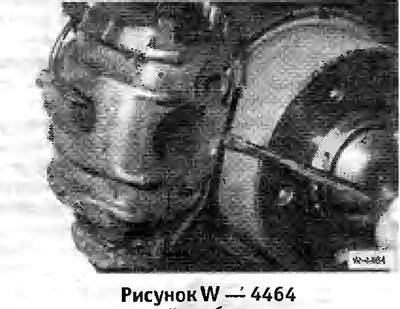
Press the bracket with a screwdriver.
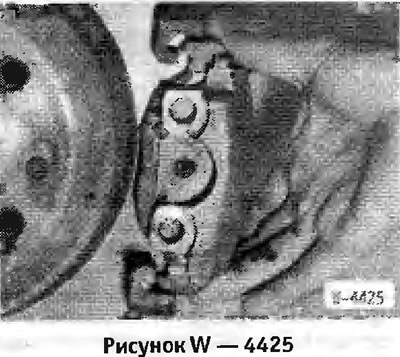
Remove the floating caliper.
Remove the outer brake shoe.
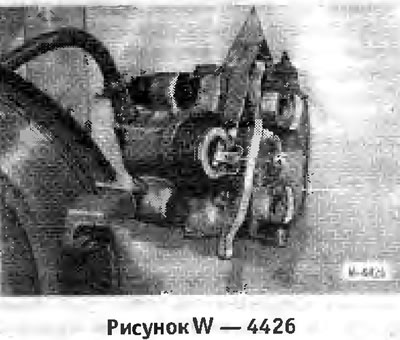
The inner brake shoe is secured to the piston by spring "6". Pull out the brake shoe.
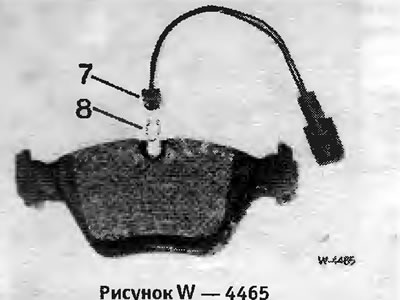
Disconnect the wear sensor "7" from the left side of the inner brake shoe.
If the insulation of the contact board is worn out, the wire insulation is damaged, or the plastic part is worn out, replace the wear sensor.
Installation
Caution: When the brake pads are removed, do not press the brake pedal, as this will cause the piston to come out of the housing.
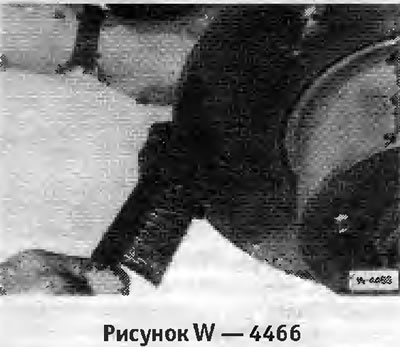
Clean the guide surfaces and the brake shoe seating areas in the housing shaft with a suitable soft metal brush or a cloth soaked in alcohol. Do not use mineral-containing substances or sharp tools.
Before installation, check the brake disc with your fingers for scratches. Scratched discs should be replaced. Before installing new brake pads, clean brake discs with a gray or bluish coating.
Measure the thickness of the brake disc.
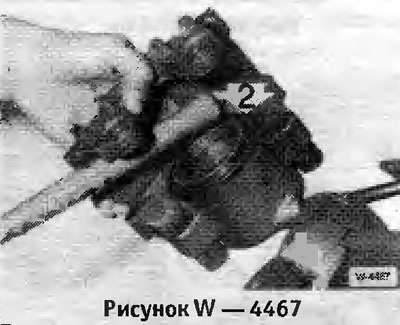
Check the integrity of the piston dust cap "2". Replace the damaged cap immediately, as penetrating dirt quickly leads to brake caliper leaks. This requires removing and disassembling the brake caliper (work at a service station).
Press the brake piston "2" with a pressing device. This can also be done with a wooden rod (hammer handle), but at the same time, be especially careful to ensure that the piston is not tilted and that the dust cap is not damaged.
Note: When the pistons are pressed, brake fluid is squeezed out of the brake cylinders into the expansion tank. Monitor the fluid level in the tank; it may be necessary to suck out the fluid.
To suck out the fluid, you can use a vessel used to release air from the brake system or any plastic bottle that is intended only for brake fluid. Do not use beverage bottles! Brake fluid is poisonous and should never be sucked out by mouth through a hose. Use a suction device. After replacing the pads, the brake fluid level should also not exceed the MAX mark, since the liquid expands when the temperature rises. Leaking brake fluid gets on the master brake cylinder, destroys the paint and causes corrosion.
Note: If the brake pads are heavily worn, check the ease of piston movement. If the piston moves with difficulty, send the caliper for repair (work at a service station).
To prevent disc brakes from squeaking, apply a thin layer of grease (for example Plastitube, Tunap VC 582/S, Chevron SRJ/2, Liqui Moly LM-36 or LM-508-ASC) on the back side of the brake pads. In this case, the lubricant is applied only to the back side. Under no circumstances should the lubricant get on the working surface of the brake pad or on the brake disc. If necessary, wipe off the lubricant and wash the surface with alcohol.
Lightly lubricate the brake pad guides in the brake caliper, such as Plastitube.
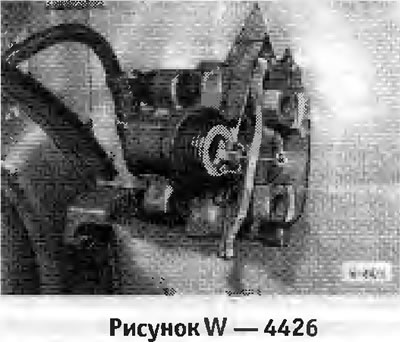
Insert the brake shoe with spring "6" into the piston.
(Figure W 4465) Secure the wear indicator "7" to the inner brake shoe. Ensure the correct position of the locking bracket "8".
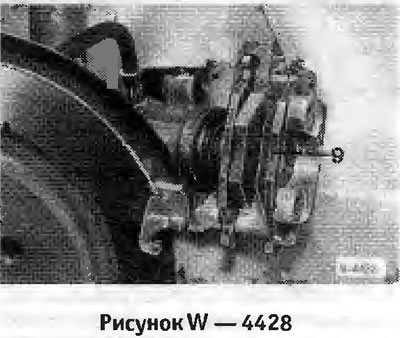
Insert the outer brake shoe "9" into the brake caliper and place the brake caliper on the brake disc.
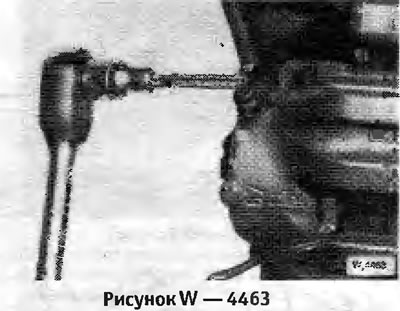
Inspect the 2 brake caliper mounting bolts and clean the bolt threads if necessary. The threads in the brake bracket can be cleaned by running a tap through them. Replace bolts with damaged or rusted threads. Tighten the bolts with a 7 mm open-end wrench to a tightening torque of 30 Nm.
Place protective caps on the bolts.
Insert the brake hose into the mount.
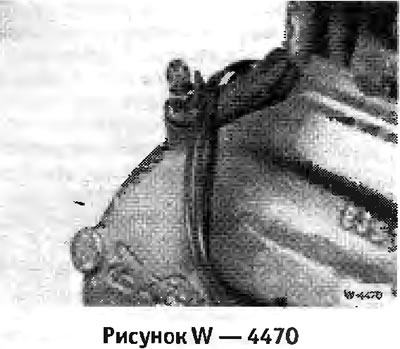
Connect the wear sensor connector on the left side of the vehicle to the connector on the brake caliper. The wire should pass through the loop of the bleed valve cover, see the picture.
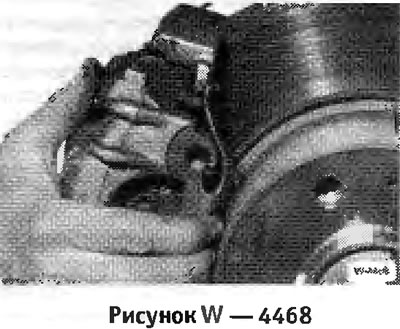
Insert the bracket into the brake caliper.
Install the wheel observing the marking of the disk position on the hub. Lower the car and cross-tighten the wheel bolts to a torque of 110 Nm.
Install the wheel hub cap.
Caution: With the vehicle stationary, press the brake pedal several times until you feel stiff resistance.
Check the brake fluid level in the expansion tank, if necessary, top up the fluid to the MAX mark
Carefully allow the new brake pads to break in by lightly pressing the brake pedal several times to brake the car from 80 km/h to 40 km/h. Allow the brakes to cool between successive brakings.
Attention: During the first 200 km of travel, avoid sudden braking until the vehicle comes to a complete stop.
This article is available at russian, bulgarian, belarusian, ukrainian, serbian, croatian, romanian, polish, slovak, hungarian
Article verified: Chebotarev Vladislav
Share information:
Previous articles
БМВ E36: Brake system
Next articles
Similar articles on other types of BMW cars:
Removal and installation front disc brake pads BMW 5 Series E39 (1995-2003)
Removal and installation front brake pads BMW 5 Series E34 (1988-1996)
Front brake pads — removal and installation BMW 7 Series E32 (1986-1994)
Removal and installation the airbag system module in the left or… BMW X3 E83 (2003-2010)
Removal and installation front door glass BMW X5 E53 (1999-2006)
Removal and installation front disc brake pads BMW 5 Series E39 (1995-2003)
Removal and installation front brake pads BMW 5 Series E34 (1988-1996)
Front brake pads — removal and installation BMW 7 Series E32 (1986-1994)
Removal and installation the airbag system module in the left or… BMW X3 E83 (2003-2010)
Removal and installation front door glass BMW X5 E53 (1999-2006)
Link in different formats to this page
Visitor comments
No comments yet
- General information
- Manual
- Maintenance
- Power unit
- Engine repair
- Cooling system
- Power system (gasoline)
- Injection system (gasoline)
- Fuel system (diesel)
- Exhaust system
- Ignition system
- Charge and launch systems
- Transmission
- Car gearbox
- Clutch and drive shafts
- Chassis
- Brake system
- Suspension front and rear
- Steering
- Body
- Body care and repair
- Exterior
- Interior
- Electrical equipment
- Troubleshooting
- Lighting and signaling
- Equipment and devices
- Heater and air conditioner
- Electrical circuits
- General information
- Manual
- Repair on the road
- Weekly checks
- Maintenance
- Troubleshooting
- Power unit
- 4 cylinder engines
- 6 cylinder engines
- Engine overhaul
- Cooling and heating
- Fuel and exhaust system
- Starting and charging system
- Ignition system
- Transmission
- Clutch
- Mechanical gearbox
- Automatic gearbox
- Cardan and drive shafts
- Chassis
- Brake system
- Wheel suspension
- Steering
- Body
- Exterior
- Interior
- Electrical equipment
- Equipment and devices
- Electrical circuits
- General information
- Maintenance
- Power unit
- Engine repair
- Cooling system
- Ignition system
- Supply system
- Fuel injection system
- Exhaust system
- Transmission
- Clutch
- Car gearbox
- Front and rear axle
- Chassis
- Steering
- Brake system
- Body
- Exterior
- Interior
- Electrical equipment
- Heating system
- Equipment and devices
- Power devices
- Electrical circuits
- Power unit
- M10/M20 engine
- M40 engine
- Ignition system
- Lubrication system
- Cooling system
- Supply system
- Fuel injection
- Exhaust system
- Transmission
- Clutch
- Manual gearbox
- Front axle
- Rear axle
- Chassis
- Steering
- Brake system
- Body
- Exterior
- Interior
- Electrical equipment
- Heating system
- Equipment and devices
- Electrical circuits
- General information
- Specifications
- Operation and maintenance
- 4-cylinder engine
- Engine repair
- Cooling and lubrication system
- Supply system
- Ignition system
- 6-cylinder engine
- Engine repair
- Cooling and lubrication system
- Supply system
- Fuel injection system
- Ignition system
- Transmission
- Clutch
- 4-speed manual gearbox
- 5-speed manual gearbox
- Automatic gearbox
- Cardan and rear axle
- Chassis
- Steering
- Front suspension
- Rear suspension
- Brake system
- Electrical equipment
- Equipment and devices
- Electrical circuits