
In the engine compartment, above the master cylinder, there is a brake fluid expansion tank that supplies brake fluid to the entire brake system.
The hydraulic booster accumulates part of the vacuum present in the engine intake system (on a diesel engine there is a special vacuum pump for this purpose). Then, as required, the force applied to the brake pedal is increased through the booster valves.
All disc brakes have what are called floating caliper calipers. In a floating caliper, only one piston is required to press both brake pads against the disc.
The handbrake acts on the rear wheels via a cable. On models with rear disc brakes, brake drums are additionally installed in the brake discs to operate the handbrake. These brake drums operate exclusively from the handbrake lever. This is necessary because disc brakes are not suitable as a parking brake.
When cleaning the brake system, brake dust is released. This dust can cause health problems. Therefore, when cleaning the brake system, take measures to avoid inhaling brake dust.
Brake pads are components of the General Operating Approval and are produced by the manufacturer in different types for different vehicle models. It is therefore recommended to install only brake pads recommended by BMW or the Federal Motor Transport Authority. Brake pads have an Authority approval number.
It is recommended that when purchasing brake pads, you also purchase brake pad wear sensors, as the sensors installed on the vehicle may also be worn out.
Work with the brake system requires accuracy and precise adherence to the instructions for its implementation. If you do not have experience in carrying out such work, it is better to carry it out at a service station.
Old used brake fluid should be handed over to special waste collection points, and not simply poured out or thrown away with household garbage. The city or village administration will inform you about the location of special waste collection points.
Note: On very wet roads, brake occasionally while driving to release deposits from the discs. Although water is thrown away from the brake discs by centrifugal force while driving, a thin film of silicones, rubber dust, grease and dirt partially remains, reducing the braking effect.
When parking the car after driving in the rain, especially in winter with special impacts on the road, it is advisable to stop the car by lightly pressing the brake pedal. Thanks to this, the brake discs are dried and will not corrode intensively.
After installing new brake pads, they need to be allowed to run in. During the first 200 km, avoid sharp braking until a complete stop. Otherwise, do not avoid giving the disc brakes increased loads, as this will create favorable conditions for contamination and corrosion of the brake pads. Strong braking at high speed favors self-cleaning of the disc brakes.
Corroded brake discs produce a shaking and noise effect that does not disappear even after repeated braking. In this case, the brake discs should be replaced.
Burnt dirt and clogged rain grooves on the brake pads cause scratches on the brake discs. This causes a reduction in braking effect.
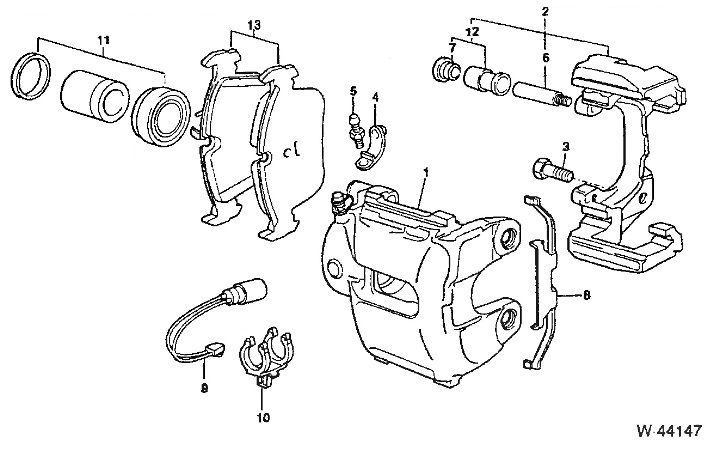
1 Brake caliper
2 Brake housing
3 Bolt, 120 Nm
4 Dust cover
5 Air release valve
6 Guide pin
7 Protective plug
8 Spring clamp
9 Wear sensor
10 Brake pad wear sensor mount
11 Brake Caliper Seal Kit
12 Guide Bushing Repair Kit
13 Brake pads (asbestos free)
The original text of the article is available on the resource: BMWman.ru