
Table of contents: ABS system ↓ ASC+T System ↓
- Home
- BMW 7 Series
- E32
- Chassis
- Brake system
- Brake system. General description
Brake system. General description (BMW 7 Series E32)
The braking system consists of a master cylinder, a brake booster and disc brakes on the front and rear wheels.
The hydraulic brake drive system is divided into two circuits. Thanks to this, if one brake circuit fails, for example due to a leak, the car can be stopped using the other circuit. The pressure in both brake circuits is created in the dual master brake cylinder under the action of the brake pedal.
A brake force regulator on the rear axle is not needed, since the brake force distribution is carried out using ABS (anti-lock braking system).
The brake fluid reservoir is located in the engine compartment on the left side under the cabin air filter housing and supplies the entire brake system with brake fluid.
The brake booster in gasoline engines uses part of the vacuum created in the intake manifold. Through the valve, the braking force from the pedal is increased by the action of the vacuum (rarefaction). Since the vacuum is low on a diesel engine, the vacuum (vacuum) required for the operation of the brake booster is created by a vacuum pump mounted on a flange on the cylinder head.
Some models are equipped with a hydraulic brake booster with a regulator.
All disc brakes are equipped with so-called floating calipers (brackets). This means that in each caliper, when braking, the brake pads are pressed against the brake disc by one piston.
The brake caliper is made of alloyed light alloy. Due to this, the brake system parts are light and provide good heat dissipation, which prevents the so-called FADING effect, which is a decrease in the efficiency of the brakes due to heating of the brake pads and other brake parts.
There is one brake pad wear sensor on each of the left front and right rear wheels.
The parking (hand) brake is operated by a cable and acts on the rear wheels. Since disc brakes are not very suitable as parking brakes, there are two additional drum brakes on the rear wheels, which are built into the brake discs. The drum brakes are only operated by the parking brake lever.
Cleaning the brake system removes dust from the pads. This dust is very harmful to health and should not be inhaled.
It is recommended to use brake pads certified by BMW and approved for use on the models described.
When working with the brake system, it is necessary to maintain perfect cleanliness and have experience working with brakes. If you do not have such experience, it is better to carry out these works in a workshop.
Brake fluid drained from the system must not be poured into the domestic sewer system; only special containers should be used.
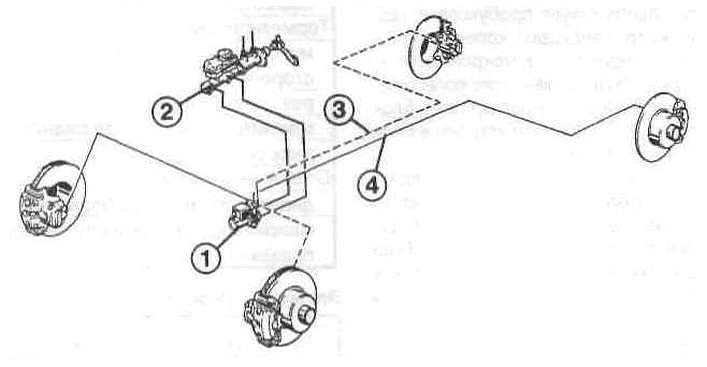
Elements of the braking system
1 - ABS hydraulic unit;
2 - master brake cylinder;
3 and 4 are two circuits of the braking system.
The anti-lock braking system (ABS) consists of an electro-hydraulic unit with a built-in electronic control unit, an ABS warning lamp and speed sensors with gears on all wheels.
ABS prevents the wheels from locking during sudden braking. Thanks to this, the car remains controllable during braking. The driver feels the ABS operation by the pulsations of the brake pedal and by the noise of the electro-hydraulic unit in the engine compartment.
A safety circuit in the electronic control unit ensures that the ABS will not operate if it fails (for example, due to a broken wire) or when the battery voltage drops (i.e. less than 10.5 V) switches off automatically, which is determined by the ABS indicator light on the instrument panel. At the same time, the regular braking system remains in operation. In this case, the car brakes as it would without the ABS system.
After the ignition is turned on, the ABS system automatically checks for faults. After about 3 seconds, the ABS indicator light on the instrument panel should go out. If the indicator light stays on longer or while driving, you need to do the following.
Stop for a short time, turn off the engine and start it again.
Check the battery voltage. If it is less than 10.5 V, charge the battery. Check if the wire clamps on the battery contacts are tightly tightened and if the contacts are reliable.
Raise and support the car, remove the wheels, check the electrical wires to the speed sensors for integrity. Other ABS checks should be performed in a workshop that has special equipment for diagnosing faults.
ASC+T System (automatic stability and traction control) prevents the rear wheels (drive) from slipping during acceleration, for example on a wet road, when the slipping wheel transmits less traction force. The system control unit is integrated into the ABS control unit.
The wheel speed is sent to the control unit by sensors on the wheels, which are used to operate the ABS system. If one of the rear wheels tends to slip, the DME control unit (digital engine electronics - engine management system) receives this information from the ABS/ASC+T control unit. The DME unit then reduces engine power by controlling the injectors and possibly influencing the ignition timing. These adjustments act in the same way as if the driver had released the gas pedal. Engine power is reduced for a short time and the wheels regain their grip on the road. If this does not work, the "T" system comes into operation "(traction control), and it applies the brakes to the slipping drive wheels. The activation of the ASC+T system is determined by the flashing of the control lamp.
The system has a built-in engine torque control. It prevents short-term locking of the drive wheels on slippery roads due to the braking effect of the engine.
Up to 40 km/h, the traction control (T) system can engage the differential lock. Since the left and right wheels are braked independently of each other, the ASC+T system acts as a differential lock that is almost 100% active.
The ASC+T system automatically detects any faults that occur. After the ignition is switched on, the indicator lamp lights up briefly and then goes out.
If the lamp does not go out or lights up while driving, this indicates a malfunction. The vehicle can continue to move, but the ASC+T system will not work. When driving with snow chains, in deep snow or when driving out of mud, it is recommended to turn off the ASC+T system using the switch on the center console. When the system is turned on again using the switch or the next time the engine is started, the system will be turned on again.
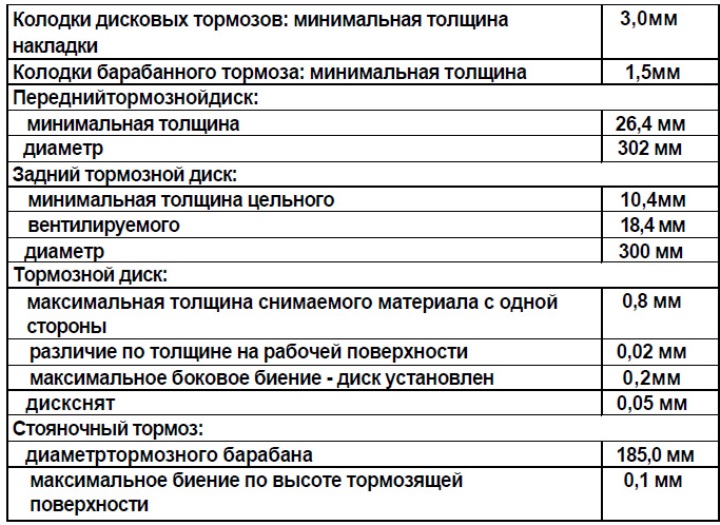
Technical data of the brake system
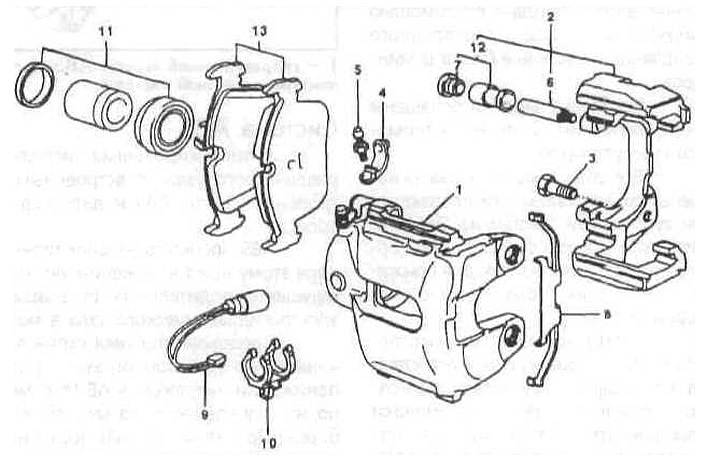
Front brake caliper components
1 - brake caliper;
2 - fastening (bracket);
3 — bolt, tightening torque 11 Nm;
4 - dust cap;
5 - air bleed valve;
6 - guide bolt;
7 - protective plug;
8 — fastening spring;
9 - wear sensor;
10 — Brake pad wear sensor holder;
11 - set of caliper cuffs;
12 - Guide bush repair kit;
13 - brake pads (asbestos free).
The hydraulic brake drive system is divided into two circuits. Thanks to this, if one brake circuit fails, for example due to a leak, the car can be stopped using the other circuit. The pressure in both brake circuits is created in the dual master brake cylinder under the action of the brake pedal.
A brake force regulator on the rear axle is not needed, since the brake force distribution is carried out using ABS (anti-lock braking system).
The brake fluid reservoir is located in the engine compartment on the left side under the cabin air filter housing and supplies the entire brake system with brake fluid.
The brake booster in gasoline engines uses part of the vacuum created in the intake manifold. Through the valve, the braking force from the pedal is increased by the action of the vacuum (rarefaction). Since the vacuum is low on a diesel engine, the vacuum (vacuum) required for the operation of the brake booster is created by a vacuum pump mounted on a flange on the cylinder head.
Some models are equipped with a hydraulic brake booster with a regulator.
All disc brakes are equipped with so-called floating calipers (brackets). This means that in each caliper, when braking, the brake pads are pressed against the brake disc by one piston.
The brake caliper is made of alloyed light alloy. Due to this, the brake system parts are light and provide good heat dissipation, which prevents the so-called FADING effect, which is a decrease in the efficiency of the brakes due to heating of the brake pads and other brake parts.
There is one brake pad wear sensor on each of the left front and right rear wheels.
The parking (hand) brake is operated by a cable and acts on the rear wheels. Since disc brakes are not very suitable as parking brakes, there are two additional drum brakes on the rear wheels, which are built into the brake discs. The drum brakes are only operated by the parking brake lever.
Cleaning the brake system removes dust from the pads. This dust is very harmful to health and should not be inhaled.
It is recommended to use brake pads certified by BMW and approved for use on the models described.
When working with the brake system, it is necessary to maintain perfect cleanliness and have experience working with brakes. If you do not have such experience, it is better to carry out these works in a workshop.
Brake fluid drained from the system must not be poured into the domestic sewer system; only special containers should be used.
Note: On wet roads, you need to apply the brakes from time to time to free the brake discs from deposits. Although the water is thrown off the brake discs by centrifugal force during movement, a thin film of silicone, resins, grease and dirt remains on them, which reduces the effectiveness of braking.
Elements of the braking system
1 - ABS hydraulic unit;
2 - master brake cylinder;
3 and 4 are two circuits of the braking system.
ABS system
The anti-lock braking system (ABS) consists of an electro-hydraulic unit with a built-in electronic control unit, an ABS warning lamp and speed sensors with gears on all wheels.
ABS prevents the wheels from locking during sudden braking. Thanks to this, the car remains controllable during braking. The driver feels the ABS operation by the pulsations of the brake pedal and by the noise of the electro-hydraulic unit in the engine compartment.
A safety circuit in the electronic control unit ensures that the ABS will not operate if it fails (for example, due to a broken wire) or when the battery voltage drops (i.e. less than 10.5 V) switches off automatically, which is determined by the ABS indicator light on the instrument panel. At the same time, the regular braking system remains in operation. In this case, the car brakes as it would without the ABS system.
After the ignition is turned on, the ABS system automatically checks for faults. After about 3 seconds, the ABS indicator light on the instrument panel should go out. If the indicator light stays on longer or while driving, you need to do the following.
Stop for a short time, turn off the engine and start it again.
Check the battery voltage. If it is less than 10.5 V, charge the battery. Check if the wire clamps on the battery contacts are tightly tightened and if the contacts are reliable.
Raise and support the car, remove the wheels, check the electrical wires to the speed sensors for integrity. Other ABS checks should be performed in a workshop that has special equipment for diagnosing faults.
Caution: Before carrying out electric welding work, disconnect the plug from the ABS control unit with the ignition on. When carrying out painting work, do not heat the control unit to a temperature exceeding 85°C.
ASC+T System
ASC+T System (automatic stability and traction control) prevents the rear wheels (drive) from slipping during acceleration, for example on a wet road, when the slipping wheel transmits less traction force. The system control unit is integrated into the ABS control unit.
The wheel speed is sent to the control unit by sensors on the wheels, which are used to operate the ABS system. If one of the rear wheels tends to slip, the DME control unit (digital engine electronics - engine management system) receives this information from the ABS/ASC+T control unit. The DME unit then reduces engine power by controlling the injectors and possibly influencing the ignition timing. These adjustments act in the same way as if the driver had released the gas pedal. Engine power is reduced for a short time and the wheels regain their grip on the road. If this does not work, the "T" system comes into operation "(traction control), and it applies the brakes to the slipping drive wheels. The activation of the ASC+T system is determined by the flashing of the control lamp.
The system has a built-in engine torque control. It prevents short-term locking of the drive wheels on slippery roads due to the braking effect of the engine.
Up to 40 km/h, the traction control (T) system can engage the differential lock. Since the left and right wheels are braked independently of each other, the ASC+T system acts as a differential lock that is almost 100% active.
The ASC+T system automatically detects any faults that occur. After the ignition is switched on, the indicator lamp lights up briefly and then goes out.
If the lamp does not go out or lights up while driving, this indicates a malfunction. The vehicle can continue to move, but the ASC+T system will not work. When driving with snow chains, in deep snow or when driving out of mud, it is recommended to turn off the ASC+T system using the switch on the center console. When the system is turned on again using the switch or the next time the engine is started, the system will be turned on again.
Technical data of the brake system
Front brake caliper components
1 - brake caliper;
2 - fastening (bracket);
3 — bolt, tightening torque 11 Nm;
4 - dust cap;
5 - air bleed valve;
6 - guide bolt;
7 - protective plug;
8 — fastening spring;
9 - wear sensor;
10 — Brake pad wear sensor holder;
11 - set of caliper cuffs;
12 - Guide bush repair kit;
13 - brake pads (asbestos free).
This article is available at russian, bulgarian, belarusian, ukrainian, serbian, croatian, romanian, polish, slovak, hungarian
Article verified: Sevastyanov Nikolay
Share information:
Previous articles
БМВ E32: Brake system
Next articles
Similar articles on other types of BMW cars:
Brake system. General information BMW 3 Series E30 (1982-1994)
Brake system. General information and device BMW 3 Series E36 (1990-2000)
Brake system — general information BMW 5 Series E34 (1988-1996)
Brake system — general information BMW 5 Series E39 (1995-2003)
Brake system — general warnings BMW X3 E83 (2003-2010)
Description of the brake system design BMW X5 E53 (1999-2006)
Brake system. General information BMW 3 Series E30 (1982-1994)
Brake system. General information and device BMW 3 Series E36 (1990-2000)
Brake system — general information BMW 5 Series E34 (1988-1996)
Brake system — general information BMW 5 Series E39 (1995-2003)
Brake system — general warnings BMW X3 E83 (2003-2010)
Description of the brake system design BMW X5 E53 (1999-2006)
Link in different formats to this page
Visitor comments
No comments yet
- General information
- Introduction to guide
- Manual
- Maintenance
- Power unit
- Engine M60/1, M60/2 (petrol)
- M62 engine (petrol)
- M57 engine (diesel)
- M67 engine (diesel)
- Cooling system
- Fuel system (petrol)
- Fuel system (diesel)
- Exhaust system
- Ignition and control systems
- Charge and launch systems
- Transmission
- Clutch
- Mechanical gearbox
- Automatic gearbox
- Cardan and drive shafts
- Chassis
- Brake system
- Front suspension
- Rear suspension
- Steering
- Body
- Exterior
- Interior
- Electrical equipment
- Equipment and devices
- Lighting
- Heating and air conditioning
- Electrical circuits
- General information
- Care and maintenance
- Power unit
- Minor engine repair
- Engine overhaul
- Lubrication system
- Cooling system
- Ignition system
- Supply system
- Injection system (petrol)
- Injection system (diesel)
- Exhaust system
- Transmission
- Clutch
- Manual gearbox
- Automatic gearbox
- Cardan gear
- Rear axle and shafts
- Chassis
- Front suspension
- Rear suspension
- Steering
- Wheels and tires
- Brake system
- Body
- Body elements
- Electrical equipment
- Equipment and devices
- Electrical circuits