
Table of contents: Removal ↓ Installation ↓
- Home
- BMW 7 Series
- E32
- Chassis
- Brake system
- Rear brake pads — removal and installation
Rear brake pads — removal and installation (BMW 7 Series E32)
Removal
Mark the position of the rear wheels on the hubs so that you can install the balanced wheels in the same positions. Loosen the wheel bolts with the car on the ground. Support the car from behind and remove the rear wheels.
If the brake pads are to be used again, they must be marked before removal. Changing or swapping the pads from the right to the left wheel is not permitted. Replacing them may result in uneven braking. Always use genuine or BMW-certified brake pads. All brake pads on the rear wheels must be replaced at the same time, even if only one of them has reached the minimum thickness.
On the right caliper, pull the brake pad wear sensor plug off the brake pad, but pull by the plug, not the wire.
Press the two plastic caps off the mounting bolts and unscrew the two Allen key mounting bolts.
Press the bracket (3) using a screwdriver.
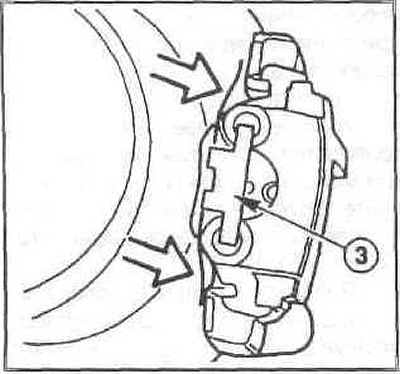
Pull the brake caliper back.
Remove the outer shoe.
The inner pad is secured by a spring in the caliper piston. Remove the pad.
Installation
Caution: When the brake pads are removed, do not press the brake pedal, otherwise the pistons will jump out of the housing.
Check the brake pad wear sensor. If the contact plate insulation is worn out, the wire insulation is damaged or the plastic parts are worn out, replace the sensor.
Clean the guide planes or shoe seats in the housing channel with a soft metal brush or wipe them with a rag soaked in alcohol. Do not use mineral solvents or sharp tools. If the brake shoes are reused, they should be cleaned as well.
Before installing the pads, the brake disc should be checked by touch for scratches and dents. Badly scratched discs should be replaced. Brake discs painted grey or blue should be cleaned before installing new pads.
Measure the thickness of the brake disc.
Check the dust cover on the piston for damage. Damaged covers should be replaced immediately, as dirt that gets inside will cause leaks in the caliper. The caliper must be removed and disassembled for replacement. Press the piston into the cylinder using a special device. You can use a block of hard wood (with a hammer handle). In this case, care must be taken not to tilt the piston or damage the piston surface and dust cap.
When the piston is pressed, the brake fluid from the cylinder will be squeezed into the fluid reservoir. It is necessary to monitor the fluid level in the reservoir and, if necessary, remove it with a syringe or rubber bulb.
Warning: Brake fluid is poisonous and should never be sucked out by mouth through a hose. After replacing the pads, do not raise the fluid level above the MAX mark on the reservoir, as the fluid expands from the temperature and may spill out of the reservoir, which will damage the paintwork and cause.
Note: If the brake pads are heavily worn, check the ease of movement of the piston. To do this, insert a wooden block into the caliper, and have an assistant slowly press the brake pedal. The piston should slide in and out easily. Another caliper must be installed to check. Make sure that the piston is not pushed out completely. If the piston moves heavily, the caliper must be repaired in a workshop.
To prevent disc brakes from squeaking, it is necessary to lubricate the following parts with a thin layer of special anti-noise paste.
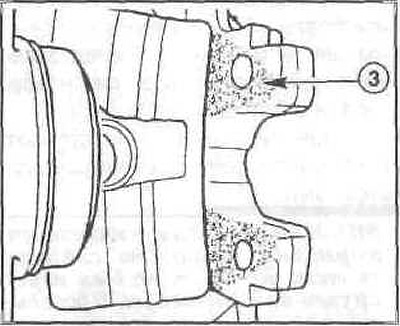
Clean the contact surface (3) of the brake caliper and, in the places shown in the figure, apply a thin layer of anti-noise paste.
Clean the holder (bracket) in the guide areas and, in the areas shown in the figure, lubricate with a thin layer of anti-noise paste.
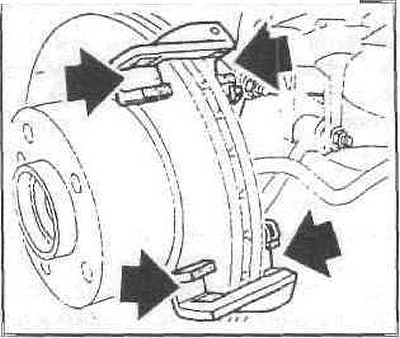
Caution: The paste must not under any circumstances come into contact with the dust caps, the working surface of the brake pads or the brake disc. If this does happen, the paste must be wiped off immediately and the area cleaned with alcohol or the dust caps must be replaced.
Caution: Do not lubricate the back of the brake pads.
Insert the brake pad together with the spring into the caliper piston.
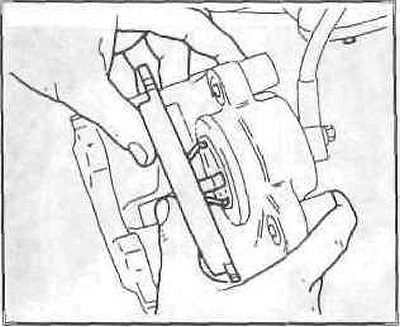
Inspect the two brake caliper mounting bolts and clean the threads from dirt if necessary. If necessary, clean the threads in the caliper bracket (mount) with a tap. Replace bolts with damaged threads or damaged by corrosion. Tighten the bolts with a 7 mm Allen key to 30 Nm.
Note: Do not lubricate the bolts, just clean them.
Place the protective bolt caps on.
On the right side of the vehicle, place the wear sensor plug onto the brake shoe. The wire should fit into the recess in the bleed valve cap.
Place the bracket on the brake caliper.
Install the rear wheels according to the marks made earlier. Do not lubricate the wheel bolts. Lower the car and tighten the wheel bolts crosswise to 100 Nm.
Note: With the vehicle stationary, press the brake pedal hard several times until you feel strong resistance. This will cause the brake pads to press against the brake disc and take the appropriate position.
Check the brake fluid level in the reservoir and, if necessary, top it up to the MAX mark.
Carefully break in the new brake pads by braking the car several times from 80 km/h to 40 km/h on a road with calm traffic, applying light pressure to the pedal. Allow the brakes to cool slightly between brakings.
Caution: Avoid sudden braking until the distance reaches 200 km.
This article is available at russian, bulgarian, belarusian, ukrainian, serbian, croatian, romanian, polish, slovak, hungarian
Article verified: Sevastyanov Nikolay
Share information:
Previous articles
БМВ E32: Brake system
Next articles
Similar articles on other types of BMW cars:
Removal and installation rear brake pads BMW 3 Series E21 (1975-1983)
Removal and installation rear brake pads BMW 3 Series E30 (1982-1994)
Removal and installation rear disc brake pads BMW 5 Series E39 (1995-2003)
Removal and installation rear brake pads BMW 5 Series E34 (1988-1996)
Removal and installation the rear door BMW X3 E83 (2003-2010)
Rear disc — removal and installation BMW X5 E53 (1999-2006)
Removal and installation rear brake pads BMW 3 Series E21 (1975-1983)
Removal and installation rear brake pads BMW 3 Series E30 (1982-1994)
Removal and installation rear disc brake pads BMW 5 Series E39 (1995-2003)
Removal and installation rear brake pads BMW 5 Series E34 (1988-1996)
Removal and installation the rear door BMW X3 E83 (2003-2010)
Rear disc — removal and installation BMW X5 E53 (1999-2006)
Link in different formats to this page
Visitor comments
No comments yet
- General information
- Introduction to guide
- Manual
- Maintenance
- Power unit
- Engine M60/1, M60/2 (petrol)
- M62 engine (petrol)
- M57 engine (diesel)
- M67 engine (diesel)
- Cooling system
- Fuel system (petrol)
- Fuel system (diesel)
- Exhaust system
- Ignition and control systems
- Charge and launch systems
- Transmission
- Clutch
- Mechanical gearbox
- Automatic gearbox
- Cardan and drive shafts
- Chassis
- Brake system
- Front suspension
- Rear suspension
- Steering
- Body
- Exterior
- Interior
- Electrical equipment
- Equipment and devices
- Lighting
- Heating and air conditioning
- Electrical circuits
- General information
- Care and maintenance
- Power unit
- Minor engine repair
- Engine overhaul
- Lubrication system
- Cooling system
- Ignition system
- Supply system
- Injection system (petrol)
- Injection system (diesel)
- Exhaust system
- Transmission
- Clutch
- Manual gearbox
- Automatic gearbox
- Cardan gear
- Rear axle and shafts
- Chassis
- Front suspension
- Rear suspension
- Steering
- Wheels and tires
- Brake system
- Body
- Body elements
- Electrical equipment
- Equipment and devices
- Electrical circuits