
- Home
- BMW 7 Series
- E32
- Chassis
- Brake system
- Brake booster — check
Brake booster — check (BMW 7 Series E32)
Checking the brake booster
The brake booster should be checked for functionality if the brake pedal force required to stop the vehicle is unusually high.
With the engine off, press the brake pedal hard at least 10 times, and then start the engine with the pedal pressed. The pedal should drop slightly under the force of your foot. In this case, the brake booster works normally.
If it is not, unscrew the vacuum hose from the brake booster. Start the engine. Put your finger on the end of the vacuum hose and check if there is a vacuum (underpressure).
If there is no vacuum: Check the vacuum hose for leaks or damage, replace if necessary. Tighten all clamps securely.
Diesel Engine: Remove the vacuum hose from the vacuum pump and check if there is vacuum at the hose connection.
If there is a vacuum: measure it, if necessary, replace the brake booster in a workshop.
Caution: Always replace the check valve in the vacuum hose, as the diaphragm in the brake booster may be damaged by fuel vapors (in a gasoline engine and a faulty check valve). The arrow on the check valve should point towards the intake manifold.
Hydraulic Brake Booster - Checking, Removing and Installing
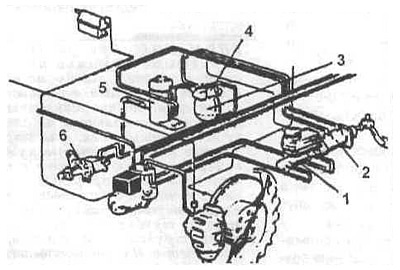
Components of a brake system with a hydraulic brake booster
1 - master brake cylinder;
2 - brake booster;
3 - hydraulic accumulator;
4 — DS battery;
5 - expansion tank;
6 — booster pump.
With the engine not running, press the brake pedal 20 times.
While holding the pedal, start the engine.
If the pedal goes down, the system is OK. If the pedal does not go down, the following faults may occur:
- the pump is faulty;
- dS regulator is faulty;
- hydraulic accumulator is faulty;
- the brake booster is faulty.
Checking the hydraulic part
Empty the hydraulic accumulator - press the brake pedal 20 times.
Disconnect the cable from the switch and remove the DS controller.
Install the connecting element in place of the switch.
Connect a pressure gauge to the connecting element and close both valves.
Checking the tightness of the DS-regulator and brake booster
Start the engine while watching the pressure gauge.
After reaching the upper excess pressure, stop the engine.
If the pressure drops by more than 5 bar within 5 minutes, the return line on the DS regulator must be loosened.
If oil is leaking from the return line of the DS regulator, the DS regulator is not sealed and must be replaced.
If oil does not come out and the pressure drops, the cause is an internal leak in the brake booster, which should be replaced.
Checking the operation of the hydraulic accumulator
Reduce the pressure in the accumulator by pressing the brake pedal 20 times - the pressure gauge is at 0.
Start the engine and watch the pressure gauge.
The pressure gauge reading should match the diagram below. If this value is not reached or exceeded, the accumulator should be replaced.
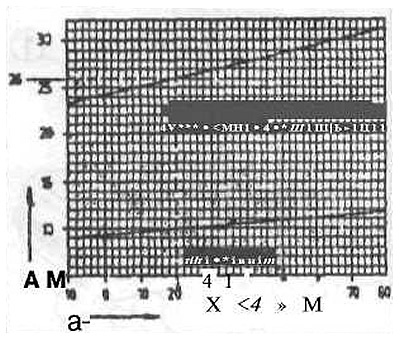
Pressure diagram
A - gas filling pressure;
B — temperature of the hydraulic accumulator,°C.
Checking the operation of the DS-regulator
Start the engine. The pressure will increase to the excess cut-off value.
Reduce the pressure of the hydraulic accumulator (according to the pressure gauge) to the engagement pressure by pressing the brake pedal with the engine running.
Then the DS-regulator will switch on again to "charge the battery". The pressure will increase again.
If the test value is not reached, the DS controller must be replaced.
Working pressure 130 bar.
Upper cut-in pressure 52-57 bar.
Lower switching pressure 36-41 bar.
Reduce the pressure in the accumulator by pressing the brake pedal 20 times.
Remove the test pressure gauge, remove the connecting element and install the switch.
Connect the cable.
Check and top up the oil level.
Checking the operation of the brake booster/master cylinder
Remove the bleeder bolt on one brake caliper.
Connect the pressure gauge and bleed the air.
Attach a pedal force gauge to the brake pedal. With the engine running (full hydraulic accumulator) apply a force of 200 N to the brake pedal. The pressure gauge should show a pressure of 70-90 bar.
If pressure is not achieved and the rest of the system is in good condition, the brake booster should be replaced.
Removal the brake booster
Press the brake pedal 20 times (empty the accumulator).
Remove the brake fluid from the expansion tank.
Remove the left lower instrument panel trim.
Disconnect the brake pedal spring. Separate the pedal-brake assembly connection.
Disconnect the expansion tank from the brake cylinder and plug it immediately. Avoid any contamination.
Disconnect the brake booster from the lever support.
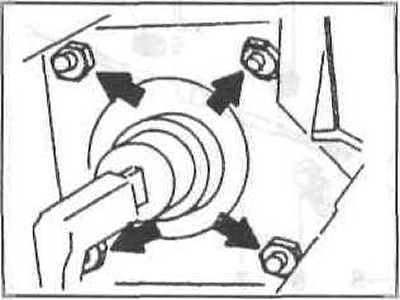
Installation is carried out in reverse order.
Replacing the brake booster
Disconnect the brake booster from the cylinder.
Find the B size on the amplifier and remove the plug.
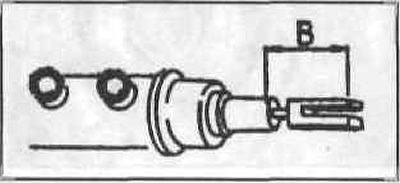
Install the fork onto the new brake booster, maintaining dimension B.
Removal and installation the DS regulator
Clean the DS controller environment.
Empty the accumulator by applying the brakes 20 times.
Disconnect the cable from the bypass pressure switch.
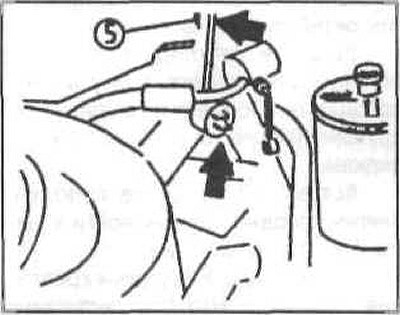
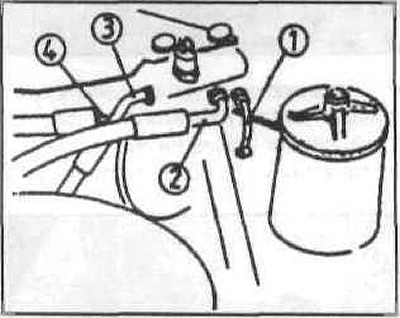
Turn it off and shut it up immediately:
- dS regulator pipeline to tank;
- pipeline (2) from DS-regulator to steering gear;
- pipeline (3) from DS regulator to pump;
- pipeline (4) from the DS controller to the brake booster.
Caution: Solid dirt particles may interfere with the operation of the DS controller, which may result in the failure of the brake and steering booster. Therefore, make sure that the tubes and hoses are free of dirt.
When installing, the pipelines should be tightened with a torque wrench, observing the tightening force.
Remove air from the system.
This article is available at russian, bulgarian, belarusian, ukrainian, serbian, croatian, romanian, polish, slovak, hungarian
Article verified: Sevastyanov Nikolay
Share information:
Previous articles
БМВ E32: Brake system
Next articles
Similar articles on other types of BMW cars:
Checking the brake booster BMW 3 Series E46 (1998-2006)
Pressure check BMW 3 Series E21 (1975-1983)
Brake Master Cylinder Parts and Vacuum Booster BMW 5 Series E12 (1972-1981)
Checking the brake booster BMW 5 Series E39 (1995-2003)
Brake booster check valve BMW X3 E83 (2003-2010)
Checking the brake booster BMW X5 E53 (1999-2006)
Checking the brake booster BMW 3 Series E46 (1998-2006)
Pressure check BMW 3 Series E21 (1975-1983)
Brake Master Cylinder Parts and Vacuum Booster BMW 5 Series E12 (1972-1981)
Checking the brake booster BMW 5 Series E39 (1995-2003)
Brake booster check valve BMW X3 E83 (2003-2010)
Checking the brake booster BMW X5 E53 (1999-2006)
Link in different formats to this page
Visitor comments
No comments yet
- General information
- Introduction to guide
- Manual
- Maintenance
- Power unit
- Engine M60/1, M60/2 (petrol)
- M62 engine (petrol)
- M57 engine (diesel)
- M67 engine (diesel)
- Cooling system
- Fuel system (petrol)
- Fuel system (diesel)
- Exhaust system
- Ignition and control systems
- Charge and launch systems
- Transmission
- Clutch
- Mechanical gearbox
- Automatic gearbox
- Cardan and drive shafts
- Chassis
- Brake system
- Front suspension
- Rear suspension
- Steering
- Body
- Exterior
- Interior
- Electrical equipment
- Equipment and devices
- Lighting
- Heating and air conditioning
- Electrical circuits
- General information
- Care and maintenance
- Power unit
- Minor engine repair
- Engine overhaul
- Lubrication system
- Cooling system
- Ignition system
- Supply system
- Injection system (petrol)
- Injection system (diesel)
- Exhaust system
- Transmission
- Clutch
- Manual gearbox
- Automatic gearbox
- Cardan gear
- Rear axle and shafts
- Chassis
- Front suspension
- Rear suspension
- Steering
- Wheels and tires
- Brake system
- Body
- Body elements
- Electrical equipment
- Equipment and devices
- Electrical circuits