
- Home
- BMW 3 Series
- E21
- 6-cylinder engine
- Fuel injection system
- Pressure check
Pressure check (BMW 3 Series E21)
Connect one hose of pressure gauge 13 3 060 with fittings 13 3 065 and 13 3 066 and with a two-way valve to the control pressure fitting of the fuel dispenser-distributor, and the other to the control pressure pipeline. Open the two-way valve.
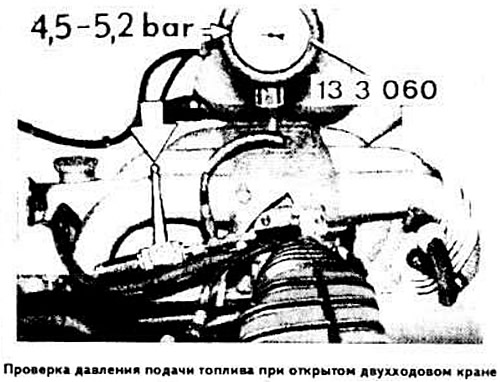
Turn on the fuel pump directly as above and measure the control pressure.
Compare the measurement result with the values indicated on the operating graph of the thermal time relay.
If the measured pressure is below normal, the control pressure regulator is faulty.
If the measured pressure is higher than normal, this indicates insufficient fuel drainage or a faulty control pressure regulator.
Check for foreign matter in the drain line, replace the pilot pressure regulator and recheck the pilot pressure with the engine cold.
Warm up the engine.
Turn on the fuel pump directly as described above.
Connect the pressure gauge as described above and open the two-way valve.
Measure the control pressure, which should be within 2.7-3.1 kg/cm².
Start the engine and measure the idle control pressure, which should be within 3.4-3.8 kg/cm².
If there is any deviation from the norm, check the condition of the vacuum hose connecting the control pressure regulator to the intake manifold.
If the vacuum hose is good, replace the pilot pressure regulator and recheck the pilot pressure with the engine hot.
Check the condition of the fuel pump and fine fuel filter.
Connect the pressure gauge as above and close the two-way valve.
Turn on the fuel pump directly as described above. Measure the fuel supply pressure, which should be within 4.5-5.2 kg/cm².
Reasons for insufficient fuel supply pressure may be:
The reasons for increased fuel supply pressure are:
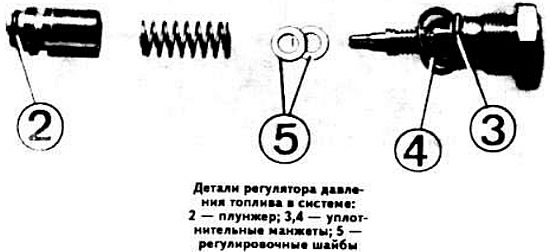
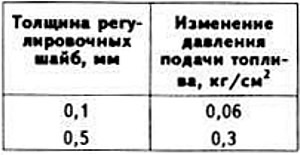
The fuel supply pressure is regulated by selecting the thickness of the adjusting washers installed on the plunger of the fuel pressure regulator in the system.
Checking the control pressure on a cold engine
Turn on the fuel pump directly as above and measure the control pressure.
Compare the measurement result with the values indicated on the operating graph of the thermal time relay.
If the measured pressure is below normal, the control pressure regulator is faulty.
If the measured pressure is higher than normal, this indicates insufficient fuel drainage or a faulty control pressure regulator.
Check for foreign matter in the drain line, replace the pilot pressure regulator and recheck the pilot pressure with the engine cold.
Checking the control pressure on a hot engine
Warm up the engine.
Turn on the fuel pump directly as described above.
Connect the pressure gauge as described above and open the two-way valve.
Measure the control pressure, which should be within 2.7-3.1 kg/cm².
Start the engine and measure the idle control pressure, which should be within 3.4-3.8 kg/cm².
If there is any deviation from the norm, check the condition of the vacuum hose connecting the control pressure regulator to the intake manifold.
If the vacuum hose is good, replace the pilot pressure regulator and recheck the pilot pressure with the engine hot.
Checking the fuel supply pressure
Check the condition of the fuel pump and fine fuel filter.
Connect the pressure gauge as above and close the two-way valve.
Turn on the fuel pump directly as described above. Measure the fuel supply pressure, which should be within 4.5-5.2 kg/cm².
Reasons for insufficient fuel supply pressure may be:
- leaks in fuel lines and their connections;
- severe contamination of the fine fuel filter;
- spontaneous combustion of a combustible mixture;
- insufficient fuel pump performance;
- violation of fuel supply pressure regulation.
The reasons for increased fuel supply pressure are:
- insufficient fuel drainage;
- violation of the adjustment of the fuel pressure regulator in the system or jamming of its plunger.
The fuel supply pressure is regulated by selecting the thickness of the adjusting washers installed on the plunger of the fuel pressure regulator in the system.
This article is available at russian, bulgarian, belarusian, ukrainian, serbian, croatian, romanian, polish, slovak, hungarian
Article verified: Polikarpov Saveliy
Share information:
Previous articles
БМВ E21: Fuel injection system
Next articles
Similar articles on other types of BMW cars:
Checking the fuel pump discharge pressure BMW 5 Series E12 (1972-1981)
Tire pressure BMW 5 Series E34 (1988-1996)
Cylinder Block — Check BMW 7 Series E32 (1986-1994)
Replacing the boost pressure sensor BMW 7 Series E38 (1994-2001)
Checking engine oil pressure BMW X3 E83 (2003-2010)
Tire pressure monitoring system BMW X5 E53 (1999-2006)
Checking the fuel pump discharge pressure BMW 5 Series E12 (1972-1981)
Tire pressure BMW 5 Series E34 (1988-1996)
Cylinder Block — Check BMW 7 Series E32 (1986-1994)
Replacing the boost pressure sensor BMW 7 Series E38 (1994-2001)
Checking engine oil pressure BMW X3 E83 (2003-2010)
Tire pressure monitoring system BMW X5 E53 (1999-2006)
Link in different formats to this page
Visitor comments
No comments yet
- General information
- Manual
- Maintenance
- Power unit
- Engine repair
- Cooling system
- Power system (gasoline)
- Injection system (gasoline)
- Fuel system (diesel)
- Exhaust system
- Ignition system
- Charge and launch systems
- Transmission
- Car gearbox
- Clutch and drive shafts
- Chassis
- Brake system
- Suspension front and rear
- Steering
- Body
- Body care and repair
- Exterior
- Interior
- Electrical equipment
- Troubleshooting
- Lighting and signaling
- Equipment and devices
- Heater and air conditioner
- Electrical circuits
- General information
- Manual
- Repair on the road
- Weekly checks
- Maintenance
- Troubleshooting
- Power unit
- 4 cylinder engines
- 6 cylinder engines
- Engine overhaul
- Cooling and heating
- Fuel and exhaust system
- Starting and charging system
- Ignition system
- Transmission
- Clutch
- Mechanical gearbox
- Automatic gearbox
- Cardan and drive shafts
- Chassis
- Brake system
- Wheel suspension
- Steering
- Body
- Exterior
- Interior
- Electrical equipment
- Equipment and devices
- Electrical circuits
- General information
- Maintenance
- Power unit
- Engine repair
- Cooling system
- Ignition system
- Supply system
- Fuel injection system
- Exhaust system
- Transmission
- Clutch
- Car gearbox
- Front and rear axle
- Chassis
- Steering
- Brake system
- Body
- Exterior
- Interior
- Electrical equipment
- Heating system
- Equipment and devices
- Power devices
- Electrical circuits
- Power unit
- M10/M20 engine
- M40 engine
- Ignition system
- Lubrication system
- Cooling system
- Supply system
- Fuel injection
- Exhaust system
- Transmission
- Clutch
- Manual gearbox
- Front axle
- Rear axle
- Chassis
- Steering
- Brake system
- Body
- Exterior
- Interior
- Electrical equipment
- Heating system
- Equipment and devices
- Electrical circuits
- General information
- Specifications
- Operation and maintenance
- 4-cylinder engine
- Engine repair
- Cooling and lubrication system
- Supply system
- Ignition system
- 6-cylinder engine
- Engine repair
- Cooling and lubrication system
- Supply system
- Fuel injection system
- Ignition system
- Transmission
- Clutch
- 4-speed manual gearbox
- 5-speed manual gearbox
- Automatic gearbox
- Cardan and rear axle
- Chassis
- Steering
- Front suspension
- Rear suspension
- Brake system
- Electrical equipment
- Equipment and devices
- Electrical circuits