
Removal
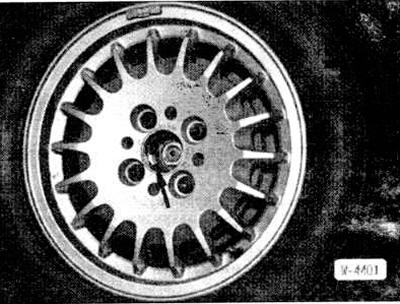
Remove the decorative wheel cap.
Mark the position of the wheel rims on the front wheel hubs with paint. This will allow the balanced wheel to be installed in the same position later.
Loosen the wheel bolts.
Raise the front of the car and remove the wheel.
Caution: Do not swap the pads from the inside to the outside and vice versa, or from the right wheel to the left and vice versa. Swapping may cause uneven braking. Always replace all front brake pads at the same time, even if only one pad has reached the wear limit. When reinstalling brake pads, they must be marked when removed.
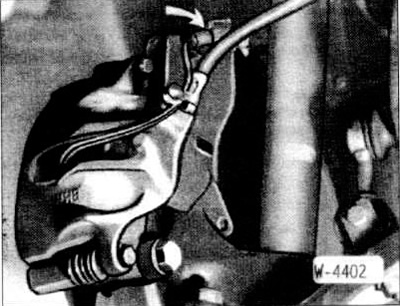
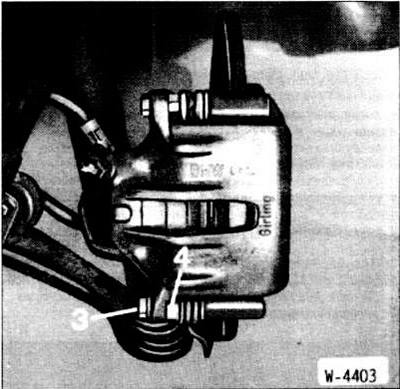
On the left wheel brake caliper, remove the wear sensor connector (arrow), but do not pull on the wire.
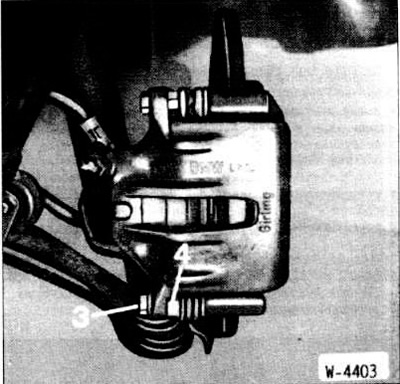
Loosen the lower mounting bolt "3" of the piston housing, while holding the guide bolt "4" with a wrench.
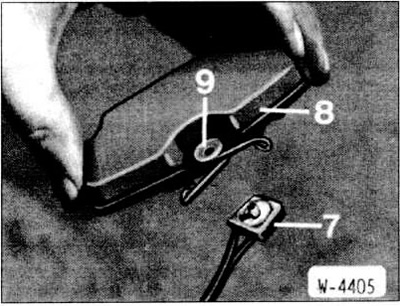
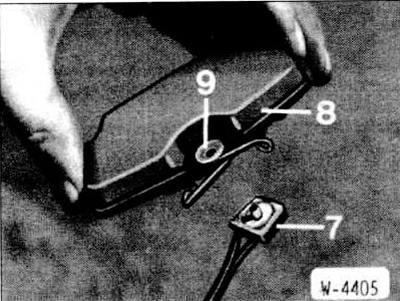
Use a screwdriver to press the wear sensor "7" out of the rear board.
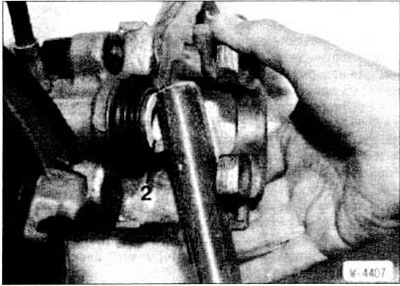
Note: When the pistons are pressed, brake fluid is squeezed out of the brake cylinders into the expansion tank. Monitor the fluid level in the tank. It may be necessary to suck out the fluid.
To suck out the fluid, you can use a vessel used to release air from the brake system, or any plastic bottle that is intended only for brake fluid. Do not use beverage bottles! Brake fluid is poisonous and should never be sucked out by mouth through a hose. Use a suction device. After replacing the pads, the brake fluid level should not exceed the MAX mark, since the liquid expands when the temperature rises. Leaking brake fluid gets on the master brake cylinder, destroys the paint and causes corrosion.
Note: If the brake pads are heavily worn, check the ease of piston movement. If the piston moves with difficulty, send the caliper for repair (the work must be performed at the service station).
To prevent disc brakes from squealing, apply a thick layer of grease (for example Plastitube, Tunap VC 582/S, Chevron SRJ/2, Liqui Moly LM-36 or LM-508-ASC) on the back side of the brake pads. In this case, the lubricant is applied only to the back side. Under no circumstances should the lubricant get on the working surface of the brake pad or on the brake disc. If necessary, wipe off the lubricant and wash the surface with alcohol.
Place the intermediate pads from the old brake pads onto the new ones. To make installation easier, glue the pads.
Attach wear sensor "7" to the inner brake pad.
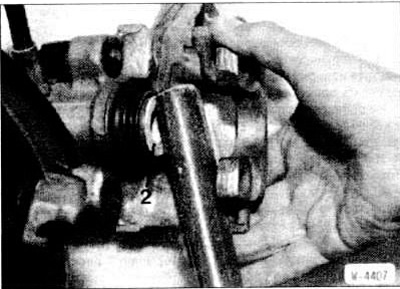
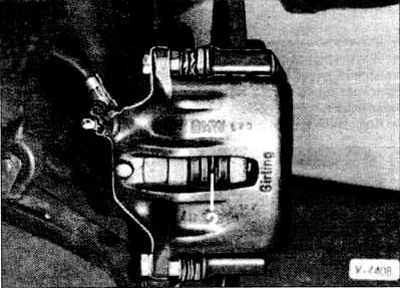
Insert both brake pads into the brake caliper so that the pressure springs "2" are facing upwards and are parallel to the upper edge of the pad. Ensure that the linings are correctly seated on the rear sides of the brake pads.
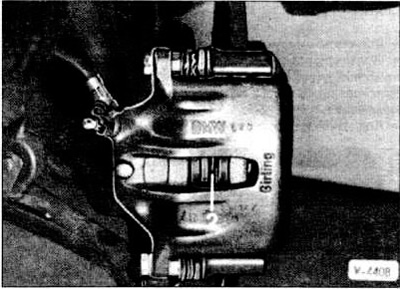
Lower the piston housing and secure it to the caliper with a new self-locking bolt "3" with a tightening torque of 35 Nm. At the same time, hold the guide bolt "4" with a wrench. Note: The self-locking mounting bolt can only be installed once.
Connect the wear sensor connector on the left side of the vehicle to the connector on the brake caliper.
Install the wheel observing the marking of the disk position on the hub. Lower the car and cross-tighten the wheel bolts to a torque of 110 Nm.
Caution: With the vehicle stationary, press the brake pedal several times until you feel stiff resistance.
Check the brake fluid level in the expansion tank and, if necessary, top up the fluid to the MAX mark.
Carefully allow the new brake pads to break in by lightly pressing the brake pedal several times from 80 km/h to 40 km/h. Allow the brakes to cool between successive brakings. Note: Avoid sudden braking until the car has come to a complete stop during the first 200 km of driving.
Note: When the pistons are pressed, brake fluid is squeezed out of the brake cylinders into the expansion tank. Monitor the fluid level in the tank. It may be necessary to suck out the fluid.
To suck out the fluid, you can use a vessel used to release air from the brake system, or any plastic bottle that is intended only for brake fluid. Do not use beverage bottles! Brake fluid is poisonous and should never be sucked out by mouth through a hose. Use a suction device. After replacing the pads, the brake fluid level should not exceed the MAX mark, since the liquid expands when the temperature rises. Leaking brake fluid gets on the master brake cylinder, destroys the paint and causes corrosion.
Note: If the brake pads are heavily worn, check the ease of piston movement. If the piston moves with difficulty, send the caliper for repair (work must be performed at a service station).
To prevent disc brakes from squeaking, apply a thin layer of grease (for example Plastitube, Tunap VC 582/S. Chevron SRJ/2, Liqui Moly LM-36 or LM-503-ASC) on the back side of the brake pads. In this case, the lubricant is applied only to the back side. Under no circumstances should the lubricant get on the working surface of the brake pad or on the brake disc. If necessary, wipe off the lubricant and wash the surface with alcohol.
Place the intermediate pads from the old brake pads onto the new ones. To make installation easier, glue the pads.
Attach wear sensor "7" to the inner brake pad.
Insert both brake pads into the brake caliper. So that the pressure springs "2" are facing upwards and are parallel to the upper edge of the pad. Ensure that the linings are correctly seated on the rear sides of the brake pads.
Lower the piston housing and secure it to the caliper with a new self-locking bolt "3" with a tightening torque of 35 Nm. At the same time, hold the guide bolt "4" with a wrench.
Caution: The self-locking mounting bolt can only be installed once.
Connect the wear sensor connector on the left side of the vehicle to the connector on the brake caliper.
Install the wheel observing the marking of the disk position on the hub. Lower the car and cross-tighten the wheel bolts to a torque of 110 Nm.
Caution: With the vehicle stationary, press the brake pedal several times until you feel stiff resistance.
Check the brake fluid level in the expansion tank and, if necessary, top up the fluid to the MAX mark.
Carefully allow the new brake pads to break in by lightly pressing the brake pedal several times to brake the car from 80 km/h to 40 km/h. Allow the brakes to cool between successive brakings.
Attention: During the first 200 km of travel, avoid sudden braking until the vehicle comes to a complete stop.
The original article is posted on the resource «BMWMAN.ru»