
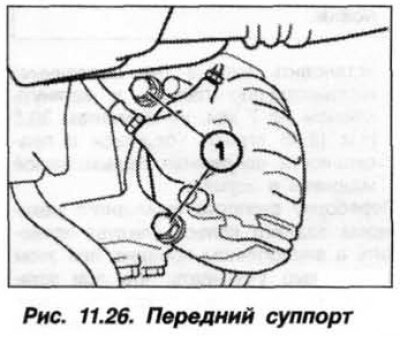
If it is necessary to completely remove the caliper, first fix the pedal in a half-pressed position (see fig. 11.3), unscrew the brake hose from the brake pipe coupling.
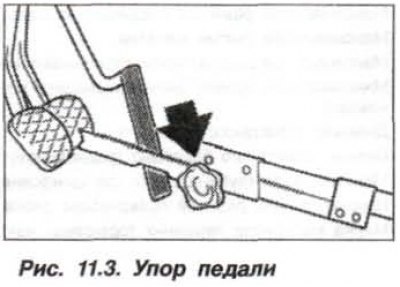
In this case, hold the hose from twisting by the hexagon. Some loss of brake fluid may occur, which must be collected in a container, and the pipeline and hose must be plugged. At the rear caliper, additionally disconnect the handbrake drive cable. Unscrew the fastening screw (arrow, Fig. 11.27) with a 5mm Allen key.
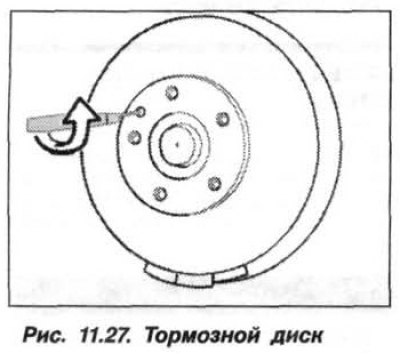
Remove the brake disc using a universal puller and, if necessary, lightly tapping the base of the brake disc with a plastic hammer. If removing the brake disc is not possible without applying large impact forces, then it is necessary to replace the brake disc and wheel hub bearing with new ones.
Attention! Brake discs are ground and replaced simultaneously at both ends of the bridge.
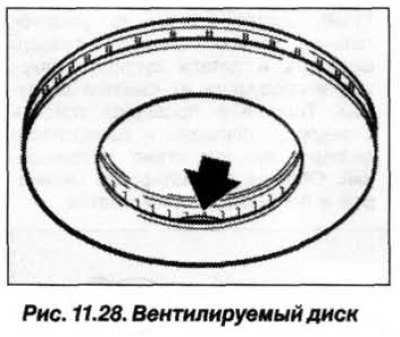
The ventilated brake disc is balanced by clamps (brackets) installed on its inner diameter (arrow, Fig. 11.28), which must remain strictly in their places. Unevenness on the mating plane of the disk and the hub can lead to warping of the brake disk.
The installation of the brake disc should be carried out in the reverse order, while it is necessary. Thoroughly clean the mating plane with the brake disc on the wheel hub, if necessary, remove traces of corrosion, having previously dissolved them.
Before installing the disk, clean its surface, remove the protective varnish from the new disk with nitro solvent, check the condition of its surface and thickness. The maximum permissible runout of the installed disk on the braking surface should not exceed 0.2 mm.
Measure the thickness of the disc to be installed (see below) at its thinnest point and at various points. Install the brake disc on the wheel hub and tighten the mounting screw to a torque of 16 N·m (1.6 kgf·m).
Install the caliper with new brake pads. Make sure that the brake hose is not twisted or stretched. Turn the steering wheel to the right and left until it stops, making sure that the brake hose moves freely.
Check the brake hose nipple tightening torque to 14.0 N·m (1.4 kgf·m). Secure the caliper with lightly lubricated bolts, tightening them to 110 N·m (11.0 kgf·m). Install the front wheels according to the markings, tighten the mounting bolts by hand, lower the car and tighten the mounting bolts crosswise to 140 N·m (14.0 kgf·m). Install the wheel mounting bolts dry.
Press the brake pedal hard several times until you feel a clear resistance, and the brake pads will take up their working position.
Attention! If the brake hose was removed, then after its installation, bleed the brake system and restore the brake fluid level in the expansion tank.
(Examine the original source using the link on the website: «BMWman.ru»)