
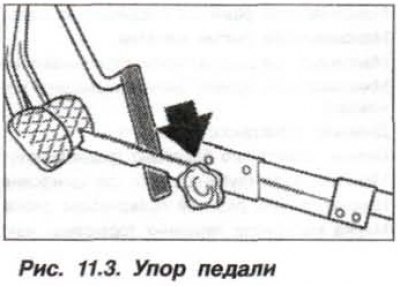
Press the brake pedal lightly and hold it in this position using a wooden block or a special device (see fig. 11.3). Opening the brake lines will prevent air from entering the brake system and brake fluid from leaking out of the expansion tank.
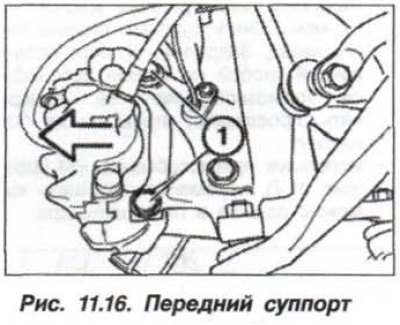
Disconnect the brake hose from the pipeline and plug the resulting holes with plastic plugs. Disconnect the brake pad wear sensor on the left wheel. Unscrew the caliper mounting bolts (1, Fig. 11.16) and remove it from the steering knuckle with a forward movement.
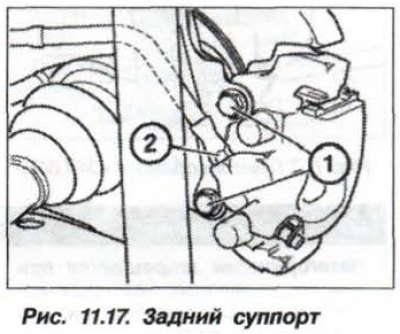
The features of the rear wheel support mounting are shown in Figure 11.17.
The installation of the front brake caliper on the car should be carried out in the reverse order, while it is necessary. Install the brake hose without tension on the caliper and pipeline, and tighten its fittings with a torque of 14 N·m (1.4 kgf·m), ensuring that the hose does not twist.
Check that the brake pad wear sensor swivel joint is fully engaged. Set the steering control to a position that corresponds to the vehicle's straight-line movement.
Degrease the contact surface of the caliper and steering knuckle. Install the caliper in place and insert the bolts, lightly lubricated with engine oil. Tighten the front caliper mounting bolts to 110 N·m (11.0 kgf·m), tighten the rear caliper mounting bolts to 65 N·m (6.5 kgf·m).
Check the routing and fastening of the brake pad wear sensor cable. Make sure that the dust cap of the brake system bleed valve is securely fastened. Prevent the cable from rubbing against the wheel disk. Bleed the brake system after completing the work.