
Attention! The brake system pressure and vacuum test must be performed with the engine turned off.
The brake system must be checked with excess pressure in the following order.
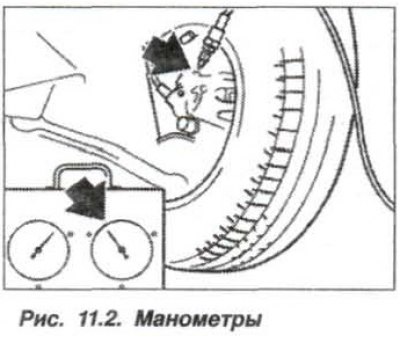
Unscrew the nipple for bleeding the brake system and connect a control pressure gauge (Fig. 11.2) and remove air from the system.
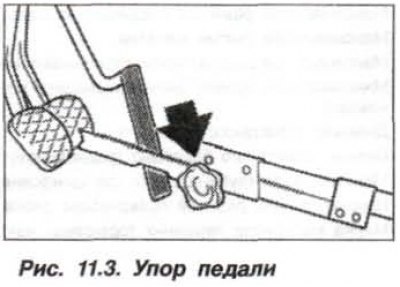
Apply a force of approximately 500 N (50.0 kgf) to the brake pedal, which corresponds to a pressure of 33 bar (33 kgf/cm²) and fix it using the stop (Fig. 11.3).
Record the reading of the right pressure gauge. After two minutes, check the reading of the pressure gauge; the pressure should drop by no more than 2%. Take measurements on both circuits of the brake system – front and rear.
The brake system vacuum test must be performed in the following order. Move the pedal stop back until the test pressure in the brake system is 3-5 bar. Make sure that the car and the measuring device are stationary, since any shaking distorts the measurement results.
The pressure value should not change within 5 minutes. If the pressure drops significantly, all rubber seals should be checked.
After completing the checks, disconnect the device and bleed the brake calipers.