

Description of the brake system design
The brake system of the BMW X5, with the E53 body, is hydraulic with a foot drive and consists of two independent subsystems - the working (foot) and parking...
The brake system of the BMW X5, with the E53 body, is hydraulic with a foot drive and consists of two independent subsystems - the working (foot) and parking...

Brake fluid — general information
Brake fluid is poisonous and precautions should be taken: do not suck brake fluid out of the container through a hose; brake fluid damages paintwork and...
Brake fluid is poisonous and precautions should be taken: do not suck brake fluid out of the container through a hose; brake fluid damages paintwork and...
Work carried out on the brake system
The braking system is one of the most important safety systems of the car, therefore all work on it must be carried out especially carefully and taking into...
The braking system is one of the most important safety systems of the car, therefore all work on it must be carried out especially carefully and taking into...
Technical characteristics of the brake system
Table 11.1. Technical characteristics of the brake system Part parameter Size, mm Nominal The Ultimate Brake caliper piston diameter 60 – Front brake pad...
Table 11.1. Technical characteristics of the brake system Part parameter Size, mm Nominal The Ultimate Brake caliper piston diameter 60 – Front brake pad...
Checking the brake system on a diagnostic stand
Checking the brake system on a diagnostic stand with running drums gives the clearest picture of the condition of the brake mechanisms, and is carried out in...
Checking the brake system on a diagnostic stand with running drums gives the clearest picture of the condition of the brake mechanisms, and is carried out in...

Checking the brake system with pressure and vacuum
Attention! The brake system pressure and vacuum test must be performed with the engine turned off. The brake system must be checked with excess pressure in the...
Attention! The brake system pressure and vacuum test must be performed with the engine turned off. The brake system must be checked with excess pressure in the...

Disc brake mechanism of a car
The basic design of the disc brake mechanism of the front wheels is shown in Figure 11.4, and that of the rear wheels in Figure 11.5.
The basic design of the disc brake mechanism of the front wheels is shown in Figure 11.4, and that of the rear wheels in Figure 11.5.

Replacing the brake pads of the wheel
Before removing the brake pads, the instrument panel displays an indication that they have reached their minimum thickness and checks the size of the pad (see...
Before removing the brake pads, the instrument panel displays an indication that they have reached their minimum thickness and checks the size of the pad (see...

Replacing the brake caliper
Removing the front wheel brake caliper (right or left) must be carried out in the following order: Place the front part of the car on stands and remove the...
Removing the front wheel brake caliper (right or left) must be carried out in the following order: Place the front part of the car on stands and remove the...

Overhaul of the brake caliper
The front wheel brake caliper must be overhauled in the following order. Prepare the "34.1.131" tool and a repair kit of spare parts. Remove the caliper from...
The front wheel brake caliper must be overhauled in the following order. Prepare the "34.1.131" tool and a repair kit of spare parts. Remove the caliper from...

Replacing the brake disc
The design of the brake discs is shown in Figure 11.4 – front brake mechanism and in Figure 11.5 – rear brake mechanism. Attention! The brake disc is replaced...
The design of the brake discs is shown in Figure 11.4 – front brake mechanism and in Figure 11.5 – rear brake mechanism. Attention! The brake disc is replaced...

Front disc — removal and installation
Removing the front brake discs must be done in the following order: Remove the wheels from the car and unscrew the two bolts (1, Fig. 11.26) brake caliper...
Removing the front brake discs must be done in the following order: Remove the wheels from the car and unscrew the two bolts (1, Fig. 11.26) brake caliper...

Rear disc — removal and installation
Removal of the rear wheel brake discs should be carried out in a similar order, taking into account the fastening of the brake caliper (fig. 11.29). Secure the...
Removal of the rear wheel brake discs should be carried out in a similar order, taking into account the fastening of the brake caliper (fig. 11.29). Secure the...

Checking the thickness of the brake disc
Checking the thickness of the brake disc (fig. 11.30) carry out with the wheel removed. In this case, it is necessary to use a special caliper, or a regular...
Checking the thickness of the brake disc (fig. 11.30) carry out with the wheel removed. In this case, it is necessary to use a special caliper, or a regular...

Grinding brake discs
Attention! Composite brake discs cannot be processed. Brake discs are always ground on both sides of both wheels for one axle, observing the roughness (purity...
Attention! Composite brake discs cannot be processed. Brake discs are always ground on both sides of both wheels for one axle, observing the roughness (purity...
Parking brake — design description
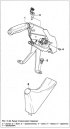
The hand-operated parking brake with drum brake mechanism has its own design features, since the rear axle brake discs also act as drums for the parking brake....
The hand-operated parking brake with drum brake mechanism has its own design features, since the rear axle brake discs also act as drums for the parking brake....

Adjusting the parking brake
Caution! The cable drive and all moving elements of the parking brake system must move easily. Before adjusting, the parking brake must be worked in. On an...
Caution! The cable drive and all moving elements of the parking brake system must move easily. Before adjusting, the parking brake must be worked in. On an...
Removal and installation the parking brake lever
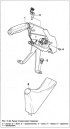
Removing the lever (1, see Fig. 11.32) the parking brake must be applied in the following order. Remove the parking brake lever bellows and the ventilation...
Removing the lever (1, see Fig. 11.32) the parking brake must be applied in the following order. Remove the parking brake lever bellows and the ventilation...

Replacing the parking brake pads
Caution! Replace the parking brake pads on both wheels at the same time. Removal of the parking brake pads must be carried out in the following order. Prepare...
Caution! Replace the parking brake pads on both wheels at the same time. Removal of the parking brake pads must be carried out in the following order. Prepare...

Replacing both handbrake cables
Replacement of both handbrake cables must be carried out in the following order. Prepare the device "34.1.030", remove the parking brake release mechanisms and...
Replacement of both handbrake cables must be carried out in the following order. Prepare the device "34.1.030", remove the parking brake release mechanisms and...

Replacement of the expansion tank
The expansion tank must be removed in the following order. Remove the shield in the trunk and disconnect the jumper connecting the "ground" and "-" terminal of...
The expansion tank must be removed in the following order. Remove the shield in the trunk and disconnect the jumper connecting the "ground" and "-" terminal of...

Replacing the master brake cylinder
The design of the master brake cylinder is shown in Figure 11.44. The master brake cylinder must be removed in the following order. Remove the shield in the...
The design of the master brake cylinder is shown in Figure 11.44. The master brake cylinder must be removed in the following order. Remove the shield in the...

Checking the brake booster
Attention! In a vehicle with a diesel engine, the vacuum is created by a specially installed vacuum pump. The brake booster is a vacuum type, designed to...
Attention! In a vehicle with a diesel engine, the vacuum is created by a specially installed vacuum pump. The brake booster is a vacuum type, designed to...

Replacing the vacuum booster
Attention! Before replacing the vacuum booster, it is necessary to replace the check valve of the vacuum line, because the membrane in the brake booster may be...
Attention! Before replacing the vacuum booster, it is necessary to replace the check valve of the vacuum line, because the membrane in the brake booster may be...

Replacing brake lines
Attention! On vehicles equipped with the "ASC+T/DSC" system, it is prohibited to disconnect the connection pipes to the hydraulic unit and the main brake...
Attention! On vehicles equipped with the "ASC+T/DSC" system, it is prohibited to disconnect the connection pipes to the hydraulic unit and the main brake...

Replacing brake hoses
Caution! Brake hoses must not come into contact with oil or petrol, and they must not be coated with varnish or underbody protection products. Check the hoses...
Caution! Brake hoses must not come into contact with oil or petrol, and they must not be coated with varnish or underbody protection products. Check the hoses...

Replacing the check valve and vacuum booster hose
Caution: Before starting work, press the brake pedal several times to relieve the vacuum in the brake booster, which will make it easier to disconnect the...
Caution: Before starting work, press the brake pedal several times to relieve the vacuum in the brake booster, which will make it easier to disconnect the...

Bleeding the brake system of the DSC type
Attention! Remove air from the system only when the engine is idling. For the "4.6is" with the "M62" engine and the "4.8is" with the "N62" engine, a new brake...
Attention! Remove air from the system only when the engine is idling. For the "4.6is" with the "M62" engine and the "4.8is" with the "N62" engine, a new brake...

ABS/ASC+T or DSC systems — general information
The systems – ABS (Anti Bljckir System – anti-lock braking system) and ASC+T (Automatic Spurtreue Charakteristikdynamische + Tagesleistung – automatic dynamic...
The systems – ABS (Anti Bljckir System – anti-lock braking system) and ASC+T (Automatic Spurtreue Charakteristikdynamische + Tagesleistung – automatic dynamic...

Replacement of the hydraulic unit of the «DSC» system
Attention! When disconnecting the battery and disconnecting the control system, the faults entered during vehicle operation are erased in the ECU-KSUD. Do not...
Attention! When disconnecting the battery and disconnecting the control system, the faults entered during vehicle operation are erased in the ECU-KSUD. Do not...

Replacing the booster pump
The design of the booster pump of the "DSC" system and its installation are shown in Figure 11.70. The replacement of the booster pump must be carried out in...
The design of the booster pump of the "DSC" system and its installation are shown in Figure 11.70. The replacement of the booster pump must be carried out in...

Replacing the DSC system sensor
The body speed sensor around the vertical axis also functions as a vehicle lateral acceleration sensor. Removing the DSC-3 speed sensor must be done in the...
The body speed sensor around the vertical axis also functions as a vehicle lateral acceleration sensor. Removing the DSC-3 speed sensor must be done in the...

Replacing the wheel speed sensor
The front wheel speed sensor must be replaced in the following order: Remove the front wheel. Unlock the SS, remove it from the holder and disconnect the SS....
The front wheel speed sensor must be replaced in the following order: Remove the front wheel. Unlock the SS, remove it from the holder and disconnect the SS....

Replacement of the ECU of the ABS/ASC+T and DSC systems
Warning! Observe safety precautions for protection against electrostatic discharge. Use grounding wrist straps. Removal of the ECU of the "ABS/ASC+T" and "DSC"...
Warning! Observe safety precautions for protection against electrostatic discharge. Use grounding wrist straps. Removal of the ECU of the "ABS/ASC+T" and "DSC"...

Replacing the brake pedal
The brake pedal is mounted on a single pedal bracket (Fig. 11.79), the design of the pedal drive is shown in Figure 11.80. The brake pedal must be replaced in...
The brake pedal is mounted on a single pedal bracket (Fig. 11.79), the design of the pedal drive is shown in Figure 11.80. The brake pedal must be replaced in...
Tightening torques for connections of brake system elements
Brake system bleeding nipple: spanner opening for "7" — 3.5 – 5.0 N·m; spanner opening angle of "11" — 12.0 – 16.0 N·m. Brake disc to wheel hub – torque 16 Nm....
Brake system bleeding nipple: spanner opening for "7" — 3.5 – 5.0 N·m; spanner opening angle of "11" — 12.0 – 16.0 N·m. Brake disc to wheel hub – torque 16 Nm....
Diagnostics of brake system faults
Table 11.2. Diagnostics of brake system faults Malfunction Cause of malfunction Methods of elimination Uneven action of the brake mechanisms of the wheels of...
Table 11.2. Diagnostics of brake system faults Malfunction Cause of malfunction Methods of elimination Uneven action of the brake mechanisms of the wheels of...
This section is available on russian, bulgarian, belarusian, ukrainian, serbian, croatian, romanian, polish, slovak, hungarian
Similar sections for other types of BMW cars:
Chassis: Brake system BMW 3 Series E46 (1998-2006, petrol)
Chassis: Brake system BMW 5 Series E28 (1981-1988)
Chassis: Brake system BMW 7 Series E32 (1986-1994)
Chassis: Brake system BMW X3 E83 (2003-2010)
Chassis: Brake system BMW 3 Series E46 (1998-2006, petrol)
Chassis: Brake system BMW 5 Series E28 (1981-1988)
Chassis: Brake system BMW 7 Series E32 (1986-1994)
Chassis: Brake system BMW X3 E83 (2003-2010)
Share information:
- General information
- Manual
- Maintenance
- M54 petrol engine
- Engine repair
- Lubrication system
- Cooling system
- Supply system
- Injection system
- Exhaust system
- Engine electrics
- M62 petrol engine
- Engine repair
- Lubrication system
- Cooling system
- Supply system
- Exhaust system
- Engine electrics
- N62 petrol engine
- Engine repair
- Cooling and lubrication system
- Power and exhaust system
- Engine electrics
- Diesel engine M57
- Engine repair
- Lubrication system
- Cooling system
- Power and exhaust system
- Engine electrics
- Turbocharging system
- Transmission
- Clutch
- Mechanical gearbox
- Automatic gearbox
- Transfer case and cardan
- Chassis
- Brake system
- Steering
- Front suspension
- Rear suspension
- Wheels and tires
- Body
- Exterior
- Interior
- Doors and windows
- Repair and maintenance
- Heater and air conditioner
- Electrical equipment
- Equipment and devices
- Levers and switches
- Electrical circuits