
Attention! On vehicles equipped with the "ASC+T/DSC" system, it is prohibited to disconnect the connection pipes to the hydraulic unit and the main brake cylinder.
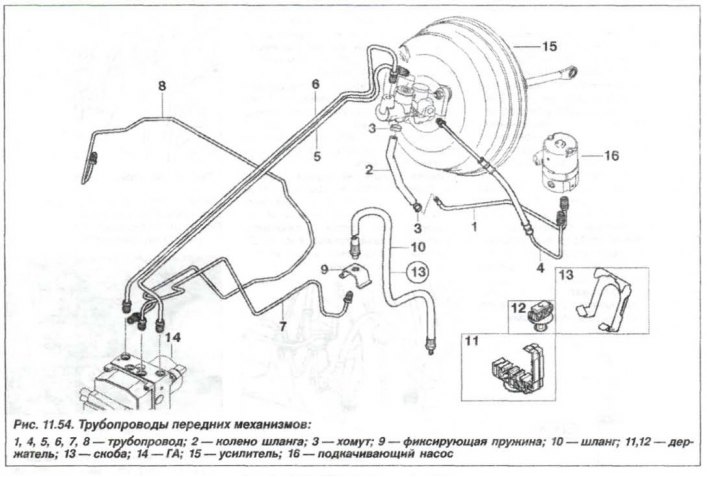
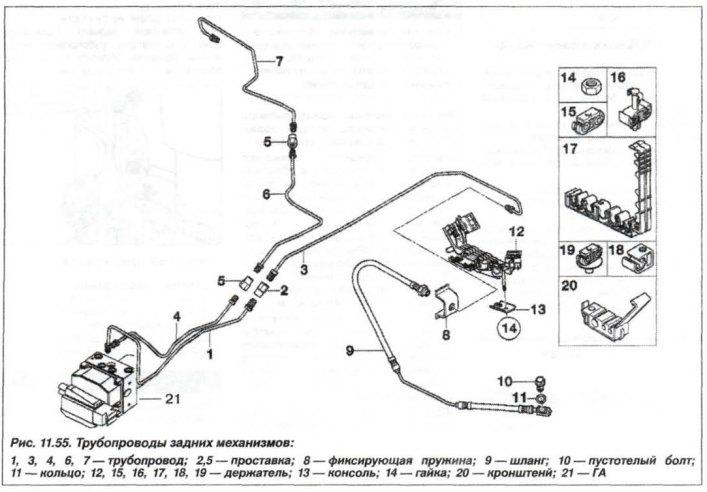
In the brake system, injection pipes with a plastic coating are used as rigid connections. Brake hoses create a flexible, incompressible connection between the body and the suspension. The design of the drive pipes is shown in Figure 11.54 for the front brake mechanisms and in Figure 11.55 for the rear brake mechanisms.
Caution! When changing pipelines, be careful not to damage the plastic layer.
The union nuts must strictly correspond to the fittings of the connections (flaring) and bending of the pipeline shall be performed in special devices. When bending and flanging, use the removed pipeline as a sample.
Lay the brake lines in their proper locations, eliminating friction against vehicle components.
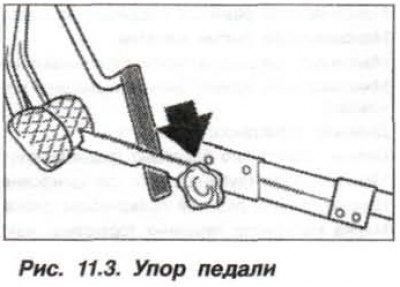
The brake line must be replaced in the following order. Place the car on a lift, inspection pit or stands. Lightly press the brake pedal and fix it (see fig. 11.3). To replace the pipelines, unscrew the union nuts (tips, fittings) and remove the pipe fastening clamps on the body. Seal the pipe connections with plugs or caps.
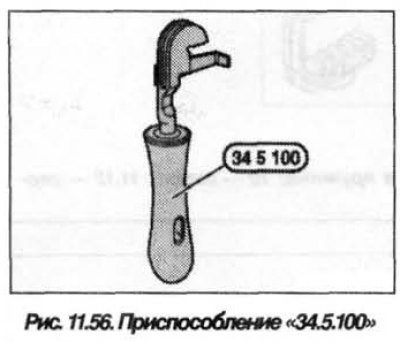
Brake drive pipes are supplied straight, of the required length and with connecting tips, nuts (nipples). Install the new pipe in place of the old one, having previously bent it with the device "34.5.100" (fig. 11.56). Use the removed pipeline as a sample. Tighten the union nuts of the pipeline fittings to a torque of 14 N·m (1.4 kgf·m).
After replacing the pipes, bleed the brake system and check the safety of the brake system.
The safety control of the braking system consists of checking:
- brake pipe fastenings;
- fastening brake hoses in holders;
- tightening the bleed nipples;
- brake fluid level in the expansion tank;
- tightness of the system with the engine running - when pressing the brake pedal with a force of 20-30 kgf and holding it for 10 seconds, there should be no "sagging" of the brake pedal;
- tightness of all vehicle connections.
[The text is based on materials from the website: BMWman]