
Attention! Remove air from the system only when the engine is idling.
For the "4.6is" with the "M62" engine and the "4.8is" with the "N62" engine, a new brake fluid of the "DOT4" type with reduced viscosity is required. Bleeding the brake system of the "DSC 5.7" type is necessary after each repair of the brake system if the hydraulic system of the brake or clutch drive was opened and air got into it. A sign of the presence of air in the system is a "failure" of the brake pedal when it is pressed. Remove air from the brake system by bleeding it on the "DIS-BMW" diagnostic stand or using the brake pedal, with the obligatory participation of an assistant.
Bleeding the brake system using the "DIS-BMW" system must be carried out in the following order.
Strictly follow the instructions for filling and bleeding the brake system when replacing or repairing its components:
- master brake cylinder;
- hydroelectric unit;
- elements of the brake system connection;
- booster pump.
After working on the booster pump, it is necessary to bleed only the circuit of the front brake drive. Before flushing the brake system, it is necessary to turn on the booster pump once using the "DIS-BMW" system, while the device for bleeding with a maximum pressure of 2 bar must be connected.
Remove the heater partition and connect the diagnostic system "DIS-BMW" (fig. 11.63) and set the mode for bleeding the hydraulic unit of the DSC system. Install the bleeding device on the compensation tank of the main brake cylinder. Turn on the diagnostic system "DIS-BMW", strictly follow the Operating Manual of the system, the pressure should not exceed 2 bar.
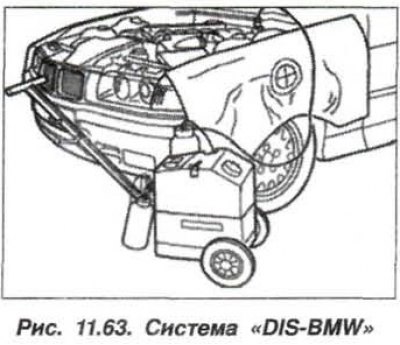
Flushing of the brake system assembly should be carried out in the following order:
- connect one end of the hose to a receiving vessel (fig. 11.64);
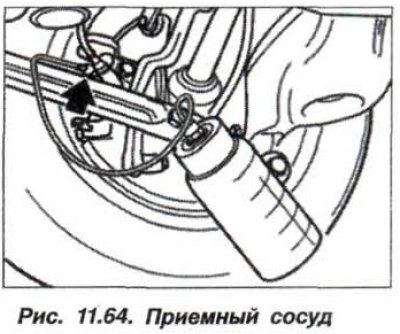
- connect the other end to the head of the nipple of the rear right wheel caliper;
- unscrew the nipple and bleed the hydraulic drive until clean brake fluid without air bubbles flows:
- tighten the nipple;
- repeat the operation on the rear left wheel.
Bleed the rear wheel brake circuit in the following order:
- connect one end of the hose to a receiving vessel (fig. 11.64);
- connect the other end to the head of the nipple of the rear right wheel caliper;
- open the nipple;
- perform a bleeding program using the "DIS-BMW" system with the bleeding nipple open;
- after completing the program, press the brake pedal five times until it stops;
- clean brake fluid should flow out, without air bubbles;
- tighten the nipple;
- repeat this operation on the rear left wheel.
Bleed the front wheel brake circuit in the following order:
- connect one end of the hose to a receiving vessel (fig. 11.65);
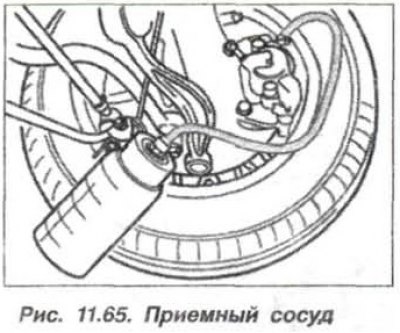
- connect the other end to the head of the nipple of the front right wheel caliper,
- open the nipple;
- perform a bleeding program using the "DIS-BMW" system with the bleeding nipple open;
- after completing the program, press the brake pedal five times until it stops;
- clean brake fluid should flow out, without air bubbles;
- tighten the nipple;
- repeat this operation on the front left wheel.
Turn off the brake fluid changer and disconnect it from the expansion tank.
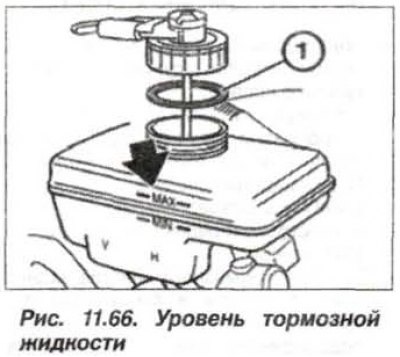
Check the brake fluid level (arrow, Fig. 11.66). Make sure that the rubber gasket (1) of the lid is present and close the tank.
If you don't have diagnostic equipment, you can bleed the brake system with the help of an assistant.
Attention! Constantly monitor the brake fluid level in the expansion tank and maintain it at the "Max" mark.
Always add fresh brake fluid.
It is recommended to start bleeding from the caliper that was replaced or repaired.
Strictly follow the order of bleeding the brake mechanisms, this will help save time and effort:
- rear right brake caliper:
- rear left brake caliper,
- front right brake caliper;
- front left brake caliper.
Bleeding the brake system must be carried out in the following order.
Remove the dust cap, clean the bleed nipple on the caliper and assemble a system for removing air from the brake drive hydraulic system by attaching a clean hose to the nipple and lowering its other end into a container (can) half filled with brake fluid. It is recommended to use a transparent container and hose.
Press the brake pedal several times (5–7) until it suddenly reacts. Leave the pedal pressed.
Open the air bleed nipple half a turn with a ring spanner (bleed valve). Collect the leaking brake fluid in a jar. Make sure that the end of the hose is constantly immersed in the fluid.
If the pressure drops, close the bleed nipple valve.
Press the brake pedal again several times (5–7) until it suddenly reacts. Leave the pedal pressed.
Continue the above process until air bubbles stop entering the fluid collection container along with the brake fluid.
Close the bleed valve, release the brake pedal, remove the brake fluid drain hose and install it on the air bleed nipple (bleed valve) protective cap.
Similarly, remove air from all brake mechanisms.
Check the safety of the braking system.
(This publication was borrowed from an online resource: www.bmwman.ru)