
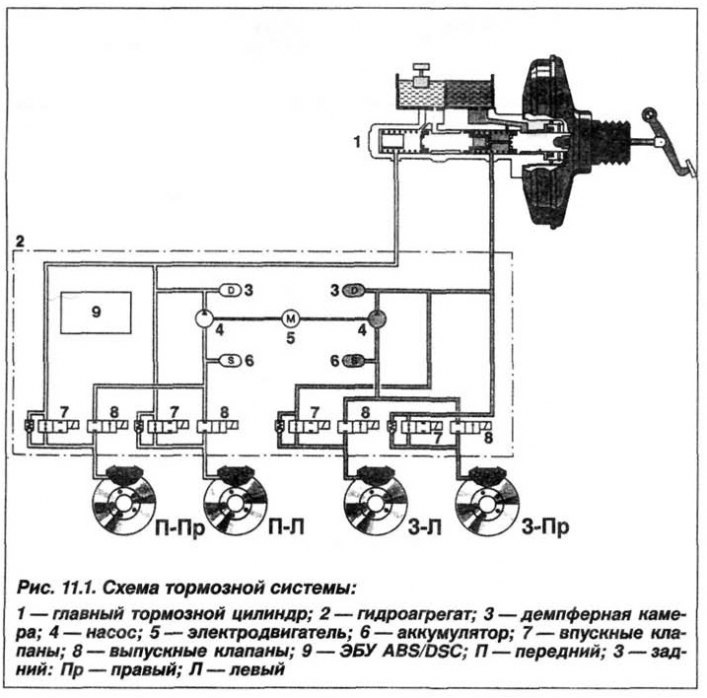
The driver's impact on the pedal is increased by a vacuum booster. Under normal operating conditions, both circuits operate synchronously. If one of the circuits fails, for example, due to its depressurization and loss of brake fluid, such a scheme allows the car to be stopped using the second braking circuit, but with some loss of efficiency in terms of braking time and braking distance.
The brake system consists of: a master brake cylinder with a compensating (nutritious) brake fluid reservoir, brake booster, hydraulic unit, disc brakes with floating calipers on the front and rear wheels, pipelines, hoses and elements of the ABS/ASC+T/ASC systems, which create a single system – DSC.
Parking braking is performed by the action of the hand drive lever, through the drive cables, on the brake shoes in the rear wheel mechanism. Since disc brakes are ineffective as mechanisms for the parking brake system, two drum brake mechanisms are additionally installed on the rear wheels, the drums of which are built into the brake discs.
The brake circuits are combined by the main brake cylinder and the hydraulic unit. In the engine compartment, on the left side, under the air filter housing, above the main brake cylinder, there is a feed (compensatory) a brake system reservoir that supplies the system with brake fluid and also supplies the clutch drive system.
The brake booster operates due to the vacuum created in the intake manifold of a petrol engine or due to a special vacuum pump in diesel engines and N62 engines.
The front wheels are equipped with a disc brake mechanism, with a ventilated brake disc. The rear wheels are also equipped with a disc brake mechanism. Depending on the car model (engine power) the brake disc can be solid or ventilated.
All disc brakes are equipped with a floating caliper brake mechanism. The disc brake calipers are made of light alloy, which significantly lightens the brake system and significantly increases the efficiency of heat dissipation. Due to this, the "Fading" phenomenon is eliminated - the loss of efficiency of the brake mechanism due to strong heating of the brake pad linings. Sensors are installed on the friction linings of the brake pads at the front left and rear right, indicating the maximum degree of their wear, which is 3 mm.
The minimum brake fluid level is monitored by a float-type sensor via a light indicator on the instrument panel.
The role of the brake force regulator on the car is performed by the "ABS/ASC+T" or "DSC" system from Bosch (Germany) and a number of additional systems ensure that the wheels do not lock and the car body does not skid during sharp braking.
Warning! As a result of the operation of the brake mechanisms, dust is released from the brake linings, which is harmful to health. All work on cleaning the brake mechanisms must be carried out in respiratory protection equipment - respirators.
When driving on a wet road or in the rain, it is recommended to periodically apply the brakes to dry and clean the brake pads and restore the effectiveness of the brakes.
To speed up the process of running in new brake pads to the disc, it is recommended to brake the car several times from 80 km/h to 40 km/h, carefully pressing the brake pedal. Between such braking, maintain a time interval for the complete cooling of the brake mechanism elements. The running-in time of new brake pads is about 180–230 km, during which the efficiency of the brakes is somewhat reduced. During the running-in process, sharp and prolonged braking to a complete stop is not recommended.
Attention! Brake discs with a corroded braking surface must be replaced.