
- Home
- BMW 7 Series
- E38
- General information
- Maintenance
- Checking the brake system and clutch
Checking the brake system and clutch (BMW 7 Series E38)
Dust from lining wear that accumulates on brake components may contain asbestos, which is hazardous to health. Do not blow out this dust with compressed air or inhale it! Do not use gasoline-based solvents to remove dust.
In addition to checking at set intervals, the condition of the brake mechanisms should be checked every time the wheels are removed or when signs of a malfunction in the brake system appear. Checking the brake fluid level is described in Section Checking fluid levels, leak control.
Signs of a problem with the brake system
Any of the following symptoms may indicate a potential brake system defect:
- When pressing the brake pedal while driving, the car "pulls" to one side;
- The brakes make scraping or squealing sounds when braking;
- The brake pedal has excessive travel;
- The brake pedal is pulsating (this is normal only when the ABS system is working);
- Brake fluid leaks are observed (usually visible on the inside of a tire or wheel)
If you notice any of these signs, have your brake system inspected immediately.
Brake lines and hoses
The brake system uses mostly metal brake lines, with the exception of flexible reinforced hoses at the wheels. Regular inspection of all these lines is very important.
1. Park the car on a level surface.
2. Jack up the vehicle and place it on stands, then remove the wheels. Checking the vacuum hoses is described in Section Checking the condition and replacing hoses and tubes in the engine compartment, localizing leaks.
3. Check all brake lines and hoses for cracks or abrasions in their outer coating, as well as leaks, bulges, and deformations. Check the brake hoses at the front and rear of the vehicle for signs of softening, cracks, deformations, or wear due to friction with other parts. Check all fittings for signs of leaks and make sure that all brake line fasteners are secure.
4. Bend the brake hose in both directions with your hands to check for damage. Do not twist the hoses.
5. Turn the steering wheel to the right and left until it stops. Make sure that the hoses do not touch the vehicle's structural elements.
6. If brake lines are found to be leaking fluid or damaged, the leaks should be repaired immediately. For a more detailed description of the brake system repair procedure, refer to Chapter Brake system.
Checking the thickness of brake pads and discs
Disc brakes
1. Jack up the car and place it on supports, then remove the corresponding wheel.
Experience shows that due to the presence of dirt on the edge of the road, the brake pads of the right wheel wear out more than the left. Therefore, it makes sense to remove the front right wheel for inspection.
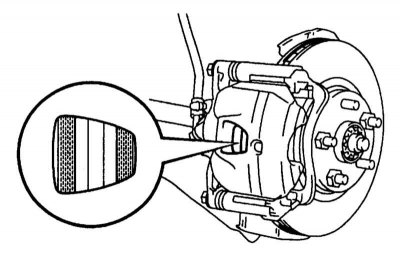
2. The thickness of the disc brake pad is measured through a special inspection window in the caliper. If the thickness of the friction lining of the pad is less than 3 mm, replace all the pads of both brake mechanisms of the wheels of this axle (see chapter Brake system).
As a rule, 1 mm of brake shoe lining wear corresponds to at least 1000 km of mileage under unfavorable operating conditions. Under normal conditions, the linings wear out much more slowly.
3. Check the brake calipers for leaks. If leaks are found, repair the caliper immediately.
4. Visually inspect the brake discs from the inside and outside for grooves, rust and cracks. Replace defective components.
5. Measure the thickness of the brake discs in several places using a micrometer or a special caliper. You can also measure the thickness of the brake disc with a regular caliper, placing a lining of a known size on each side (for example, two coins), and then subtract the thickness of the linings from the measured value.
6. Compare the minimum of the results obtained with the requirements of the Specifications for Chapter Brake system. If the wear limit is reached, be sure to replace both brake discs. The brake disc should also be replaced if there are large cracks or deep grooves on the working surface.
Parking brake shoes
1. Using the instructions in Chapter Brake system, remove the rear brake discs.
2. Measure the thickness of the friction linings on the rear brake shoes and inspect them for signs of contamination with brake fluid or grease. If the lining is within 1.5 mm of the rivet heads or metal base at the thinnest point, replace all shoes. Shoes that are cracked, polished to a shine, or contaminated with brake fluid or grease should also be replaced. The replacement procedure is described in Chapter Brake system.
3. Check the condition of the shoe tension and retaining springs, as well as the adjusting mechanism. Make sure that all these components are correctly installed and in working order. Worn or deformed springs can cause premature wear of the friction linings.
4. Check the wheel cylinders for signs of leaks by carefully moving aside the protective rubber boots. The presence of minor traces of moisture under the boots is acceptable. However, if brake fluid is found under them or is leaking from the wheel cylinder, the cylinders should be overhauled or replaced (refer to Chapter Brake system).
5. Check the drums for deep scratches, grooves, cracks and overheated areas that appear as discolored spots. If the defects found cannot be removed with sandpaper, the drum should be resurfaced in a workshop.
6. Following the instructions of the Chapter Brake system, install the brake discs.
7. Install the wheels. If the parking brake needs to be checked, do not lower the vehicle to the ground.
Checking the reliability and travel of the parking brake lever
1. The simplest way to check the operation of the parking brake is to park the car on a steep slope with the brake applied and the transmission in neutral (you must be in the car during the check). If the parking brake does not prevent the vehicle from rolling, it should be adjusted (see chapter Brake system).
2. Jack up the rear of the car and place it on stands.
It is recommended to first gently apply the parking brake at a speed of 40 km/h until you feel light braking. Then, maintaining the specified speed, apply the lever one more click and drive about 400 m. After that, release the parking brake and let it cool down.
3. Apply the parking brake 5 notches. Turn the wheels by hand – you should feel a slight resistance from the brake action.
4. Tighten the brake by 6 teeth. The wheels should not be able to turn manually. If the lever needs to be pulled further to create braking, adjust the parking brake (see chapter Brake system).
Checking the brake booster
1. With the engine off, press the brake pedal several times; with each press, its travel should decrease.
2. With the brake pedal depressed, start the engine – the pedal should move down.
3. Keep the brake pedal depressed and turn off the engine. If the pedal travel does not change after holding it for 30 seconds, the vacuum booster is OK.
4. If one of the above checks is not satisfactory, repair or replace the vacuum booster (see chapter Brake system).
This article is available at russian, bulgarian, belarusian, ukrainian, serbian, croatian, romanian, polish, slovak, hungarian
Article verified: Polikarpov Saveliy
Share information:
Previous articles
БМВ E38: Maintenance
Next articles
Similar articles on other types of BMW cars:
Checking the tightness of the system BMW 3 Series E21 (1975-1983)
Diagnostics of brake system faults BMW 3 Series E30 (1982-1994)
Checking the parking brake system BMW 5 Series E39 (1995-2003)
Checking the brake system BMW 5 Series E28 (1981-1988)
Bleeding the cooling system and checking it for leaks (M54, N46, N47,… BMW X3 E83 (2003-2010)
Checking the brake system BMW X5 E53 (1999-2006)
Checking the tightness of the system BMW 3 Series E21 (1975-1983)
Diagnostics of brake system faults BMW 3 Series E30 (1982-1994)
Checking the parking brake system BMW 5 Series E39 (1995-2003)
Checking the brake system BMW 5 Series E28 (1981-1988)
Bleeding the cooling system and checking it for leaks (M54, N46, N47,… BMW X3 E83 (2003-2010)
Checking the brake system BMW X5 E53 (1999-2006)
Link in different formats to this page
Visitor comments
No comments yet
- General information
- Introduction to guide
- Manual
- Maintenance
- Power unit
- Engine M60/1, M60/2 (petrol)
- M62 engine (petrol)
- M57 engine (diesel)
- M67 engine (diesel)
- Cooling system
- Fuel system (petrol)
- Fuel system (diesel)
- Exhaust system
- Ignition and control systems
- Charge and launch systems
- Transmission
- Clutch
- Mechanical gearbox
- Automatic gearbox
- Cardan and drive shafts
- Chassis
- Brake system
- Front suspension
- Rear suspension
- Steering
- Body
- Exterior
- Interior
- Electrical equipment
- Equipment and devices
- Lighting
- Heating and air conditioning
- Electrical circuits
- General information
- Care and maintenance
- Power unit
- Minor engine repair
- Engine overhaul
- Lubrication system
- Cooling system
- Ignition system
- Supply system
- Injection system (petrol)
- Injection system (diesel)
- Exhaust system
- Transmission
- Clutch
- Manual gearbox
- Automatic gearbox
- Cardan gear
- Rear axle and shafts
- Chassis
- Front suspension
- Rear suspension
- Steering
- Wheels and tires
- Brake system
- Body
- Body elements
- Electrical equipment
- Equipment and devices
- Electrical circuits