



- Home
- BMW X5
- E53
- General information
- Maintenance
- Checking the brake system
Checking the brake system (BMW X5 E53)
Attention! When working on the brake system, it is prohibited to use compressed air and gasoline-based solvents.
Disc brake mechanisms have built-in brake pad wear indicator sensors on the pads. Information about brake pad wear is displayed on the instrument panel and its indication requires immediate replacement of the brake pads.
Thickness of the pads
The thickness of the outer brake pad linings can be determined without removing the wheel. In this case, it is necessary to position the car so that a slot for the wear indicator appears in the opening of the disk (Fig. 2.31).
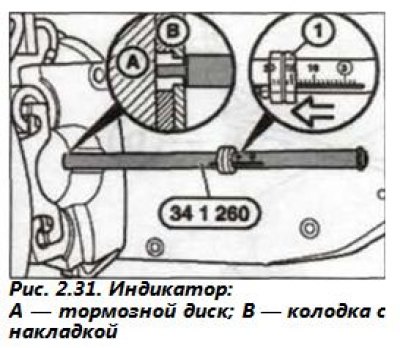
Install the "34.1.260" device through the rim into the socket, press the device against the brake lining. Move the ring (1) until it stops in the direction indicated by the arrow, and read the readings.
A friction lining of 5 mm thickness ensures a vehicle mileage of at least 3,000 km. Its minimum permissible thickness is 3.0 mm. If its thickness approaches the limit, it is necessary to remove the shoe and check the actual degree of its wear with a gauge and assess its further possibility of use. Experience shows that the brake lining decreases by 1 mm when the vehicle mileages 1,000 km in unfavorable conditions. If the lining thickness is less than 3.0 mm or it is worn unevenly, replace the brake shoes (4 pcs.) on the entire axle.
Attention! If the slightest signs of a malfunction in the brake system are detected, driving is strictly prohibited until the cause of its occurrence is eliminated.
Brake lines and hoses
The brake fluid circulates through rigidly fixed steel tubes with a plastic coating and flexible reinforced hoses at the front wheels and as connections at the rear axle. Constant and careful inspection of all lines is very important for driving safety.
Drum parking brake mechanism
To inspect the drum mechanism of the parking brake, it is necessary to remove the rear brake disc, as described in the section "Brake system". Inspect the drum mechanism in the following order. Inspect the rear brake mechanisms for leaks of brake fluid or contamination with grease. Measure the thickness of the friction linings on the shoes of the rear brake mechanisms (Fig. 2.32).
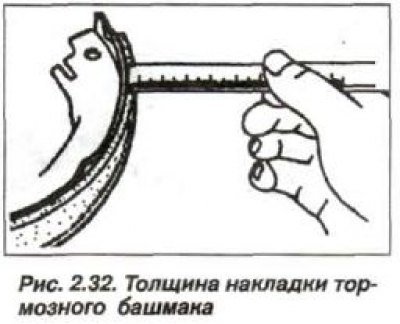
If at least one pad has a thickness above the rivet heads or the metal base at its thinnest point, within 2.0 mm or less, replace all shoes (4 pcs.).
Parking brake lever
Check the reliability and travel of the parking brake lever in the following order. Place the car on an inclined plane. Hold it on the service brakes, apply the parking brake, while the gearbox should be in neutral, release the service brakes. If the car rolls, it is necessary to adjust the parking brake, see section "Brake system".
- Place the car on a level surface, lift its rear part and place it on stands.
- Apply the parking brake 1 notch. Turn the wheels by hand, no braking should be experienced.
- Apply the parking brake by 2 teeth. The parking brake indicator on the control panel should light up. Turn the wheels by hand, braking should occur.
- Apply the parking brake to 3 teeth. It is not possible to turn the wheels by hand; the wheel must be fully braked.
- The deviation of the difference in circumferential force on the left and right wheels is allowed to be no more than 30% of the larger value (measured on a roller test stand). If the difference in circumferential force is higher, readjust.
- Check the release lever for ease of movement and lubricate it if necessary.
- If the stroke of the parking brake lever exceeds more than 10 teeth of the adjusting screw (ratchet), it must be readjusted.
This article is available at russian, bulgarian, belarusian, ukrainian, serbian, croatian, romanian, polish, slovak, hungarian
Article verified: Zhuravleva Isolda
Share information:
Previous articles
БМВ E53: Maintenance
Next articles
Similar articles on other types of BMW cars:
Checking the tightness of the system BMW 3 Series E21 (1975-1983)
Diagnostics of brake system faults BMW 3 Series E30 (1982-1994)
Checking the parking brake system BMW 5 Series E39 (1995-2003)
Checking the brake system BMW 5 Series E28 (1981-1988)
Checking the brake system and clutch BMW 7 Series E38 (1994-2001)
Checking the cooling system for tightness BMW 7 Series E32 (1986-1994)
Bleeding the cooling system and checking it for leaks (M54, N46, N47,… BMW X3 E83 (2003-2010)
Checking the tightness of the system BMW 3 Series E21 (1975-1983)
Diagnostics of brake system faults BMW 3 Series E30 (1982-1994)
Checking the parking brake system BMW 5 Series E39 (1995-2003)
Checking the brake system BMW 5 Series E28 (1981-1988)
Checking the brake system and clutch BMW 7 Series E38 (1994-2001)
Checking the cooling system for tightness BMW 7 Series E32 (1986-1994)
Bleeding the cooling system and checking it for leaks (M54, N46, N47,… BMW X3 E83 (2003-2010)
Link in different formats to this page
Visitor comments
No comments yet
- General information
- Manual
- Maintenance
- M54 petrol engine
- Engine repair
- Lubrication system
- Cooling system
- Supply system
- Injection system
- Exhaust system
- Engine electrics
- M62 petrol engine
- Engine repair
- Lubrication system
- Cooling system
- Supply system
- Exhaust system
- Engine electrics
- N62 petrol engine
- Engine repair
- Cooling and lubrication system
- Power and exhaust system
- Engine electrics
- Diesel engine M57
- Engine repair
- Lubrication system
- Cooling system
- Power and exhaust system
- Engine electrics
- Turbocharging system
- Transmission
- Clutch
- Mechanical gearbox
- Automatic gearbox
- Transfer case and cardan
- Chassis
- Brake system
- Steering
- Front suspension
- Rear suspension
- Wheels and tires
- Body
- Exterior
- Interior
- Doors and windows
- Repair and maintenance
- Heater and air conditioner
- Electrical equipment
- Equipment and devices
- Levers and switches
- Electrical circuits