
The condition of the drive belts must be checked in the following order.
- Set the parking brake, turn off the engine, open the hood and let it cool. Using a flashlight, run your fingers along the entire length of each belt, feeling for cracks and delamination.
- Check the belts for wear and tear and "bald spots" - areas polished to a shine. Each belt should be inspected on both sides.
- Check the belt tension by pressing on it with your thumb and determining the degree of its deflection. The deflection is measured with a ruler. The "thumb" rule states that if the distance between the pulley centers is from 180 to 280 mm, the deflection should be 6 mm, if the distance between the pulley centers is from 300 to 400 mm, the deflection should be 13 mm. The V-belt is tensioned by an automatic tensioner and does not require checking its tension during maintenance.
- Check the belt for dirt deposits, stones between the ribs and rubber build-up at the base of the ribs. Check the wear on the side surfaces of the belts (fig. 2.38, a), the new belt has trapezoidal ribs.
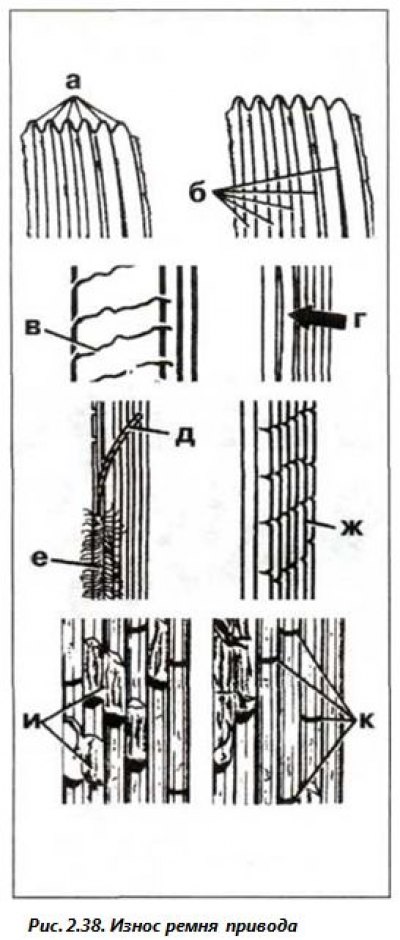
- Check the belt puller (cord). When worn, it is visible at the base of the ribs (fig. 2.38, b). Determined by the presence of lighter areas.
- Check for transverse cracks on the back side of the belt (fig. 2.38. in).
- Check for delamination of individual ribs on the back side of the belt (fig. 2.38, g).
- Check for fraying of the outer harnesses of the belt (fig. 2.38. e).
- Check for lateral breaks in the harness (fig. 2.38, d).
- Check for breaks in the belt ribs (fig. 2.38, and).
- Check for breaks in individual transverse ribs of the belt (fig. 2.38, to).
- If there is one or more of the above defects, replace the belt. Check the belt for aging by the presence of small cracks.