
Cars Mazda Cars Mitsubishi Cars Toyota Cars Chevrolet Cars AvtoVAZ Cars Kia Cars Nissan
English Русский
Български
Беларускі
Український
Српски
Hrvatski
Română
Polski
Slovenský
Magyar
| Articles | Contacts | Sitemap |   
BMWman.ru


3 series   5 series   7 series   BMW X3   BMW X5   BMW X6

E53 (1999-2006)
  • Home
  • BMW X5
  • E53
  • General information
  • Maintenance
  • Checking the condition of the tires

Checking the condition of the tires (BMW X5 E53)

            0

BMW "X5" cars with the "E53" body have different tires and disks, depending on the model. Tires and disks require regular inspection of their condition. On tires, first of all, you should check the condition of the inflation valve and the wear of the tread. The inflation valve should be checked in the following order:
  • remove the rubber protective cap;
  • unscrew the cap-key of the inflation valve;
  • lightly wet the valve and make sure there are no air bubbles. If an air bubble forms, this indicates an air leak through the valve:
  • turn the key cap over and screw it onto the valve core;
  • recheck the valve for leaks. If the valve leaks air, it must be replaced;
  • be sure to install the protective cap.

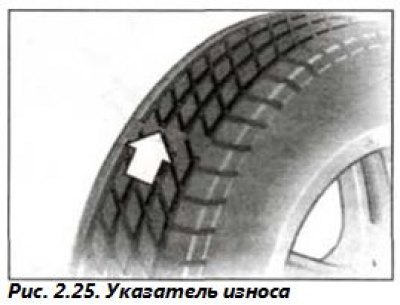
All tires have a built-in wear indicator in the form of control strips that are exposed when the tread depth decreases to 1.6 mm, after which the tires are considered worn out (arrow, Fig. 2.25)
All tires have a built-in wear indicator in the form of control strips that are exposed when the…


The optimal tire tread depth is 3.0 mm or more, for winter tires - 4.0 mm or more. The efficiency of winter tires ("M+S") on snow, mud and slush drops already at a tread depth of 4 mm.

The control strips are located around the entire circumference of the tire where the "TWI" marks are located (Tread Wear Indicator). Checking tire wear should be done in several places ("TWI") simultaneously, as tire wear depends on many factors.


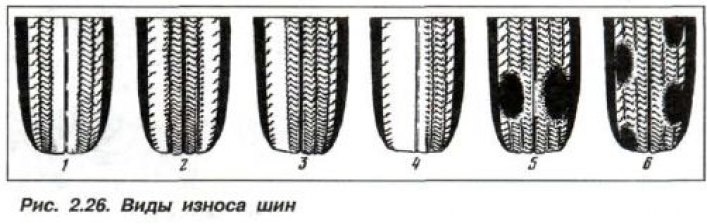
The nature of the tread wear can be used to determine the cause of it, Fig. 2.26.
The nature of the tread wear can be used to determine the cause of it, Fig. 2.26.


Thus, tire (1) shows wear caused by prolonged driving with increased pressure, and tire (2) - with insufficient pressure. Wear of tire (3) with characteristic rounded edges on one side of the tread pattern and sharp on the other side is caused by wheel alignment violations. With significant deviations (10-15 mm) from the recommended toe, tires can be worn out in less than 1,000 km. Tire (4) has uneven tread wear due to wheel camber violations. This is especially noticeable with a large difference in camber between the left and right wheels. Type of wear (5) in the form of one or two "bald spots" is a consequence of increased runout of the brake disc or drum. These "bald spots" may be accompanied by similar diametrically located "bald spots" if the brake drum of the parking brake has increased ovality or lateral runout of the brake disc. A less pronounced "bald spot" appears as a result of emergency braking at high speed when driving on a concrete road.

Tire (6) shows patchy wear resulting from large angular oscillations of the front wheels or one wheel.


The main causes of spotty tire wear are:
  • play in the steering rod joints;
  • malfunction of the front shock absorbers or one of them;
  • serious wheel imbalance;
  • loose steering gear mount.

Damaged wheels are not repaired, they are replaced with new ones, which increases safety.

Pay special attention to the absence of punctures and cuts on the tires. If the cuts reach the tire frame, it must be replaced.

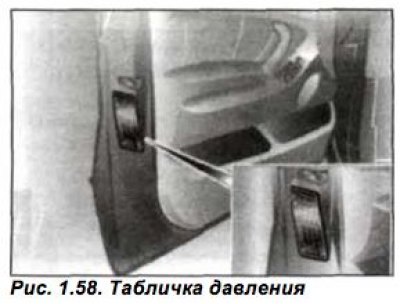
It is recommended to change tires, including the spare tire, at least once every 6 years, even if the service life of the tires is 10 years. Balancing should be performed every time a tire or wheel is replaced. The pressure in the spare tire should be 0.5 bar higher than the maximum prescribed value indicated on the plate (see fig. 1.58) are shown on the end of the driver's door.
It is recommended to change tires, including the spare tire, at least once every 6 years, even if…


Install the wheel mounting bolts dry and tighten them crosswise to a torque of 140±10 Nm (14.0±1.0 kgf·m).

Note: For safety reasons, only tires of the same type and tread pattern should be installed on the vehicle.

This article is available at russian, bulgarian, belarusian, ukrainian, serbian, croatian, romanian, polish, slovak, hungarian
Article verified: Zhuravleva Isolda

Share information:
Previous articles
БМВ E53: Maintenance
Next articles

Checking the washer reservoir level
Checking the brake fluid level
Coolant level control
Checking the engine oil level and replacing it
Resetting the maintenance indicator
Checking and adjusting idle speed and CO levels
Replacing the air filter element
Checking the brake system
Checking the steering system
Wheels and tires


Similar articles on other types of BMW cars:
Checking the condition of tires and pressure in them. Designation of… BMW 3 Series E46 (1998-2006)
Checking the technical condition of connecting rod and piston group… BMW 3 Series E21 (1975-1983)
Checking the condition of the tires and their pressure BMW 5 Series E28 (1981-1988)
Checking the technical condition of the cylinder head BMW 5 Series E12 (1972-1981)
Checking the condition of the tires and their inflation pressure BMW 7 Series E38 (1994-2001)
Checking the engine oil level BMW 7 Series E32 (1986-1994)
Identifying engine faults by the condition of spark plugs BMW X3 E83 (2003-2010)
Link in different formats to this page


Visitor comments

No comments yet


How much 43 + 48 =


BMW E53 (1999-2006) 
  • General information
  • Manual
  • Maintenance
  • M54 petrol engine
  • Engine repair
  • Lubrication system
  • Cooling system
  • Supply system
  • Injection system
  • Exhaust system
  • Engine electrics
  • M62 petrol engine
  • Engine repair
  • Lubrication system
  • Cooling system
  • Supply system
  • Exhaust system
  • Engine electrics
  • N62 petrol engine
  • Engine repair
  • Cooling and lubrication system
  • Power and exhaust system
  • Engine electrics
  • Diesel engine M57
  • Engine repair
  • Lubrication system
  • Cooling system
  • Power and exhaust system
  • Engine electrics
  • Turbocharging system
  • Transmission
  • Clutch
  • Mechanical gearbox
  • Automatic gearbox
  • Transfer case and cardan
  • Chassis
  • Brake system
  • Steering
  • Front suspension
  • Rear suspension
  • Wheels and tires
  • Body
  • Exterior
  • Interior
  • Doors and windows
  • Repair and maintenance
  • Heater and air conditioner
  • Electrical equipment
  • Equipment and devices
  • Levers and switches
  • Electrical circuits
BMWman.ru © 2017-2026 · Mobile version · News and articles · Sitemap: EN BG BY UA RS HR RO PL SK HU · Feedback · Site search
3er E21 · 3er E30 · 3er E36 · 3er E46 [petrol] · 3er E46 · 5er E12 · 5er E28 · 5er E34 · 5er E39 · 7er E32 · 7er E38 · X3 E83 · X5 E53 ·
This site uses cookies 🍪, without them some features simply would not work.