
Attention! Below are the items of the most complete maintenance according to the Inspection regulations. The exact scope of maintenance for a particular car model must be printed out after specifying the VIN number from the KSD CD.
All vehicles are equipped with a service interval display built into the instrument cluster (1. Fig. 2.12).
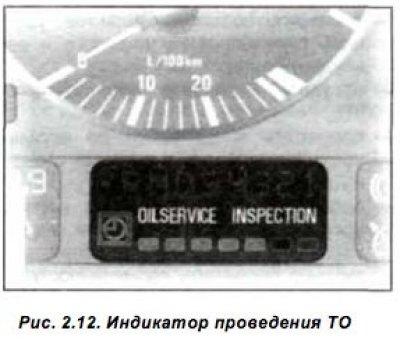
The service interval indicator has five green, one yellow and one red indicator (LED) and a clock symbol indicating the need to change the brake fluid. Each time the engine is started, the panel lights up for a few seconds, showing one of the following indications:
- "Oilservis" - service required for 10,000 km mileage interval;
- "Inspection I" (TO-I) - service required at intervals of 24 months or every 20,000 km;
- "Inspection II" (TO-II) - service required at 24 month intervals, regardless of mileage.
The reminder is given in advance, by reducing the number of green lights, when the next maintenance is approaching. The yellow light appears in combination with the message "Oilservis" or "Inspection", warning about the next scheduled maintenance. The red light indicates that the scheduled maintenance has been missed.
The frequency of maintenance is set depending on the load, and practically covers the entire range of operating conditions. If the car is used less than 10,000 km per year, it is recommended to change the engine oil annually, due to its natural aging, independent of the load, and once every two years it is necessary to undergo maintenance according to the regulations "Oilservice".
It is necessary to take into account the intensity and conditions of vehicle use, because a mileage of 100,000 km over short distances in heavy city traffic cannot be equated with a mileage of 100,000 km over long distances.
Full scope of work on conducting inspections according to regulations "Inspection" provides for the following scope of checks.
Engine compartment:
- read information from the fault memory, if there is code "54C6" replace the oil in the transfer case;
- change engine oil and oil filter;
- replace spark plugs;
- check the condition of the hoses, the level of coolant and its concentration;
- reset the upcoming maintenance indicator;
- check and bring the fluid level in the windshield washer system up to normal;
- check and bring the fluid level in the power steering system up to normal, visually check for leaks;
- change the brake fluid according to the indications on the instrument panel, but not less than once every two years;
- replace the air filter element.
Chassis:
- check the front and rear service brake pads;
- check the steering play;
- check the steering rods and joints, steering gear;
- visually check the tightness of the gearbox;
- change oil in manual transmission;
- change oil in RK;
- visually check the condition of the pipelines and hoses, their tightness, fastening and location;
- visually check the condition of the exhaust system, its tightness, fastening and location;
- visually check the condition of the brake system pipes, their tightness, fastening and location;
- check the tightness of the axle shaft covers;
- check the travel of the parking brake lever;
- check the tire pressure and their condition (wear).
Body and electrical equipment:
- check lighting equipment;
- check windshield wipers and washers, nozzle adjustment;
- check the condition of the seat belts;
- check the condition and functionality of the locking mechanisms, lubricate them;
- check battery condition;
- check the condition of the heating and air conditioning system, replace the microfilter;
- check the body and its bottom for corrosion and damage.
Final inspection of the following systems:
- brake;
- steering;
- clutches;
- shock absorbers;
- control and signal lamps;
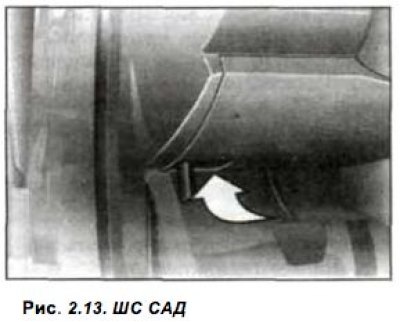
- automatic diagnostics. You should check the fault registration memory in the engine management system by connecting to the loop (Fig. 2.13) of the automatic diagnostics system (ADS), which is located on the lower left side of the instrument panel, opposite the driver's seat under the cover. There is an inscription "OBD" on the cover.
[The website served as the basis for the text: BMWman.ru]