



Table of contents: Maintenance performed according to…↓ Schedule of current maintenance ↓ Monthly or every 1500 km (whichever…↓ Annually or every 15,000 km ↓ Every 2 years or 20,000 km ↓ Every 2 years regardless of the…↓ Every 4 years or 40,000 km…↓ Every 4 years, regardless of the…↓ Every 150,000 km ↓
- Home
- BMW 3 Series
- E46
- General information
- Maintenance
- Routine car maintenance
Routine car maintenance (BMW 3 Series E46)
As you service your vehicle, you'll soon discover that you can - and should - combine many procedures because of the similarities in the steps involved. For example, if the vehicle is raised off the ground to lubricate the chassis, you should inspect the exhaust system, suspension, steering system, and fuel system while you're underneath the vehicle. If the wheels are off for other work, you might want to check the brakes. Finally, suppose you have to borrow or rent a torque wrench. Even if you only need it to tighten the spark plugs, you might as well check the torque on as many critical nuts and bolts as you have time for.
The first step in carrying out a vehicle maintenance program is self-preparation. Carefully study the materials of all Sections related to the upcoming procedures, then prepare all the necessary materials, equipment and tools. If you are afraid of encountering problems when performing some specific work, consult a specialist.
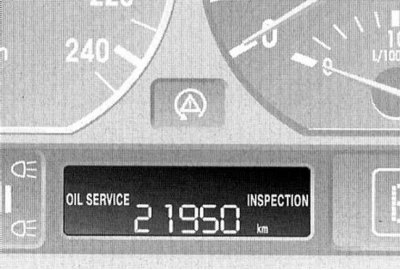
Scheduled maintenance due date indicator
The mileage remaining until the next maintenance is due is indicated to the driver in ignition key position 1 by the service interval indicator for a few seconds after the engine is started. Additionally, the inscriptions may light up "OIL SERVICE", "INSPEKTION", and a clock symbol indicating that the next oil change is not necessary. The minus sign "-" before the message indicates that the service period has exceeded the specified kilometers.
As a factor taken into account when calculating service cycles, the microprocessor, in addition to the mileage traveled, also takes into account the operating conditions of the vehicle, such as short or long distance driving or the driver's driving style.
At the service station, after an oil change or after maintenance, the service interval indicator is reset. To reset the indication, a special electronic device is required, which is sold at BMW service stations and by KLANN under the number KL-0585-10. Authorized BMW service stations must reset the interval indicator data free of charge at the owner's request, even if the maintenance was performed by the owner himself.
The suggested recommendations assume that the vehicle is serviced by the owner himself, as opposed to work performed at a BMW dealership service station. The service intervals for the BMW 3 Series depend on the conditions in which the vehicle is used. Although this schedule is based on the manufacturer's recommendations, the intervals between most procedures can be shortened at the owner's discretion, for example, checking and changing lubricants and fluids should be performed at intervals that ensure maximum service life for the engine or drive. In addition, if the owner is interested in maintaining the vehicle in a state of maximum readiness for possible resale, many procedures can be performed more frequently. We welcome such an initiative.
Initial servicing and inspection of a new car must be carried out at a service station of the representative office of the company, in order to fulfill the conditions of the warranty obligation. In most cases, such inspection is free of charge (for further information, please contact the company's representative office).
Work carried out as part of maintenance "OIL service" (A message lights up on the dashboard after the engine starts "engine OIL service").
Under severe operating conditions, in particular when driving in the urban cycle and on short highways, frequent travel in mountainous areas, when transporting a trailer and in high dust conditions, the service interval should be halved.
All weekly checks, plus:
Work carried out as part of maintenance "INSPEKTION SERVICE I" (On the dashboard, after starting the engine, a message appears "Inspektion I").
All of the above, plus:
The clock symbol lights up on the instrument panel.
The first time after 3 years, then every 2 years: Perform a memory reading of electronic system faults, check of idle speed, ignition timing and CO content.
Work carried out as part of maintenance "INSPEKTION SERVICE II" (On the dashboard, after starting the engine, a message appears "Inspektion II").
All of the above, plus:
(The text is based on materials from the website: «bmwman.ru»)
The first step in carrying out a vehicle maintenance program is self-preparation. Carefully study the materials of all Sections related to the upcoming procedures, then prepare all the necessary materials, equipment and tools. If you are afraid of encountering problems when performing some specific work, consult a specialist.
Maintenance performed according to the service interval indicator on the instrument panel
Scheduled maintenance due date indicator
The mileage remaining until the next maintenance is due is indicated to the driver in ignition key position 1 by the service interval indicator for a few seconds after the engine is started. Additionally, the inscriptions may light up "OIL SERVICE", "INSPEKTION", and a clock symbol indicating that the next oil change is not necessary. The minus sign "-" before the message indicates that the service period has exceeded the specified kilometers.
As a factor taken into account when calculating service cycles, the microprocessor, in addition to the mileage traveled, also takes into account the operating conditions of the vehicle, such as short or long distance driving or the driver's driving style.
At the service station, after an oil change or after maintenance, the service interval indicator is reset. To reset the indication, a special electronic device is required, which is sold at BMW service stations and by KLANN under the number KL-0585-10. Authorized BMW service stations must reset the interval indicator data free of charge at the owner's request, even if the maintenance was performed by the owner himself.
To ensure optimum engine performance, it is recommended that all checks be carried out at a BMW service station to be able to read the contents of the fault memory of the self-diagnosis system. Refer to Section Troubleshooting. When operating the engine management system, faults may occur that are not noticeable to the driver and are automatically ignored by the emergency operation program. As a result, the engine operates in a non-optimal mode, which, for example, leads to increased fuel consumption. Such a fault is recorded in the fault memory.
Schedule of current maintenance
The suggested recommendations assume that the vehicle is serviced by the owner himself, as opposed to work performed at a BMW dealership service station. The service intervals for the BMW 3 Series depend on the conditions in which the vehicle is used. Although this schedule is based on the manufacturer's recommendations, the intervals between most procedures can be shortened at the owner's discretion, for example, checking and changing lubricants and fluids should be performed at intervals that ensure maximum service life for the engine or drive. In addition, if the owner is interested in maintaining the vehicle in a state of maximum readiness for possible resale, many procedures can be performed more frequently. We welcome such an initiative.
Initial servicing and inspection of a new car must be carried out at a service station of the representative office of the company, in order to fulfill the conditions of the warranty obligation. In most cases, such inspection is free of charge (for further information, please contact the company's representative office).
Monthly or every 1500 km (whichever comes first)
- Check the engine oil level (Section Checking fluid levels).
- Check the engine coolant level (Section Checking fluid levels).
- Check the brake/clutch fluid level (Section Checking fluid levels).
- Check the windshield washer fluid level (Section Checking fluid levels).
- Check the condition and pressure of your tires (Section Checking the condition of tires and pressure in them. Designation of tires and wheel disks).
Work carried out as part of maintenance "OIL service" (A message lights up on the dashboard after the engine starts "engine OIL service").
Under severe operating conditions, in particular when driving in the urban cycle and on short highways, frequent travel in mountainous areas, when transporting a trailer and in high dust conditions, the service interval should be halved.
Annually or every 15,000 km
All weekly checks, plus:
- Replace the engine oil and oil filter (Section Changing engine oil and oil filter).
- Check the engine air filter element and replace it if dirty (Section Replacing the air filter element).
- Check the thickness of the front and rear brake pads (Section Brake system checks).
- Check the travel of the parking brake lever and adjust if necessary (Section Brake system checks).
- Replace the cabin air fine filter element (Section Replacing the cabin air filter element).
- Reset the service interval indicator to its original position (please refer to the materials presented above).
Work carried out as part of maintenance "INSPEKTION SERVICE I" (On the dashboard, after starting the engine, a message appears "Inspektion I").
Every 2 years or 20,000 km
All of the above, plus:
Engine and exhaust system
- First time after 3 years, then every 2 years: Check the exhaust system, idle speed, CO concentration, ignition timing, read the contents of the fault memory (STO, Specifications).
- Check the condition of the V-belt (Section Checking the condition of ribbed drive belts).
- Check the level and frost resistance of the cooling system coolant. Check for leaks and clean the radiator grille from external contaminants (Section Checking the functioning of the cooling system and frost resistance of the coolant).
- Perform a visual inspection of the engine and engine compartment components for fluid leaks (Section Checking the condition and replacing the engine compartment hoses).
- Perform a visual inspection of the fuel system hoses and lines for leaks and fluid leaks (Section Checking the condition and replacing the engine compartment hoses).
- Check the exhaust system for external damage (Section Checking the condition of the exhaust system).
Clutch, manual transmission, automatic transmission and final drive
- Check the hoses, lines and clutch drive connections for leaks (Section Brake system checks).
- Check the gearbox, rear axle main gear, wheel drive shafts, and joint protective boots for leaks of lubricants and fluids, and damage (Sections Checking the oil level in a manual transmission, Checking the condition of suspension and steering components).
- Check the drive shaft joint seals (Section Checking the condition of the protective covers of the drive shafts).
Front suspension and steering
- Check the steering rod ends for play, reliability of fastening, and damage to the dust boots (Section Checking the condition of suspension and steering components).
- Check the steering rack protective boots for damage and leaks (Section Checking the condition of suspension and steering components).
- Check the power steering fluid level and top up if necessary (Section Checking the power steering fluid level). Check the steering gear, pump, as well as pipes and connections for fluid leaks.
Body, equipment
- Check the underbody protection and body paintwork for corrosion and damage (Chapter Body and Section Visual inspection of the body and its bottom).
- Perform a visual inspection of damage to security systems (belts and pillows) (Chapter Checking seat belts).
Brakes, tires, wheels
- Remove the wheels, clean and lubricate the centering belt. Rotate and, if necessary, replace the wheels. When installing, tighten the wheel mounting bolts crosswise to the torque specified in the Specifications (Section Wheel rotation and replacement).
- Check tread depth, tire pressure, tire wear and damage (including spare tire) (Chapter Checking the condition of tires and pressure in them. Designation of tires and wheel disks).
- Check the thickness of the front and rear brake pads, the condition of the brake disc surface. When replacing the rear brake pads on a scheduled basis, check the thickness of the parking brake pads at the same time (Section Brake system checks).
- Check the travel of the parking brake lever and adjust if necessary (Section Brake system checks).
- Check the brake system lines, hoses, brake cylinders and connections for leaks and damage. Add brake fluid if necessary. (Sections Brake system checks, Checking fluid levels).
Electrical equipment
- Check the operation of all power consumers, controls and indicators.
- Check and adjust the headlight beam if necessary.
- Check the wiper blades for wear. If the blades do not move evenly, check the installation angles (Section Checking the condition, replacing the brushes and adjusting the angle of the windshield wipers).
- Check the operation of the windshield and headlight washers - installation of nozzles, patency of the system tubes.
- Check the battery electrolyte level. Check the reliability of the terminals and holders (Section Checking battery condition, care and charging).
- Reset the service interval indicator (please refer to the materials presented above).
Every 2 years regardless of the mileage traveled
The clock symbol lights up on the instrument panel.
- Replace the brake fluid (Section Replacing brake fluid).
The first time after 3 years, then every 2 years: Perform a memory reading of electronic system faults, check of idle speed, ignition timing and CO content.
Work carried out as part of maintenance "INSPEKTION SERVICE II" (On the dashboard, after starting the engine, a message appears "Inspektion II").
Every 4 years or 40,000 km (whichever comes first)
All of the above, plus:
- Petrol engines: Replace spark plugs (Section Checking and replacing spark plugs).
- Replace the element and wash the air filter housing (Section Replacing the air filter element).
- Diesel engines: Replace the fuel filter (Section Checking the fuel system, replacing the fuel filter. Operation of a diesel model in winter conditions).
- Lubricate door latches and lock cylinders with a general-purpose lubricant (Section Lubrication of door hinges and locks).
- Replace the battery of the remote control key fob for the single lock if necessary (Section Replacing the remote control key battery).
Every 4 years, regardless of the mileage traveled
- Replace the cooling system fluid).
Every 150,000 km
- Replace oxygen sensors (lambda probes).
(The text is based on materials from the website: «bmwman.ru»)
This article is available at russian, bulgarian, belarusian, ukrainian, serbian, croatian, romanian, polish, slovak, hungarian
Article verified: Sevastyanov Nikolay
Share information:
Previous articles
БМВ E46: Maintenance
Next articles
Similar articles on other types of BMW cars:
Routine maintenance BMW 5 Series E34 (1988-1996)
Routine car maintenance BMW 5 Series E28 (1981-1988)
Vehicle maintenance plan BMW 7 Series E32 (1986-1994)
Schedule of current maintenance BMW 7 Series E38 (1994-2001)
Maintenance upcoming indicator (MOT) BMW X3 E83 (2003-2010)
Carrying out maintenance work BMW X5 E53 (1999-2006)
Routine maintenance BMW 5 Series E34 (1988-1996)
Routine car maintenance BMW 5 Series E28 (1981-1988)
Vehicle maintenance plan BMW 7 Series E32 (1986-1994)
Schedule of current maintenance BMW 7 Series E38 (1994-2001)
Maintenance upcoming indicator (MOT) BMW X3 E83 (2003-2010)
Carrying out maintenance work BMW X5 E53 (1999-2006)
Link in different formats to this page
Visitor comments
No comments yet
- General information
- Manual
- Maintenance
- Power unit
- Engine repair
- Cooling system
- Power system (gasoline)
- Injection system (gasoline)
- Fuel system (diesel)
- Exhaust system
- Ignition system
- Charge and launch systems
- Transmission
- Car gearbox
- Clutch and drive shafts
- Chassis
- Brake system
- Suspension front and rear
- Steering
- Body
- Body care and repair
- Exterior
- Interior
- Electrical equipment
- Troubleshooting
- Lighting and signaling
- Equipment and devices
- Heater and air conditioner
- Electrical circuits
- General information
- Manual
- Repair on the road
- Weekly checks
- Maintenance
- Troubleshooting
- Power unit
- 4 cylinder engines
- 6 cylinder engines
- Engine overhaul
- Cooling and heating
- Fuel and exhaust system
- Starting and charging system
- Ignition system
- Transmission
- Clutch
- Mechanical gearbox
- Automatic gearbox
- Cardan and drive shafts
- Chassis
- Brake system
- Wheel suspension
- Steering
- Body
- Exterior
- Interior
- Electrical equipment
- Equipment and devices
- Electrical circuits
- General information
- Maintenance
- Power unit
- Engine repair
- Cooling system
- Ignition system
- Supply system
- Fuel injection system
- Exhaust system
- Transmission
- Clutch
- Car gearbox
- Front and rear axle
- Chassis
- Steering
- Brake system
- Body
- Exterior
- Interior
- Electrical equipment
- Heating system
- Equipment and devices
- Power devices
- Electrical circuits
- Power unit
- M10/M20 engine
- M40 engine
- Ignition system
- Lubrication system
- Cooling system
- Supply system
- Fuel injection
- Exhaust system
- Transmission
- Clutch
- Manual gearbox
- Front axle
- Rear axle
- Chassis
- Steering
- Brake system
- Body
- Exterior
- Interior
- Electrical equipment
- Heating system
- Equipment and devices
- Electrical circuits
- General information
- Specifications
- Operation and maintenance
- 4-cylinder engine
- Engine repair
- Cooling and lubrication system
- Supply system
- Ignition system
- 6-cylinder engine
- Engine repair
- Cooling and lubrication system
- Supply system
- Fuel injection system
- Ignition system
- Transmission
- Clutch
- 4-speed manual gearbox
- 5-speed manual gearbox
- Automatic gearbox
- Cardan and rear axle
- Chassis
- Steering
- Front suspension
- Rear suspension
- Brake system
- Electrical equipment
- Equipment and devices
- Electrical circuits