
Table of contents: Check and care ↓ Charger ↓
- Home
- BMW 3 Series
- E46
- General information
- Maintenance
- Checking battery condition, care and charging
Checking battery condition, care and charging (BMW 3 Series E46)
Every 2 years, regardless of mileage.
Tools and materials needed for battery maintenance
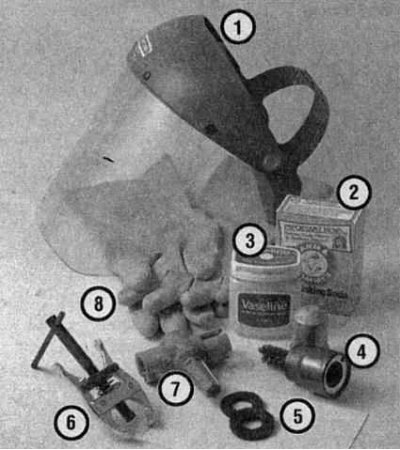
1 - Face shield/safety glasses - when brushing away traces of corrosion, particles of crystallized acid can easily get into the eyes
2 - Baking soda - an aqueous solution of baking soda can be used to neutralize corrosion
3 - acid-free petroleum jelly - a layer of petroleum jelly applied to the battery terminals will help prevent corrosion
4 - Terminal/Wire Tip Stripper - This wire brush stripper will remove all traces of corrosion from battery terminals and wire tips
5 - impregnated felt washers - installing these washers on each battery terminal directly under the wire tips will help prevent corrosion
6 - Puller - Sometimes the wire ends are very difficult to remove from the battery terminals, even after completely loosening the nuts/bolts. This tool will help you remove the ends vertically upwards without damage
7 - Terminal/Wire Terminal Stripper - Another type of stripping tool, a slightly modified version of item 4, that performs the same functions
8 - rubber gloves - another means of protection when working with a battery; remember that there is acid in the battery!
Check and care
When working with a battery, certain safety precautions must be taken. Battery cells always contain highly flammable hydrogen, so never allow a lit cigarette or other open flame to approach the battery. Battery electrolyte is a sulfuric acid solution, which causes serious injuries if it gets into your eyes or on exposed areas of the body. In addition, the acid corrodes clothing and paints. When disconnecting a battery, always disconnect the negative cable first and reconnect it last!
1. Battery maintenance is a very important procedure to avoid stopping on the road due to battery discharge. Several tools are required to perform the maintenance procedure. On cars with a 4-cylinder petrol engine the battery is located in the engine compartment, on vehicles with diesel and 6-cylinder petrol engine the battery is located in the trunk at the back on the right under the cover.
2. Before starting any maintenance procedure, always turn off the engine and all electrical equipment first, then disconnect the negative battery cable.
If your vehicle's radio is equipped with an anti-theft system, make sure you enter the correct code before disconnecting the battery.
3. Your vehicle is equipped with a maintenance-free battery. You can remove the can lids and add distilled water. Some models may be equipped with maintenance-free batteries that are completely sealed.
4. Remove the caps and check the electrolyte level in each battery can. It should be above the plates. Usually there is a level indicator on each can. If the electrolyte level is below the norm, add only distilled water and then close the can caps.
Overfilling the cells may cause electrolyte to spill during boost charging, causing corrosion and damage to components near the battery.
5. If your vehicle's positive battery terminal and cable clamp are equipped with a rubber protector, make sure it is not torn or damaged. It should completely cover the terminal.
6. It is necessary to periodically inspect the external condition of the battery for damage such as cracks in the casing.
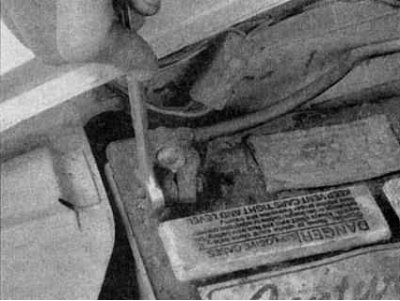
7. Check that the battery cable clamps are tight enough to ensure a good electrical connection. Check each wire along its entire length for cracks and frayed insulation and wires.
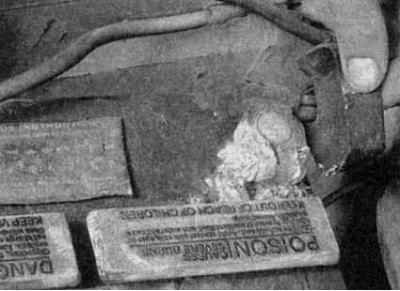
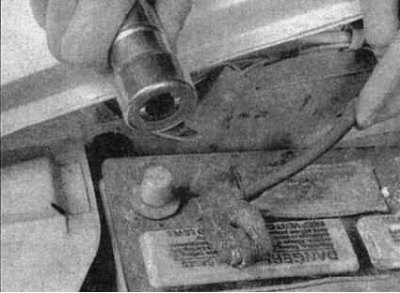
8. If traces of corrosion are detected (usually presenting as a loose white coating) disconnect the wires from the terminals, clean them with a special brush, and reconnect them. The occurrence of corrosion can be minimized by installing specially treated washers, which are available from auto parts stores, or by coating the terminals and wire clamps with a layer of acid-free petroleum jelly or a suitable lubricant after they are connected.
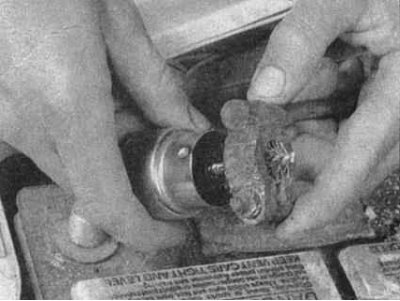
9. Make sure that the battery tray is in good condition and that the clamp bolt is securely tightened. If the battery has been removed from the tray (refer to Section Removal and installation the battery), make sure that there are no parts or other foreign objects on it during installation. When clamping the fastening clamp, do not tighten its bolt too tightly.
10. Traces of corrosion from the tray, battery case and surrounding surfaces can be removed using a solution of baking soda and water. Apply the mixture with a small brush, let it sit and then rinse with plenty of clean water.
11. Metal surfaces of the vehicle that have been subject to corrosion should be coated with a zinc-based primer and then painted.
Charger
Manufacturers recommend removing the battery from the vehicle to charge it, as the gas released during this procedure can damage the vehicle's painted surfaces or interior, depending on the battery's location. Rapid charging with the battery cables connected can cause damage to the vehicle's electrical system.
13. Remove all caps from the battery jars (if they exist) and cover the holes with a clean rag to prevent electrolyte from spilling. Disconnect the negative battery cable and connect the charger cables to its terminals (positive to positive, negative to negative), then plug the charger into the power outlet. If it has a switch, make sure it is set to "12 volts".
If your vehicle's radio is equipped with an anti-theft system, make sure you enter the correct code before disconnecting the battery.
14. If you are using a charger with a current greater than two amps, check the battery regularly while charging to ensure that it has not overheated. Using a slow charger, you can safely leave the battery to charge overnight after checking regularly for the first two hours. Certain precautions may be required when charging maintenance-free batteries (for example, using a very low current charger). There may be a warning label on this battery, but if there isn't, consult your BMW dealer or an electrician at your local auto repair shop.
15. If the battery jars have removable caps, check the specific gravity of the electrolyte with a hydrometer every hour during the last few hours of the charge cycle. Inexpensive hydrometers are available at auto parts stores - follow the instructions on the package when using them. The battery is considered charged if the specific gravity of the electrolyte does not change over two hours and the electrolyte bubbles freely in the jars. The specific gravity of the electrolyte in the individual jars should be nearly the same. If this is not the case, one or more of the battery jars is bad and should be replaced.
16. Some maintenance-free batteries have a built-in hydrometer at the top, which has a window - a color indicator of the battery's charge level. Usually, a brightly colored window means the battery is fully charged, and a dark color indicates that additional charging is needed. More precise instructions are provided in the battery manufacturer's instructions.
17. If the battery is sealed and does not have a built-in hydrometer, you can check the state of charge by connecting a digital voltmeter to the battery terminals. A fully charged battery will show 12.6 volts or more.
This article is available at russian, bulgarian, belarusian, ukrainian, serbian, croatian, romanian, polish, slovak, hungarian
Article verified: Sevastyanov Nikolay
Share information:
Previous articles
БМВ E46: Maintenance
Next articles
Similar articles on other types of BMW cars:
Checking battery condition, care and charging BMW 5 Series E28 (1981-1988)
Checking the technical condition of the cylinder head BMW 5 Series E12 (1972-1981)
Checking the condition and replacing hoses and tubes in the engine… BMW 7 Series E38 (1994-2001)
Starting the engine from an auxiliary battery BMW 7 Series E32 (1986-1994)
Identifying engine faults by the condition of spark plugs BMW X3 E83 (2003-2010)
Battery — care and charging BMW X5 E53 (1999-2006)
Checking battery condition, care and charging BMW 5 Series E28 (1981-1988)
Checking the technical condition of the cylinder head BMW 5 Series E12 (1972-1981)
Checking the condition and replacing hoses and tubes in the engine… BMW 7 Series E38 (1994-2001)
Starting the engine from an auxiliary battery BMW 7 Series E32 (1986-1994)
Identifying engine faults by the condition of spark plugs BMW X3 E83 (2003-2010)
Battery — care and charging BMW X5 E53 (1999-2006)
Link in different formats to this page
Visitor comments
No comments yet
- General information
- Manual
- Maintenance
- Power unit
- Engine repair
- Cooling system
- Power system (gasoline)
- Injection system (gasoline)
- Fuel system (diesel)
- Exhaust system
- Ignition system
- Charge and launch systems
- Transmission
- Car gearbox
- Clutch and drive shafts
- Chassis
- Brake system
- Suspension front and rear
- Steering
- Body
- Body care and repair
- Exterior
- Interior
- Electrical equipment
- Troubleshooting
- Lighting and signaling
- Equipment and devices
- Heater and air conditioner
- Electrical circuits
- General information
- Manual
- Repair on the road
- Weekly checks
- Maintenance
- Troubleshooting
- Power unit
- 4 cylinder engines
- 6 cylinder engines
- Engine overhaul
- Cooling and heating
- Fuel and exhaust system
- Starting and charging system
- Ignition system
- Transmission
- Clutch
- Mechanical gearbox
- Automatic gearbox
- Cardan and drive shafts
- Chassis
- Brake system
- Wheel suspension
- Steering
- Body
- Exterior
- Interior
- Electrical equipment
- Equipment and devices
- Electrical circuits
- General information
- Maintenance
- Power unit
- Engine repair
- Cooling system
- Ignition system
- Supply system
- Fuel injection system
- Exhaust system
- Transmission
- Clutch
- Car gearbox
- Front and rear axle
- Chassis
- Steering
- Brake system
- Body
- Exterior
- Interior
- Electrical equipment
- Heating system
- Equipment and devices
- Power devices
- Electrical circuits
- Power unit
- M10/M20 engine
- M40 engine
- Ignition system
- Lubrication system
- Cooling system
- Supply system
- Fuel injection
- Exhaust system
- Transmission
- Clutch
- Manual gearbox
- Front axle
- Rear axle
- Chassis
- Steering
- Brake system
- Body
- Exterior
- Interior
- Electrical equipment
- Heating system
- Equipment and devices
- Electrical circuits
- General information
- Specifications
- Operation and maintenance
- 4-cylinder engine
- Engine repair
- Cooling and lubrication system
- Supply system
- Ignition system
- 6-cylinder engine
- Engine repair
- Cooling and lubrication system
- Supply system
- Fuel injection system
- Ignition system
- Transmission
- Clutch
- 4-speed manual gearbox
- 5-speed manual gearbox
- Automatic gearbox
- Cardan and rear axle
- Chassis
- Steering
- Front suspension
- Rear suspension
- Brake system
- Electrical equipment
- Equipment and devices
- Electrical circuits