
Cars Mazda Cars Mitsubishi Cars Toyota Cars Chevrolet Cars AvtoVAZ Cars Kia Cars Nissan
English Русский
Български
Беларускі
Український
Српски
Hrvatski
Română
Polski
Slovenský
Magyar
| Articles | Contacts | Sitemap |   
BMWman.ru


3 series   5 series   7 series   BMW X3   BMW X5   BMW X6

E38 (1994-2001) E32 (1986-1994)
  • Home
  • BMW 7 Series
  • E32
  • General information
  • Care and maintenance
  • Starting the engine from an auxiliary battery

Starting the engine from an auxiliary battery (BMW 7 Series E32)

            0

Warning: If you do not follow the instructions below, there is a risk of electrolyte spilling out of the battery. In addition, there is a risk of damage due to an explosion of the battery or failure of parts of the electrical system.


Cross-section of auxiliary wires for starting the engine for gasoline and diesel engines. Immediately purchase wires of a larger cross-section, as they are more universal.

Both batteries must be rated for 12 V.

A discharged battery can freeze already at -10°C. Before connecting auxiliary wires, a frozen battery must thaw.

The discharged battery must be properly connected to the vehicle's on-board network.

Check the electrolyte level in the discharged battery; add distilled water if necessary.

The cars must be positioned so that they do not touch each other. Otherwise, the battery may leak when the positive contacts are connected.

Apply the parking brakes on both vehicles. Set the transmission to neutral (automatic transmission - range P).

Turn off all current consumers. The engine of the "donor" car should idle during the start-up process. This prevents the generator from failing due to voltage surges during start-up.

During the starting process, do not bring an open flame or a burning cigarette close to the battery to prevent the gases coming out of the battery from exploding.

Make sure that auxiliary wires are not damaged by rotating parts such as a fan.

Connect the auxiliary wires in the following order. 12. Connect the red wire to the positive terminal in the engine compartment of the car with the discharged battery, having first folded back the protective cover. If this is a car of another model, then connect the wire to the positive terminal of its battery.
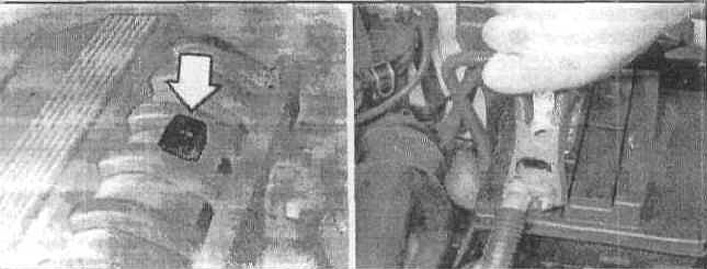


Connect the auxiliary wires in the following order. 12. Connect the red wire to the positive…


13. Connect the other end of the red wire to the positive contact of the charged battery.

14. Connect the black wire to the ground point on the front shock absorber mount of the vehicle with a charged battery. If the vehicle is a different model, connect the wire to the negative terminal of the battery.
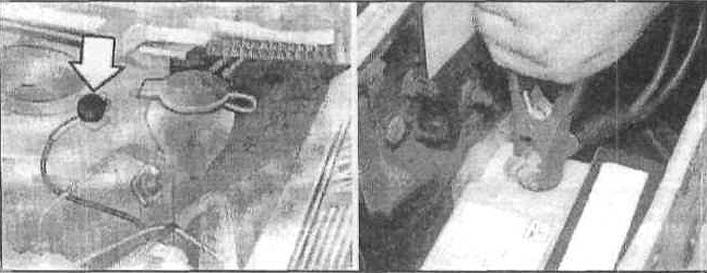
14. Connect the black wire to the ground point on the front shock absorber mount of the vehicle…


4. Connect the other end of the black wire to the same ground point of the car with the discharged battery. If this is a car of a different model, then connect the wire to a reliable ground, for example, to a metal part on the cylinder block. Never connect the wire to the negative terminal of the discharged battery, because if sparks appear, the battery may explode due to the ignition of the detonating gas inside it.


Caution: The clamps of the auxiliary wires must not touch each other, and the clamps of the positive wire must not touch.


Connection points on cars


Start the engine of the car with the discharged battery and let it run. When starting, do not turn on the starter for more than 10 seconds, because the clamps and the auxiliary wires themselves heat up due to the high current. Between attempts to start, pause for at least 30 seconds.

Do not lean over the AB - it is dangerous.
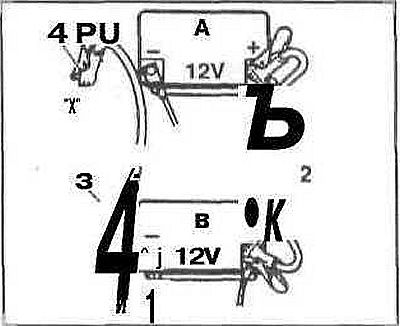
1 - positive contact of discharged battery (A);
2 - positive contact of the AB "donor" (B);
3 - negative contact of the AB "donor" (B);
4 — grounding point on a vehicle with a discharged battery.


Caution: On BMW vehicles, turn on the headlights, rear window defroster and heater blower before disconnecting the auxiliary wires to avoid voltage surges from the voltage regulator.


After starting the engine, disconnect the wires in the reverse order, i.e. first the black wire from the car with the discharged battery, then from the donor battery, then the red wire from the donor battery and from the discharged battery.

This article is available at russian, bulgarian, belarusian, ukrainian, serbian, croatian, romanian, polish, slovak, hungarian
Article verified: Sevastyanov Nikolay

Share information:
Previous articles
БМВ E32: Care and maintenance
Next articles

General description of the car
Vehicle Identification Numbers
Introduction to the BMW 7 Series E32 Manual
Towing a car
Lifting a car with a jack
Vehicle maintenance plan
Preventative maintenance when changing oil
Technical support


Similar articles on other types of BMW cars:
Starting the engine from an external battery BMW 3 Series E46 (1998-2006, petrol)
Starting the engine from an auxiliary power source BMW 3 Series E46 (1998-2006)
Engine fuel system diagram with Solex Zenith 35/40 INAT carburetor… BMW 5 Series E12 (1972-1981)
Jump starting the engine from another car's battery BMW 5 Series E39 (1995-2003)
Starting the engine from an external power source BMW X3 E83 (2003-2010)
Battery — care and charging BMW X5 E53 (1999-2006)
Link in different formats to this page


Visitor comments

No comments yet


How much 24 + 23 =


BMW E38 (1994-2001) 
  • General information
  • Introduction to guide
  • Manual
  • Maintenance
  • Power unit
  • Engine M60/1, M60/2 (petrol)
  • M62 engine (petrol)
  • M57 engine (diesel)
  • M67 engine (diesel)
  • Cooling system
  • Fuel system (petrol)
  • Fuel system (diesel)
  • Exhaust system
  • Ignition and control systems
  • Charge and launch systems
  • Transmission
  • Clutch
  • Mechanical gearbox
  • Automatic gearbox
  • Cardan and drive shafts
  • Chassis
  • Brake system
  • Front suspension
  • Rear suspension
  • Steering
  • Body
  • Exterior
  • Interior
  • Electrical equipment
  • Equipment and devices
  • Lighting
  • Heating and air conditioning
  • Electrical circuits
BMW E32 (1986-1994) 
  • General information
  • Care and maintenance
  • Power unit
  • Minor engine repair
  • Engine overhaul
  • Lubrication system
  • Cooling system
  • Ignition system
  • Supply system
  • Injection system (petrol)
  • Injection system (diesel)
  • Exhaust system
  • Transmission
  • Clutch
  • Manual gearbox
  • Automatic gearbox
  • Cardan gear
  • Rear axle and shafts
  • Chassis
  • Front suspension
  • Rear suspension
  • Steering
  • Wheels and tires
  • Brake system
  • Body
  • Body elements
  • Electrical equipment
  • Equipment and devices
  • Electrical circuits
BMWman.ru © 2017-2026 · Mobile version · News and articles · Sitemap: EN BG BY UA RS HR RO PL SK HU · Feedback · Site search
3er E21 · 3er E30 · 3er E36 · 3er E46 [petrol] · 3er E46 · 5er E12 · 5er E28 · 5er E34 · 5er E39 · 7er E32 · 7er E38 · X3 E83 · X5 E53 ·
This site uses cookies 🍪, without them some features simply would not work.