
- Home
- BMW 7 Series
- E32
- General information
- Care and maintenance
- General description of the car
General description of the car (BMW 7 Series E32)
BMW 7 Series cars are available with different engine concepts: 6-cylinder petrol engine, 6-cylinder turbodiesel, 8-cylinder V-engine and 12-cylinder V-engine.
The power unit is located longitudinally in the engine compartment and can only be pulled out upwards using a suitable crane or lifting device.
6-cylinder petrol engines are designated MZO or M52. The cylinder head and cylinder block are made of aluminum alloy. This alloy provides better thermal conductivity and less weight compared to conventional cast iron. This improves cooling and fuel economy. The cylinder head with 4 valves per cylinder has an adjustable camshaft for the intake valves (vANOS designation according to BMW specification).
The 725tds model is equipped with a 6-cylinder M51 turbodiesel with a working volume of 2.5 liters. The cylinder block is made of gray cast iron, the cylinder head is made of light alloy.
The cylinder block contains the cylinder bores. If there is severe wear or scratches on the cylinder walls, the cylinders can be honed in a workshop or reground. After this, you will need to install pistons of a repair size.
The cylinder head on all engines is made according to the cross-flow principle. This means that the fresh fuel-air mixture enters one side of the cylinder head, and the exhaust gases exit on the other side of the head. Using this principle ensures faster gas exchange. At the top of the cylinder head is the camshaft/shafts. The diesel engine has only one camshaft. Petrol engines with 4 valves per cylinder have 2 camshafts, one of which drives only the intake valves, and the other - the exhaust valves. Just like on a diesel engine, the camshafts are driven by a roller chain. The intake and exhaust valves of modern engines are equipped with maintenance-free hydraulic tappets. On these engines, valve clearance adjustment is not performed.
The 6-cylinder engines are equipped with a variable valve timing system on the camshaft, which is abbreviated as VANOS. When it is in operation, the camshaft for the intake valves rotates relative to the drive sprocket depending on the engine speed using an actuator, which ensures optimal valve timing. The actuator is controlled by the engine control unit, which opens and closes the oil injection valve.
The engine is lubricated by an oil pump, which in 6-cylinder petrol engines is located in the front of the oil pan and is driven by a chain from the crankshaft. In a diesel engine, the oil pump is located in the timing case cover on the crankshaft side and is connected to it by a gear transmission. The engine oil in the pan flows through holes and pipes to the crankshaft and camshaft bearings and into the cylinder holes.
The water pump is located in front of the cylinder block and its shaft is connected to the radiator fan via a viscous coupling at the appropriate temperature. The water pump is driven via a poly-V belt, which also drives the generator. It should be borne in mind that the cooling system is filled with a special cooling liquid (CL) all year round, which is an aqueous solution of antifreeze containing special anti-corrosion additives.
An electronic ignition and injection system is used to prepare the flammable petrol-air mixture, which ensures long-term low values of exhaust gas toxicity. The ignition system with separate ignition coils has no moving parts, so it works without wear. In a diesel engine, the fuel dosage is regulated by an electronic DDE device (digital diesel electronics).
Gasoline engines consume fuel with an octane rating of 95, but by adjusting the knocking by cylinders, it is possible to use other grades of gasoline. When using gasoline with an octane rating of 98, fuel consumption during normal operation decreases, and power increases. When using gasoline with an octane rating of 91, power decreases, and fuel consumption increases.
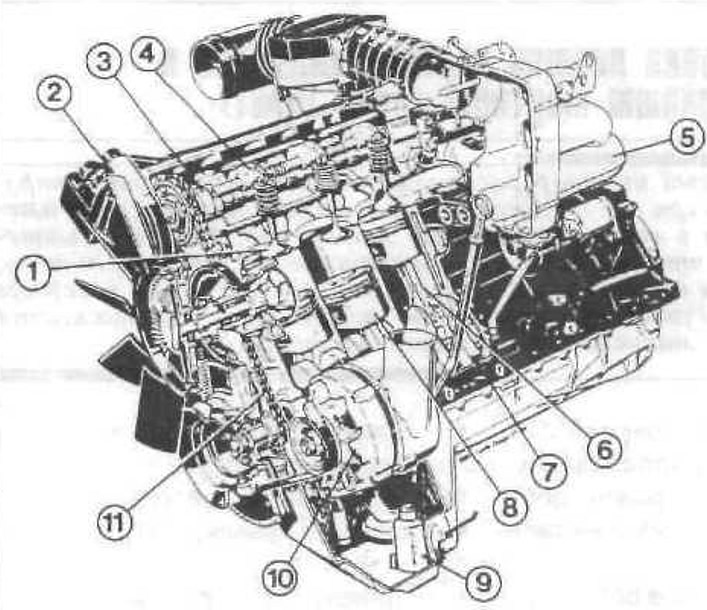
1 - inlet valve; 2 — ignition distributor; 3 — camshaft; 4 — rocker arm; 5 - intake manifold; 6 — connecting rod; 7 — crankshaft; 8 — piston; 9 — oil level sensor; 10 — generator; 11 — camshaft drive chain.
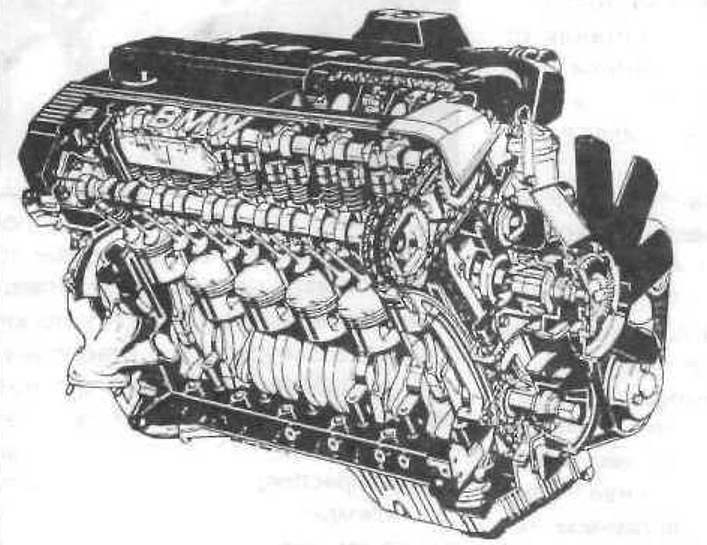
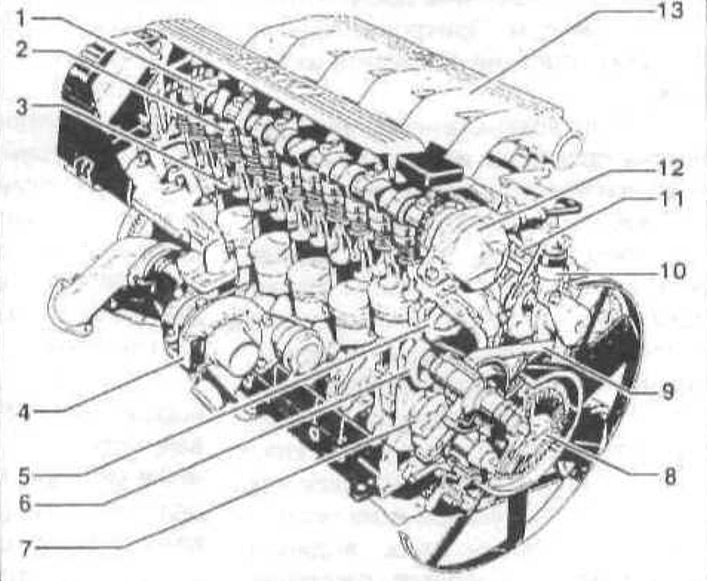
1 — camshaft; 2 — hydraulic pusher; 3 — valve; 4 - turbocharger (turbocharger); 5 - thermostat; 6 - water pump; 7 - oil pump; 8 — viscous coupling; 9 - poly V-belt; 10 — poly V-belt tensioner; 11 — timing chain; 12 - vacuum pump; 13 — intake manifold.
The power unit is located longitudinally in the engine compartment and can only be pulled out upwards using a suitable crane or lifting device.
6-cylinder petrol engines are designated MZO or M52. The cylinder head and cylinder block are made of aluminum alloy. This alloy provides better thermal conductivity and less weight compared to conventional cast iron. This improves cooling and fuel economy. The cylinder head with 4 valves per cylinder has an adjustable camshaft for the intake valves (vANOS designation according to BMW specification).
The 725tds model is equipped with a 6-cylinder M51 turbodiesel with a working volume of 2.5 liters. The cylinder block is made of gray cast iron, the cylinder head is made of light alloy.
The cylinder block contains the cylinder bores. If there is severe wear or scratches on the cylinder walls, the cylinders can be honed in a workshop or reground. After this, you will need to install pistons of a repair size.
The cylinder head on all engines is made according to the cross-flow principle. This means that the fresh fuel-air mixture enters one side of the cylinder head, and the exhaust gases exit on the other side of the head. Using this principle ensures faster gas exchange. At the top of the cylinder head is the camshaft/shafts. The diesel engine has only one camshaft. Petrol engines with 4 valves per cylinder have 2 camshafts, one of which drives only the intake valves, and the other - the exhaust valves. Just like on a diesel engine, the camshafts are driven by a roller chain. The intake and exhaust valves of modern engines are equipped with maintenance-free hydraulic tappets. On these engines, valve clearance adjustment is not performed.
The 6-cylinder engines are equipped with a variable valve timing system on the camshaft, which is abbreviated as VANOS. When it is in operation, the camshaft for the intake valves rotates relative to the drive sprocket depending on the engine speed using an actuator, which ensures optimal valve timing. The actuator is controlled by the engine control unit, which opens and closes the oil injection valve.
The engine is lubricated by an oil pump, which in 6-cylinder petrol engines is located in the front of the oil pan and is driven by a chain from the crankshaft. In a diesel engine, the oil pump is located in the timing case cover on the crankshaft side and is connected to it by a gear transmission. The engine oil in the pan flows through holes and pipes to the crankshaft and camshaft bearings and into the cylinder holes.
The water pump is located in front of the cylinder block and its shaft is connected to the radiator fan via a viscous coupling at the appropriate temperature. The water pump is driven via a poly-V belt, which also drives the generator. It should be borne in mind that the cooling system is filled with a special cooling liquid (CL) all year round, which is an aqueous solution of antifreeze containing special anti-corrosion additives.
An electronic ignition and injection system is used to prepare the flammable petrol-air mixture, which ensures long-term low values of exhaust gas toxicity. The ignition system with separate ignition coils has no moving parts, so it works without wear. In a diesel engine, the fuel dosage is regulated by an electronic DDE device (digital diesel electronics).
Gasoline engines consume fuel with an octane rating of 95, but by adjusting the knocking by cylinders, it is possible to use other grades of gasoline. When using gasoline with an octane rating of 98, fuel consumption during normal operation decreases, and power increases. When using gasoline with an octane rating of 91, power decreases, and fuel consumption increases.
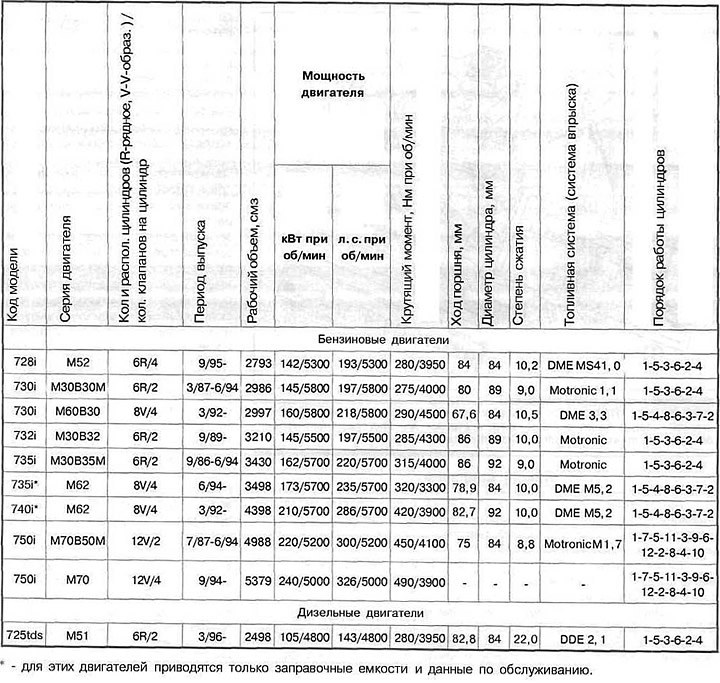
Main technical parameters of engines
Engine M30
1 - inlet valve; 2 — ignition distributor; 3 — camshaft; 4 — rocker arm; 5 - intake manifold; 6 — connecting rod; 7 — crankshaft; 8 — piston; 9 — oil level sensor; 10 — generator; 11 — camshaft drive chain.
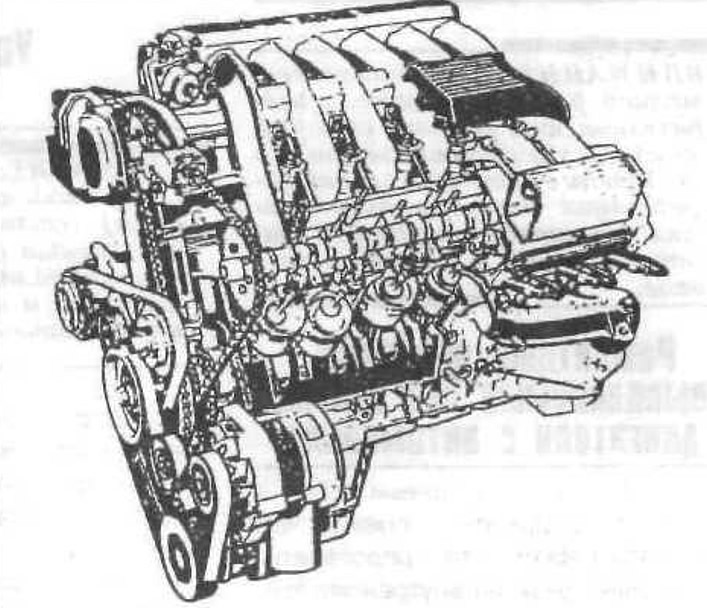
Engine M70 (twelve-cylinder engine)
Engine M52 (four valves per cylinder)
Engine M51 (725tds)
1 — camshaft; 2 — hydraulic pusher; 3 — valve; 4 - turbocharger (turbocharger); 5 - thermostat; 6 - water pump; 7 - oil pump; 8 — viscous coupling; 9 - poly V-belt; 10 — poly V-belt tensioner; 11 — timing chain; 12 - vacuum pump; 13 — intake manifold.
This article is available at russian, bulgarian, belarusian, ukrainian, serbian, croatian, romanian, polish, slovak, hungarian
Article verified: Sevastyanov Nikolay
Share information:
Previous articles
БМВ E32: Care and maintenance
Next articles
Similar articles on other types of BMW cars:
General information about engines BMW 3 Series E30 (1982-1994)
Gearbox. General information BMW 3 Series E36 (1990-2000)
General description of the heater and air conditioner BMW 5 Series E28 (1981-1988)
General information about the engine BMW 5 Series E12 (1972-1981)
Fuses — general description BMW X3 E83 (2003-2010)
General data of the BMW X5 E53 car BMW X5 E53 (1999-2006)
General information about engines BMW 3 Series E30 (1982-1994)
Gearbox. General information BMW 3 Series E36 (1990-2000)
General description of the heater and air conditioner BMW 5 Series E28 (1981-1988)
General information about the engine BMW 5 Series E12 (1972-1981)
Fuses — general description BMW X3 E83 (2003-2010)
General data of the BMW X5 E53 car BMW X5 E53 (1999-2006)
Link in different formats to this page
Visitor comments
No comments yet
- General information
- Introduction to guide
- Manual
- Maintenance
- Power unit
- Engine M60/1, M60/2 (petrol)
- M62 engine (petrol)
- M57 engine (diesel)
- M67 engine (diesel)
- Cooling system
- Fuel system (petrol)
- Fuel system (diesel)
- Exhaust system
- Ignition and control systems
- Charge and launch systems
- Transmission
- Clutch
- Mechanical gearbox
- Automatic gearbox
- Cardan and drive shafts
- Chassis
- Brake system
- Front suspension
- Rear suspension
- Steering
- Body
- Exterior
- Interior
- Electrical equipment
- Equipment and devices
- Lighting
- Heating and air conditioning
- Electrical circuits
- General information
- Care and maintenance
- Power unit
- Minor engine repair
- Engine overhaul
- Lubrication system
- Cooling system
- Ignition system
- Supply system
- Injection system (petrol)
- Injection system (diesel)
- Exhaust system
- Transmission
- Clutch
- Manual gearbox
- Automatic gearbox
- Cardan gear
- Rear axle and shafts
- Chassis
- Front suspension
- Rear suspension
- Steering
- Wheels and tires
- Brake system
- Body
- Body elements
- Electrical equipment
- Equipment and devices
- Electrical circuits