



The power unit is located longitudinally in the engine compartment and can only be removed upwards using a special lifting crane.
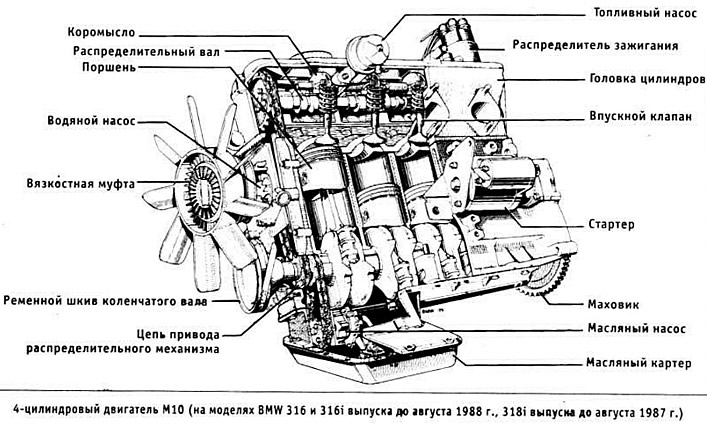
The engine block made of gray cast iron has cylinder bores. If there is significant wear or scratches on the walls, the cylinders can be honed, i.e. ground in a special workshop. After this, only pistons of increased dimensions should be installed. The lower part of the engine block contains the crankshaft, mounted on its bearings. The connecting rods, which connect with the pistons, are mounted on the crankshaft on plain bearings. The lower part of the engine is completed by an oil sump, which collects the oil needed for lubrication and cooling of the engine. The cylinder head, made of light metal alloys, is bolted on top of the engine block. It is aluminum, since this metal has higher thermal conductivity and lower specific gravity than cast iron.
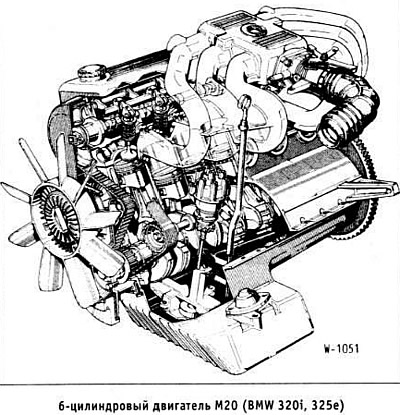
The cylinder head is designed according to the so-called cross-flow principle. This means that the freshly prepared air-fuel mixture enters the cylinder head on one side, while the burnt gases are expelled on the other side of the cylinder head. The cross-flow design allows for faster gas exchange. The camshaft is located at the top of the cylinder head. The camshaft is driven from the crankshaft via a single-row roller chain on a four-cylinder engine or via a toothed belt on a six-cylinder engine. The camshaft controls the operation of the V-shaped intake and exhaust valves.
Engine lubrication is provided by an oil pump mounted on the four-cylinder engine at the front of the engine crankcase. On a six-cylinder engine, the oil pump is located in the oil sump and is driven via an intermediate shaft. Oil from the oil sump flows through channels to the crankshaft and camshaft bearings, as well as to the working surfaces of the cylinders.
The water pump is located in the front part of the engine block. The water pump is driven by a V-belt, which also serves to drive the generator. An additional V-belt drives the power steering pump. It should be borne in mind that the cooling system should be filled with a mixture of antifreeze and anti-corrosion concentrate with lime-free water throughout the year.
A carburetor or fuel injection device is used to prepare the flammable air-fuel mixture and is generally maintenance-free.
The ignition spark is generated by a transistor ignition system, which maintains the ignition timing virtually constant. Depending on the engine type, the ignition distributor is mounted either on the left side of the engine block or on the rear side of the cylinder head. On models 320i, 323i, it is driven via an intermediate shaft. In turn, the intermediate shaft is driven from the crankshaft via a toothed belt. On models 316, 318i, and 325i, the ignition distributor is driven directly from the camshaft.
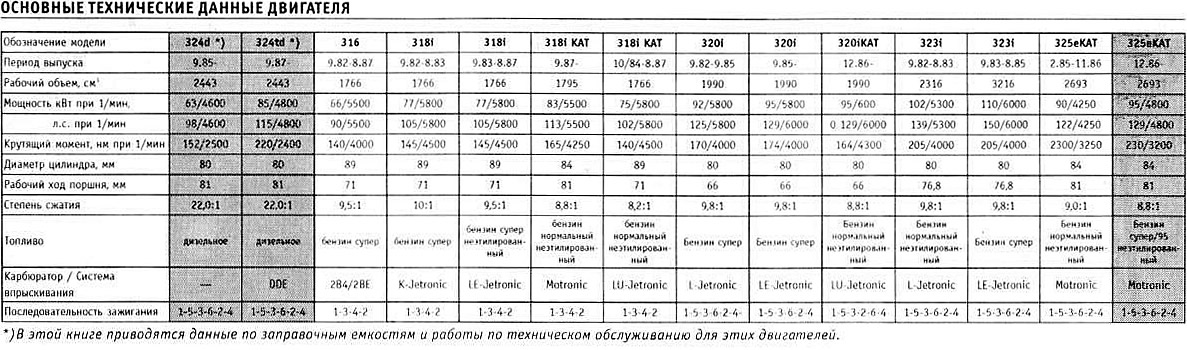
Основные технические данные двигателя