



If the following instructions are not followed, there is a risk of poisoning from leaking electrolyte. In addition, injury or damage to the vehicle may occur due to battery explosion.
- Do not allow the electrolyte to come into contact with your eyes, skin, fabric or paintwork. The electrolyte is aggressive. If the electrolyte comes into contact with your skin, immediately rinse the affected area thoroughly with clean water. If necessary, consult a doctor.
- Do not use open flames or objects that produce sparks near the battery, as flammable gases may be released from the battery.
- Use protective glasses.
- Be careful not to damage the jumper cables with rotating parts such as the radiator fan.
1. The cross-sectional area of the starter cable for a petrol engine with a capacity of up to 2.5 l must be at least 16 mm² (diameter about 5 mm). For a diesel engine or petrol engine with a capacity of more than 2.5 l, the cable cross-section must be at least 25 mm². The decisive factor here should be the car with a discharged battery. The cable cross-section is usually indicated on the packaging. It is recommended to buy a jumper cable with insulated cable clamps and a cross-section of 25 mm², as it is also suitable for engines with a smaller cylinder capacity.
2. Both batteries must have a voltage of 12 V.
3. A discharged battery can freeze at temperatures as low as -10°C. Before connecting the jumper cable, it is essential that the frozen battery be defrosted.
4. The discharged battery must be connected to the vehicle's electrical system in accordance with the rules.
5. Check the electrolyte level in the discharged battery. If necessary, add distilled water.
6. Move the cars apart so that there is no metal contact between them. Otherwise, electric current may flow when the positive poles are connected.
7. Apply the parking brakes on both vehicles. Set the manual transmission to neutral and the automatic transmission to the "P" parking position.
8. Turn off all power consumers.
9. The engine of the vehicle supplying the battery must be running at idle speed during the charging process. This protects the generator from damage that may occur due to voltage peaks during startup.
10. Connect the jumper cable in the following sequence:
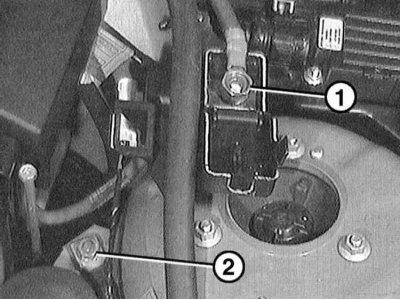
10a. Connect the red cable to the positive terminal (+) in the engine compartment of the vehicle to be powered. First open the cover "1". If the vehicle to be powered is not a BMW 3-series, connect the cable to the positive pole (+) of the battery.
10b. Connect the other end of the red cable to the positive terminal "1" of the power supply vehicle.
10c. Connect the black cable to the ground (-) point "2" on the shock absorber strut of the supply vehicle. If the supply vehicle is not a BMW 3-Series, connect the cable to the negative (-) terminal of the battery.
10d. Connect the other end of the black cable to the ground point on the right shock absorber strut of the vehicle being powered. If the vehicle being powered is not a BMW 3 Series, connect the cable to a reliable ground point.
Do not connect to the negative terminal (-) of a discharged battery. The best option is a metal part bolted to the cylinder block. Under adverse circumstances, connecting the cable to the negative terminal of a discharged battery may cause the battery to explode due to sparking and the release of detonating gas.
The terminals of the starting cable must not come into contact with each other when the cables are connected and, accordingly, the positive terminals must not touch the ground points (body or frame) – risk of short circuit!
11 Start the engine of the vehicle being powered (dead battery) at idle speed. When starting, the starter should be pressed continuously for no more than 10 sec, since the increased current consumption heats up the terminals of the poles and the cable. Therefore, between individual starts, it is necessary to take breaks for cooling for about 1/2 min.
12. If you have difficulty starting, do not turn on the starter for a long time unless necessary. Fuel is continuously injected during starting. Find out the cause of the malfunction and eliminate it.
13. After successful start, both vehicles must be connected with a cable for another 3 minutes of operation.
14. To avoid voltage peaks when disconnecting a vehicle with a discharged battery, turn on the fan and rear window heating. Do not turn on the high beams. Incandescent lamps burn out at high voltage.
15. After starting the vehicle, disconnect the cables from the other vehicle in the reverse order of connection. First disconnect the black cable (-) from the vehicle being powered, then disconnect the power vehicle. Disconnect the black cable first from the power vehicle and then from the vehicle being powered.
[This article is based on information from the website: «bmwman.ru»]