
- Home
- BMW 3 Series
- E46
- General information
- Manual
- Automotive chemicals, oils and lubricants
Automotive chemicals, oils and lubricants (BMW 3 Series E46)
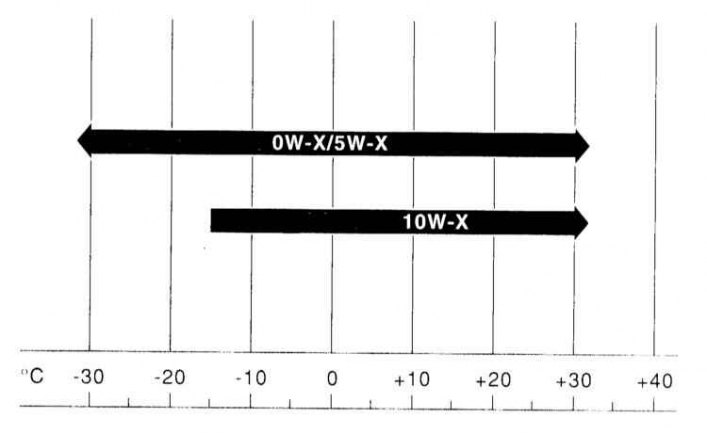
Viscosity map of motor oils
Special oils BMW long life p/n 07 511470 407
X can take values 30, 40, 50
There are many chemicals, oils, and lubricants available for sale that are essential for routine maintenance and repair of a vehicle. These include a wide range of chemical and petroleum products, from cleaning compounds and solvents to oils, greases, and aerosols to protect rubber and plastic components of a vehicle.
Cleaners
Cleaner for injection systems and air flaps is a powerful solvent for resins, carbon deposits and carbon deposits. Most cleaners leave behind a dry-type lubricating film that does not harden or become resinous over time. It is because of the formation of such a film that these cleaners are not recommended for use in cleaning electrical components.
Brake system cleaner is used to remove traces of grease and brake fluid from the surfaces of brake system components, where absolute cleanliness is a primary condition for efficient operation. The cleaner leaves no traces and in many cases eliminates the squeal of brake mechanisms caused by contamination of their components.
Electrical Component Cleaner helps to remove oxide films, traces of corrosion and carbon deposits from contact surfaces without disrupting electrical conductivity. It can also be used to clean spark plugs, jets, voltage regulators and other units where complete cleaning from oil and grease is desired.
Desiccants are used to remove water and moisture from the surfaces of electrical components such as generators, voltage regulators, fuse boxes, electrical connectors, etc. Desiccants are typically non-conductive, non-corrosive, and non-flammable.
Degreasers are super-strong solvents and are used to remove traces of grease from the outer surfaces of the engine and chassis components. They are available in the form of aerosols or applied with a brush or brush and, depending on the type, are washed off with either water or solvent.
Lubricating fluids
Engine oils are specially developed compounds for lubricating internal engine components. They usually contain a wide range of various additives that prevent foaming and corrosion. Engine oils are available in various viscosity grades - from 5 to 80. The need to use a particular grade of oil is usually determined by climatic conditions and the requirements of a specific engine. Liquid (light) oils are usually used in cold climates and with minor engine loads. Heavy (viscous) oils are used in hot conditions and with increased engine loads. All-season oils have the characteristics of both light and heavy oils and are usually designated from 5W-20 to 20W-50.
Transmission oil designed for use in differentials, gearboxes and other applications where high temperature resistance is required.
Lubricant for chassis components and wheel bearings is a thick lubricant used in components subject to increased loads and friction, such as wheel bearings, suspension ball joints, steering rod ends and cardan joints.
High Temperature Wheel Bearing Grease capable of withstanding the high temperatures that occur in wheel bearings of vehicles equipped with disc brakes. Typically contains molybdenum disulphide, which is a dry type lubricant.
White grease (tsiatim) is a thick lubricant applied to metal surfaces in contact with each other in places where there are problems with increased moisture. It remains soft at both low and high temperatures, is not washed out or diluted by water.
Assembly grease is a special grease for use under high pressure conditions, usually contains molybdenum and is used to lubricate components subject to increased loads (such as main and connecting rod bearings and cam lobes) before the first engine start after completion of a major overhaul.
Silicone lubricants used to protect rubber, plastic, vinyl and nylon components.
Graphite lubricants are used where oil cannot be used due to contamination problems (for example, in castles). Dry graphite perfectly lubricates metal parts, preventing the impact of moisture, acids and other aggressive contaminants on them. The lubricant is electrically conductive and does not disrupt contact in such units as, for example, the ignition switch.
Molybdenum-containing penetrating compounds are used to facilitate the release of "stuck" fasteners, as well as to lubricate fasteners to prevent corrosion in the future.
Thermal conductive grease is non-conductive and is used for installing electronic ignition modules, which require intensive heat dissipation.
Sealants
RTV sealant is the most widely used gasket sealant. It is made on the basis of silicon, hardens in air, provides sealing, adhesion, is waterproof, fills surface defects, remains elastic, does not shrink or shrink, is relatively easy to remove and is used in addition to almost all gaskets on units where temperatures do not exceed average values.
Anaerobic sealant unlike RTV sealant, it can be used not only in addition to gaskets, but also to form them. It remains elastic, is resistant to solvents and fills surface irregularities well. The main difference from RTV sealant is in the curing conditions. If RTV sealant begins to harden after exposure to air, then anaerobic sealant only hardens in the absence of air. This means that such a sealant hardens only after assembling the components and pressing them tightly against each other.
Pipe Sealant and threaded connections is used to seal nipple connections of hydraulic, pneumatic and vacuum lines. It is usually made on the basis of Teflon compound and is supplied in the form of aerosols applied like paint, liquids or in the form of tape (FUM).
Chemicals
Anti-seize compound serves to prevent "sticking", corrosion, jamming and cold welding of fasteners. High-temperature anti-seizing sealants are usually made on the basis of copper-containing or graphite lubricants and are used in fasteners of the exhaust system and exhaust manifold.
Anaerobic gripping compounds serve to prevent spontaneous loosening of fasteners under the influence of vibrations and harden only after installation in the absence of contact with air. Medium-power gripping compounds are used to fix small fasteners (nuts, bolts, screws), which are subject to regular release in the future. High-power compounds are usually used to lock large fasteners that are not released on a regular basis.
Oil additives are used to change the chemical properties of the oil without changing its viscosity in order to reduce internal friction in the engine. It should be noted that most manufacturers of motor oils warn against using any additives to them.
Fuel additives perform several functions at once, depending on their chemical composition. They usually contain solvents that help remove sludge and carbon deposits from the internal surfaces of the fuel injection system components and the intake tract. In addition, the use of such additives helps remove carbon deposits that form on the walls of combustion chambers. Some additives contain substances that serve to lubricate the components of the upper part of the cylinder head (valve mechanism, piston rings), others help remove condensation from the walls of the fuel tank.
Others
Brake fluid - is a specially developed compound that can withstand the effects of high temperatures and pressures that occur in the brake system. Do not allow brake fluid to come into contact with painted surfaces of the car or exposed areas of the body. Keep brake fluid in a hermetically sealed container to prevent moisture from getting into it (the liquid is very hygroscopic) and dirt.
Adhesive for fixing sealing strips of body openings, as its name suggests, is used to secure sealing strips for door openings, windows and luggage compartment lids. It can be used to secure interior trim elements.
Anti-corrosion coating for the underbody of a car is a tar-like composition made on an oil base and serves as a protective coating for metal surfaces, preventing their corrosion. In addition, it performs the function of soundproofing the interior.
Waxes and polishes are used to protect painted surfaces from environmental influences. Different types of paint may require the use of different types of waxes and polishes. Some polishes contain abrasive or chemical additives that serve to remove the outer layer of oxides (tarnishings) from the painted surfaces of old cars. Recently, various types of wax-free polishes have become widely available on the market, which contain many chemical additives such as polymers or silicon-based substances. Such polishes are usually easier to apply and last longer than regular (wax) polishes.
This article is available at russian, bulgarian, belarusian, ukrainian, serbian, croatian, romanian, polish, slovak, hungarian
Article verified: Sevastyanov Nikolay
Share information:
Previous articles
БМВ E46: Manual
Next articles
Similar articles on other types of BMW cars:
Fuels and lubricants of domestic production BMW 5 Series E12 (1972-1981)
Quality of oils BMW 5 Series E34 (1988-1996)
Automotive chemicals, oils and lubricants BMW 7 Series E38 (1994-2001)
Motor oils BMW 7 Series E32 (1986-1994)
Introduction to the Automotive Repair Manual BMW X3 E83 (2003-2010)
Checking the level and replacing transmission oils BMW X5 E53 (1999-2006)
Fuels and lubricants of domestic production BMW 5 Series E12 (1972-1981)
Quality of oils BMW 5 Series E34 (1988-1996)
Automotive chemicals, oils and lubricants BMW 7 Series E38 (1994-2001)
Motor oils BMW 7 Series E32 (1986-1994)
Introduction to the Automotive Repair Manual BMW X3 E83 (2003-2010)
Checking the level and replacing transmission oils BMW X5 E53 (1999-2006)
Link in different formats to this page
Visitor comments
No comments yet
- General information
- Manual
- Maintenance
- Power unit
- Engine repair
- Cooling system
- Power system (gasoline)
- Injection system (gasoline)
- Fuel system (diesel)
- Exhaust system
- Ignition system
- Charge and launch systems
- Transmission
- Car gearbox
- Clutch and drive shafts
- Chassis
- Brake system
- Suspension front and rear
- Steering
- Body
- Body care and repair
- Exterior
- Interior
- Electrical equipment
- Troubleshooting
- Lighting and signaling
- Equipment and devices
- Heater and air conditioner
- Electrical circuits
- General information
- Manual
- Repair on the road
- Weekly checks
- Maintenance
- Troubleshooting
- Power unit
- 4 cylinder engines
- 6 cylinder engines
- Engine overhaul
- Cooling and heating
- Fuel and exhaust system
- Starting and charging system
- Ignition system
- Transmission
- Clutch
- Mechanical gearbox
- Automatic gearbox
- Cardan and drive shafts
- Chassis
- Brake system
- Wheel suspension
- Steering
- Body
- Exterior
- Interior
- Electrical equipment
- Equipment and devices
- Electrical circuits
- General information
- Maintenance
- Power unit
- Engine repair
- Cooling system
- Ignition system
- Supply system
- Fuel injection system
- Exhaust system
- Transmission
- Clutch
- Car gearbox
- Front and rear axle
- Chassis
- Steering
- Brake system
- Body
- Exterior
- Interior
- Electrical equipment
- Heating system
- Equipment and devices
- Power devices
- Electrical circuits
- Power unit
- M10/M20 engine
- M40 engine
- Ignition system
- Lubrication system
- Cooling system
- Supply system
- Fuel injection
- Exhaust system
- Transmission
- Clutch
- Manual gearbox
- Front axle
- Rear axle
- Chassis
- Steering
- Brake system
- Body
- Exterior
- Interior
- Electrical equipment
- Heating system
- Equipment and devices
- Electrical circuits
- General information
- Specifications
- Operation and maintenance
- 4-cylinder engine
- Engine repair
- Cooling and lubrication system
- Supply system
- Ignition system
- 6-cylinder engine
- Engine repair
- Cooling and lubrication system
- Supply system
- Fuel injection system
- Ignition system
- Transmission
- Clutch
- 4-speed manual gearbox
- 5-speed manual gearbox
- Automatic gearbox
- Cardan and rear axle
- Chassis
- Steering
- Front suspension
- Rear suspension
- Brake system
- Electrical equipment
- Equipment and devices
- Electrical circuits