
- Home
- BMW 3 Series
- E46
- General information
- Manual
- Jacking and towing
Jacking and towing (BMW 3 Series E46)
Jacking up
(The standard jack is located under the cover in the trunk floor).
When carrying out work under a vehicle, it must be installed on a lift or, if there is no lift, on two or four reliable supports.
If work needs to be done under the vehicle, the latter must be secured on supports. Supporting the vehicle only on a car jack is not enough. Danger to life!
1. Only an empty vehicle can be lifted on a level and hard-surfaced surface.
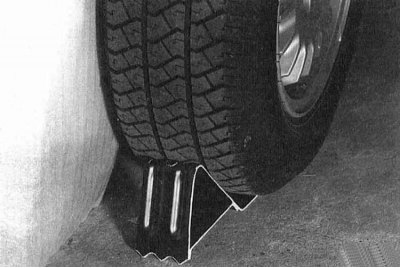
2. Wheels that remain on the ground when lifted must be chocked to prevent the vehicle from moving. Do not rely on the parking brake for this purpose. The parking brake must be released for some repairs.
To avoid damage to the underside of the vehicle, use appropriate rubber or wooden pads. Never lift the vehicle by the powertrain, front or rear suspension, as this may cause serious damage.
3. The vehicle should be placed on stands so that one support on each side faces outward.
Car jack support points
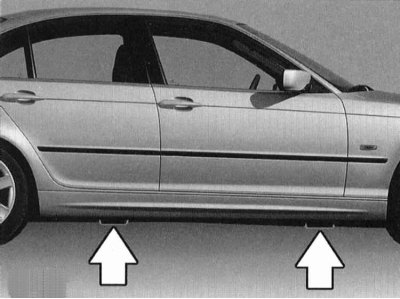
4. Rubber blocks are used as support points for the car jack and lift (arrows in the illustration), located on the lower beam.
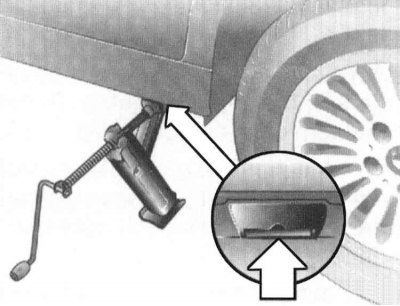
5. Position the car jack so that its support is flush with the surface of the platform with its entire plane, and the head, when raised, rests against the rectangular recess on the car.
6. Raise the jack so that the wheel is off the ground and place a stand under the car.
Towing
Installing a tow rope/towing bar
The vehicle must only be towed using the towing eye specifically provided for this purpose. The eye is included in the on-board tool kit and must be screwed into the appropriate places on the front or rear bumper before towing.
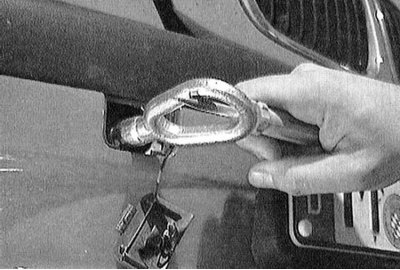
1. Front mount: Remove the cover at the top of the bumper groove by prying it up with a screwdriver and screw in the front towing eye until it stops.
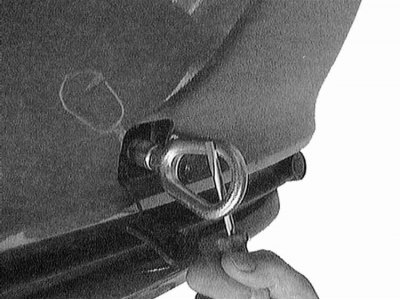
2. Rear mount: Remove the cover at the top of the bumper groove by prying it up with a screwdriver and screw the eye in until it stops.
Towing rules
3. Turn on the ignition to prevent the steering wheel from locking and to ensure that the brake light, horn and windshield wipers can be turned on.
4. Set the manual transmission to neutral; for vehicles with automatic transmission, set the selector to the "N" position.
5. Turn on the hazard warning lights on both vehicles.
6. Since the brake booster and power steering only operate when the engine is running, when the engine is not running you have to press harder on the brake pedal and apply more force to the steering wheel.
7. It is recommended to use a towing rod. If a towing rope is used, there is a risk of the vehicle running over. The towing rope must be elastic. This reduces the dynamic load on the vehicles. Only ropes made of artificial fibre or ropes with an intermediate elastic element should be used.
Cars with automatic transmission
Selector position: "N"
Maximum towing speed: 70 km/h!
Maximum towing distance: 150 km.
8. If the gearbox is damaged or the distance is long, the vehicle is towed with the drive wheels raised. Reason: when the engine is not running, the transmission oil pump does not work and the latter does not receive enough oil, which is necessary for higher speeds and long towing.
9. When using a transporter: The vehicle may only be transported with the drive wheels raised. Caution: To avoid damage to the gearbox, do not tow the vehicle in reverse with the drive wheels rotating.
Starting a car by towing
Starting a vehicle by towing is not possible on vehicles with automatic transmission.
The car should only be started when the engine is cold, otherwise there is a risk of damage to the catalytic converter.
10. Turn on the hazard warning lights.
11. Turn on the ignition.
12. Engage 3rd gear, press the clutch pedal and hold it.
13. Start towing the vehicle.
14. Slowly engage the clutch while both vehicles are moving.
15. As soon as the engine starts, press the clutch pedal and disengage the gear to avoid running into the towing vehicle.
This article is available at russian, bulgarian, belarusian, ukrainian, serbian, croatian, romanian, polish, slovak, hungarian
Article verified: Sevastyanov Nikolay
Share information:
Previous articles
БМВ E46: Manual
Next articles
Similar articles on other types of BMW cars:
Jacking, towing and changing wheels BMW 5 Series E28 (1981-1988)
Lifting and towing a car BMW 5 Series E12 (1972-1981)
Towing a car BMW 7 Series E32 (1986-1994)
Jacking/lifting and emergency transportation of a vehicle BMW 7 Series E38 (1994-2001)
Towing and towing-starting BMW X3 E83 (2003-2010)
Jacking, towing and changing wheels BMW 5 Series E28 (1981-1988)
Lifting and towing a car BMW 5 Series E12 (1972-1981)
Towing a car BMW 7 Series E32 (1986-1994)
Jacking/lifting and emergency transportation of a vehicle BMW 7 Series E38 (1994-2001)
Towing and towing-starting BMW X3 E83 (2003-2010)
Link in different formats to this page
Visitor comments
No comments yet
- General information
- Manual
- Maintenance
- Power unit
- Engine repair
- Cooling system
- Power system (gasoline)
- Injection system (gasoline)
- Fuel system (diesel)
- Exhaust system
- Ignition system
- Charge and launch systems
- Transmission
- Car gearbox
- Clutch and drive shafts
- Chassis
- Brake system
- Suspension front and rear
- Steering
- Body
- Body care and repair
- Exterior
- Interior
- Electrical equipment
- Troubleshooting
- Lighting and signaling
- Equipment and devices
- Heater and air conditioner
- Electrical circuits
- General information
- Manual
- Repair on the road
- Weekly checks
- Maintenance
- Troubleshooting
- Power unit
- 4 cylinder engines
- 6 cylinder engines
- Engine overhaul
- Cooling and heating
- Fuel and exhaust system
- Starting and charging system
- Ignition system
- Transmission
- Clutch
- Mechanical gearbox
- Automatic gearbox
- Cardan and drive shafts
- Chassis
- Brake system
- Wheel suspension
- Steering
- Body
- Exterior
- Interior
- Electrical equipment
- Equipment and devices
- Electrical circuits
- General information
- Maintenance
- Power unit
- Engine repair
- Cooling system
- Ignition system
- Supply system
- Fuel injection system
- Exhaust system
- Transmission
- Clutch
- Car gearbox
- Front and rear axle
- Chassis
- Steering
- Brake system
- Body
- Exterior
- Interior
- Electrical equipment
- Heating system
- Equipment and devices
- Power devices
- Electrical circuits
- Power unit
- M10/M20 engine
- M40 engine
- Ignition system
- Lubrication system
- Cooling system
- Supply system
- Fuel injection
- Exhaust system
- Transmission
- Clutch
- Manual gearbox
- Front axle
- Rear axle
- Chassis
- Steering
- Brake system
- Body
- Exterior
- Interior
- Electrical equipment
- Heating system
- Equipment and devices
- Electrical circuits
- General information
- Specifications
- Operation and maintenance
- 4-cylinder engine
- Engine repair
- Cooling and lubrication system
- Supply system
- Ignition system
- 6-cylinder engine
- Engine repair
- Cooling and lubrication system
- Supply system
- Fuel injection system
- Ignition system
- Transmission
- Clutch
- 4-speed manual gearbox
- 5-speed manual gearbox
- Automatic gearbox
- Cardan and rear axle
- Chassis
- Steering
- Front suspension
- Rear suspension
- Brake system
- Electrical equipment
- Equipment and devices
- Electrical circuits