



- Home
- BMW 7 Series
- E38
- General information
- Introduction to guide
- Jacking/lifting and emergency transportation of a vehicle
Jacking/lifting and emergency transportation of a vehicle (BMW 7 Series E38)
Jacking up with a standard and rolling jack, changing a wheel
The standard jack is intended only for short-term lifting of the car when changing a wheel; before performing any work under the vehicle, it must be placed on special supports.
1. Park the car on a level, horizontal surface, if possible with a hard surface.
2. Set the parking brake and set the AT selector lever to position "P" (on models with AT) or engage first or reverse gear (on models with manual transmission).
3. If necessary, turn on the hazard warning lights and put up an emergency stop sign.
4. Support the wheel located diagonally from the one to be replaced with wheel chocks.
When performing the procedure on a slope, place chocks under both wheels of the serviceable axle on the downhill side.
5. Prepare a jack, wrench and spare wheel. If equipped, remove the protective cap of the wheel, then loosen the bolts securing the broken wheel by one turn. If necessary, unlock the bolts with locks in the head, for which remove the protective cap from the head, insert the key parallel to the oval recess and turn it by a quarter of a turn. Place the head of the jack under the appropriate point under the threshold beam - make sure that the jack is positioned strictly vertically, and its heel rests on the ground with its entire surface - if the ground is loose, put a suitable lining under the heel (in winter it is useful to have a piece of wide board in the car).
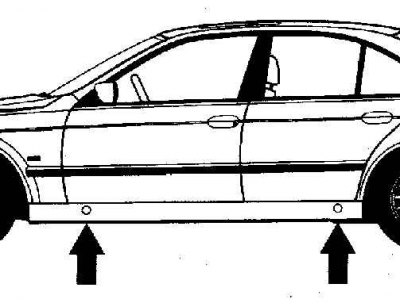
Jacking points and installation of safety supports
6. Also make sure that the jack head fits into the rectangular recess on the bottom of the car.
Regardless of the presence of a slope, the jack must always occupy a strictly vertical position!
7. Using the jack handle, lift the car – the damaged wheel should be completely off the ground.
8. Loosen the wheel bolts completely and replace the wheel.
9. Check the inflation pressure of the installed wheel and make the appropriate adjustments if necessary (see Specifications in Chapter Controls and operating techniques).
10. Put the removed wheel and tool back in their original places.
11. Finally, tighten the wheel nuts evenly in several steps in a diagonal pattern to a force of approximately 100 Nm.
Hanging the car
Under no circumstances is it permitted to support the vehicle on the power unit, front and rear suspension, as this may seriously damage these structures.
To raise the vehicle, use a platform or lift with four legs resting on jacking points.
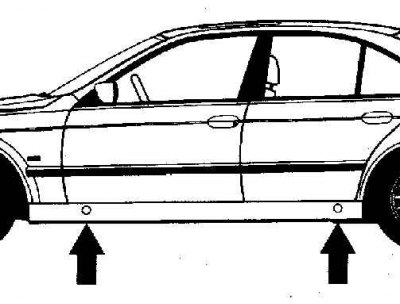
Jacking points and installation of safety supports
Transportation of a damaged vehicle
Transportation on a tow truck platform
The most reasonable way to transport a damaged vehicle is by tow truck. Such transportation can be carried out:
- By fully loading the faulty vehicle onto the tow truck platform;
- Partial loading method (one axle on the tow truck's overhead shelf, and the other either on a special trolley or on the ground).
Preparing for towing
The removable tow rope mounting eyes are screwed into the holes located under the plugs on the right side of each bumper. It is convenient to use a lug wrench to screw in the eyes.
Before towing a damaged vehicle, turn on the ignition, put the transmission in neutral and release the parking brake.
It is best to tow with a rigid hitch. When towing with a flexible hitch, use only an elastic rope specifically designed for this purpose.
Before starting to move, drivers of both vehicles (towing and towed) the route should be agreed upon among themselves.
Towing for the purpose of starting the engine
First try starting the engine from an auxiliary battery (see below). Starting the engine of models with automatic transmission by towing or pushing is not possible, and on models with manual transmission this can damage the catalytic converter - the towing distance for starting the engine should not exceed 50 m.
1. Engage 2nd or 3rd gear, depress the clutch pedal and, while holding it, turn on the ignition.
2. When both cars are moving, slowly engage the clutch (release the pedal).
3. Once the engine starts, depress the clutch pedal and shift out of gear to avoid colliding with the towing vehicle.
Towing a damaged vehicle
Towing a vehicle without transmission oil, or if the automatic transmission is faulty, is not permitted without lifting the drive wheels off the ground.
The driver of the towing vehicle should try to move as smoothly as possible, smoothly releasing the clutch when changing gears and, especially, when starting off.
When driving a towed vehicle, make sure that the cable remains taut throughout the movement; try to avoid sudden jerks and running over a loose cable.
Remember that when the engine is off, the car's braking efficiency is significantly reduced due to the fact that the brake booster stops functioning. In this case, you should press the service brake pedal with significantly more force than usual; when maneuvering, more force will have to be applied to the steering wheel, since the power steering will also not function.
The movement should be carried out along the shortest route. A faulty vehicle with automatic transmission may be towed at a speed of no more than 70 km/h and for a distance of no more than 150 km. Observe traffic regulations, avoid sudden braking, acceleration and excessive maneuvering. Remember that when towing a vehicle along the edge of a dirt road, there is always a risk of skidding to the side of the road.
Before towing a faulty vehicle with automatic transmission, check the transmission fluid level (see chapter Vehicle settings and routine maintenance), – if the ATF level is insufficient, it should be corrected, or the vehicle should be towed only with the drive wheels off the ground.
This article is available at russian, bulgarian, belarusian, ukrainian, serbian, croatian, romanian, polish, slovak, hungarian
Article verified: Polikarpov Saveliy
Share information:
Previous articles
БМВ E38: Introduction to guide
Next articles
Similar articles on other types of BMW cars:
Vehicle Passport Data BMW 3 Series E21 (1975-1983)
Removal and installation the window lifting mechanism BMW 3 Series E36 (1990-2000)
Vehicle Passport Data BMW 5 Series E12 (1972-1981)
Emergency alarm system BMW 5 Series E34 (1988-1996)
Table of causes of malfunctions in vehicle operation BMW X3 E83 (2003-2010)
Emergency light signaling BMW X5 E53 (1999-2006)
Vehicle Passport Data BMW 3 Series E21 (1975-1983)
Removal and installation the window lifting mechanism BMW 3 Series E36 (1990-2000)
Vehicle Passport Data BMW 5 Series E12 (1972-1981)
Emergency alarm system BMW 5 Series E34 (1988-1996)
Table of causes of malfunctions in vehicle operation BMW X3 E83 (2003-2010)
Emergency light signaling BMW X5 E53 (1999-2006)
Link in different formats to this page
Visitor comments
No comments yet
- General information
- Introduction to guide
- Manual
- Maintenance
- Power unit
- Engine M60/1, M60/2 (petrol)
- M62 engine (petrol)
- M57 engine (diesel)
- M67 engine (diesel)
- Cooling system
- Fuel system (petrol)
- Fuel system (diesel)
- Exhaust system
- Ignition and control systems
- Charge and launch systems
- Transmission
- Clutch
- Mechanical gearbox
- Automatic gearbox
- Cardan and drive shafts
- Chassis
- Brake system
- Front suspension
- Rear suspension
- Steering
- Body
- Exterior
- Interior
- Electrical equipment
- Equipment and devices
- Lighting
- Heating and air conditioning
- Electrical circuits
- General information
- Care and maintenance
- Power unit
- Minor engine repair
- Engine overhaul
- Lubrication system
- Cooling system
- Ignition system
- Supply system
- Injection system (petrol)
- Injection system (diesel)
- Exhaust system
- Transmission
- Clutch
- Manual gearbox
- Automatic gearbox
- Cardan gear
- Rear axle and shafts
- Chassis
- Front suspension
- Rear suspension
- Steering
- Wheels and tires
- Brake system
- Body
- Body elements
- Electrical equipment
- Equipment and devices
- Electrical circuits