
- Home
- BMW 7 Series
- E38
- General information
- Maintenance
- Checking fluid levels, leak control
Checking fluid levels, leak control (BMW 7 Series E38)
Regardless of the scheduled inspection intervals, do not allow fluids to leak under the vehicle, as such leaks indicate a problem that should be addressed immediately.
Fluids are an integral part of the lubrication, cooling, windshield washer and braking systems. Due to the gradual consumption and contamination of fluids during normal vehicle operation, they should be replaced periodically. Top up only with fluids that meet the requirements of the Specifications in Section Vehicle settings and routine maintenance.
Whenever checking the fluid level, the vehicle must be on a level, horizontal surface.
Engine oil
Engine oil consumption should not exceed 1 liter per 1000 km. Higher oil consumption is a sign of wear of the oil-deflecting caps and/or piston rings or engine shaft seals.
Visual inspection of leaks
1. If the engine is oily and has high oil consumption, check the following areas for leaks:
- Engine oil pan gasket;
- Engine Oil Drain Plug Seal;
- Seal D/V engine oil pressure;
- Oil filter housing cover gasket;
- Gasket between the block and the cylinder head;
- Cylinder head cover gasket;
- Oil filler cap seal;
- Crankshaft and camshaft oil seals.
Since when there is a leak, the oil spreads over a large surface area of the engine, it is difficult to immediately determine its location. To detect leaks, proceed as follows:
2. Clean the engine by covering the generator and fuse box with a plastic bag, spraying the engine with a regular cold cleaner and after a short time washing with water.
3. Sprinkle the mating surfaces and seals on the outside of the engine with lime or talc.
4. Check the engine oil level and correct it if necessary.
5. In order to warm up the oil, take the car for a test drive – the viscosity of the heated oil will decrease, and it will appear faster in the places of leaks.
6. Finally, examine the engine by shining a lamp on it, locate the leaks and eliminate them.
Checking and adjusting the level
1. Check the engine oil level using a dipstick (see illustrationsEngine Compartment Components), installed in the guide tube.
2. The engine oil level should be measured on a cold engine, or no earlier than 10 minutes after it has been turned off.
If you start measuring immediately after turning off the engine, some oil will remain in the upper part of the engine and the measurement results will be erroneous.
3. Remove the dipstick from the guide and wipe the blade dry with a clean rag or paper towel. Insert the dipstick all the way back into the guide and remove it again.
4. The height of the oil-wetted section of the dipstick will correspond to the oil level in the engine. This level should be between the "MIN" and "MAX" marks on the dipstick, otherwise the oil level should be adjusted. If the oil level goes beyond the "MAX" mark, the oil should be pumped out, because otherwise the engine seals and catalytic converter may be damaged.
5. To add oil, remove the filler cap (see illustrations Engine Compartment Components). After adding oil, wait a few minutes for the level to stabilize, then remove the dipstick and check the level again. If necessary, make adjustments again. If dirt is found on the filler cap, wash it with gasoline. Finally, close the oil filler cap tightly.
6. Is checking the oil level an important preventive measure? Which should be done as often as possible, and definitely before each long trip. In addition, you should pay attention to the condition of the oil: if it is milky or drops of water can be seen in its composition, there may be a leak in the cylinder head gasket or a crack in the cylinder head or block, as a result of which coolant gets into the oil. In this case, the engine should be repaired immediately. Each time you measure the oil level, before wiping the dipstick blade, run your thumb and forefinger over it. If you find dirt or metal particles stuck to the dipstick, the oil should be replaced (see section Changing engine oil and oil filter).
Coolant - checking and adjusting the level and condition
Do not allow antifreeze to come into contact with your skin or the painted surfaces of your vehicle. If this does happen, wash off the antifreeze immediately with plenty of water. Antifreeze is extremely toxic, so do not leave it unattended in an open container or spilled on the floor: children or animals may be attracted to its sweet smell and may drink it.
Do not remove the expansion tank filler cap or the radiator cap until the engine has completely cooled down!
1. The vehicles in question are equipped with a compensating cooling system with excess pressure. The location of the expansion tank depends on the specific vehicle model (see illustrations Engine Compartment Components). As the engine warms up during operation, the expanding coolant (coolant) fills the reservoir. When the engine cools down, the coolant automatically flows back into the cooling system, which ensures that the coolant level is maintained at a constant level.
2. The coolant level should be checked regularly, at least every month, and before each long trip.
3. The coolant level in the expansion tank fluctuates depending on the engine temperature: when the engine is cold (temperature is about 20 degrees.) it should be at the level of the "KALT/COLD" mark (or a little higher than it) on the transparent wall of the tank, and as the engine warms up, the coolant level should increase, but not go beyond the "MAX" mark. If this is not the case, let the engine cool down, then remove the expansion tank cap and adjust the coolant level.
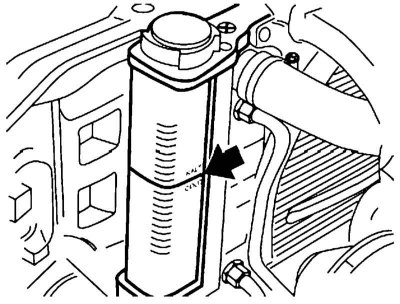
Mark on the wall of the expansion tank, option 1
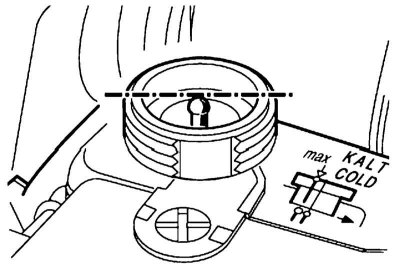
Mark on the wall of the expansion tank, option 2
4. To fill the cooling system, be sure to use the mixture specified in the Specifications in Section Vehicle settings and routine maintenance.
If there is a need to fill the cooling system on the road, then in the summer you can use clean water, but not another type of antifreeze. The required type of antifreeze can be added later, but as quickly as possible.
5. If the coolant level drops rapidly, visually inspect the cooling system for leaks - these are usually detected by a white or rust-colored coating in the area surrounding the leak.
- Check the condition of the hoses and the reliability of their fastening to the pipes; replace damaged hoses and clamps (see also Section Checking the condition and replacing hoses and tubes in the engine compartment, localizing leaks). Cracks are easier to detect if you pinch the hose;
- Check the expansion tank cap seal.
- Check the cooling system with pressure. To do this, install a pressure-injecting device on the expansion tank neck. At the initial pressure 1 atm its losses should not exceed 0.1 atm in 2 minutes. Otherwise, check the tightness of the cooling system.
6. If no leaks are found, check the radiator cap for leaks. To do this, first pull the vacuum valve on the cap and release it – it should return to its original position. Make sure that the valve seat is not dirty or damaged. Then lubricate the radiator cap seal with coolant and connect a pressure-injecting device to the cap. The valve should open at a pressure of about 2 atm. Otherwise, replace the radiator cap.
7. You should also check the condition of the coolant – it should be relatively clean. If the liquid is brown or rusty, it should be drained, the cooling system should be flushed and filled with a new mixture (see section Replacing the coolant). Even if the coolant looks normal, the corrosion inhibitors it contains lose their effectiveness over time, so the coolant should be replaced periodically.
8. Use a hydrometer to check the coolant's frost resistance.
Brake fluid
Brake fluid can cause damage to your eyes or painted surfaces if it gets into contact with them. Do not use brake fluid that has been open for a long time or that is more than one year old. Brake fluid tends to absorb moisture from the air, which can degrade its properties and lead to a dangerous loss of braking efficiency.
Brake fluid is also used to drive the clutch.
1. The brake fluid reservoir is located on the left side of the engine compartment, near its bulkhead, and is divided into two parts, each for its own brake circuit (see illustrations Engine Compartment Components). Transparent walls of the reservoir allow the brake fluid level to be observed from the outside. To warn of a low brake fluid level, there is a corresponding K/L in the instrument cluster, the activation of which is duplicated by a corresponding message (see chapter Controls and operating techniques). However, it is recommended to check the fluid level regularly.
2. The liquid level with the lid closed should be between the "MIN" and "MAX" marks on the tank walls. Make sure that the level does not fall below the "MIN" mark.
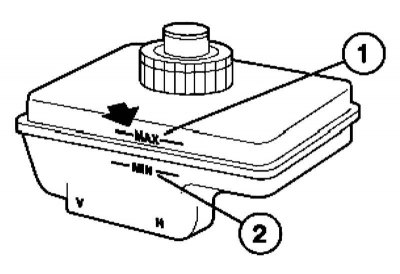
Brake fluid reservoir with MIN and MAX marks
3. If the level is low, first wipe the top of the reservoir and the cap with a clean rag to prevent dirt from getting into the brake system after removing the cap. Add fluid to the correct level, but do not overfill.
4. While the reservoir cap is removed, check the brake fluid and reservoir for contamination. If there are any rust particles, dirt or water droplets, the fluid should be replaced. After bringing the brake fluid level to the desired level, make sure the cap is installed level to prevent fluid leakage and/or dirt ingress.
5. The fluid level in the brake master cylinder (MBC) will drop slightly as a result of wear of the brake shoe friction linings. There is no need to top it up as long as the level remains near the "MIN" mark – it will rise after replacing the linings. A very low level may indicate worn brake shoes – check them (see section Checking the brake system and clutch).
6. If the brake fluid level drops constantly, immediately check the entire brake system for leaks. Typically, worn caps in the wheel cylinders are the cause. Inspect the brake lines, hoses and nipples along with the calipers, wheel cylinders and master cylinder (see section Checking the brake system and clutch). Brake fluid is also used in the clutch drive, so you should check its lines and slave cylinder for damage and loose connections.
7. If the reservoir is empty or nearly empty when checking the fluid level, the brake system must be checked for leaks and bled (see sections Checking the brake system and clutch and Replacing brake fluid and bleeding the brake system).
Power Steering Fluid
When equipped accordingly, power steering fluid is also used in hydraulic suspension.
1. The power steering fluid level can be checked either when it is warmed up (80°C) or when it is at ambient temperature.
2. For checking, the dipstick built into the power steering fluid reservoir cap is marked with "MIN" and "MAX" (see illustrationsEngine Compartment Components).
3. Turn off the engine and remove the power steering fluid reservoir cap.
4. Wipe the dipstick with a clean cloth.
Do not allow power steering fluid to become contaminated.
5. Place the lid on the tank (without twisting), remove it and make sure that the fluid level is between the corresponding marks. Otherwise, add fresh power steering fluid. Close the cover.
6. Start the engine and turn the steering wheel from lock to lock several times to remove air from the power steering.
7. Turn off the engine. The power steering fluid level should rise approximately 5 mm above the "MAX" mark.
Windscreen and headlight lens washer fluid
1. Windshield and headlight washer fluid should be added to the appropriate reservoir through the filler neck (see illustrations Engine Compartment Components).
2. In temperate climates, you can use plain water to wash your windshields, but it is recommended to add a glass cleaner to it. The reservoir should be no more than two-thirds full to allow for expansion of the water when it freezes. In cold climates, you should use a special windshield washer antifreeze that lowers the freezing point of the liquid. It is usually sold in concentrated or ready-made form.
It is not allowed to use antifreeze for the cooling system as an additive to increase the frost resistance of the washer fluid. Mix concentrated antifreeze with water in accordance with the manufacturer's instructions on the package.
3. To remove heavy dirt, add a strong detergent to the appropriate tank.
[The original article is available on the website «www.bmwman.ru»]
This article is available at russian, bulgarian, belarusian, ukrainian, serbian, croatian, romanian, polish, slovak, hungarian
Article verified: Polikarpov Saveliy
Share information:
Previous articles
БМВ E38: Maintenance
Next articles
Similar articles on other types of BMW cars:
Checking fluid levels BMW 3 Series E46 (1998-2006)
Checking the control pressure regulator BMW 3 Series E21 (1975-1983)
Power Steering and Level Control — Checking Fluid Level BMW 5 Series E34 (1988-1996)
Checking fluid levels BMW 5 Series E28 (1981-1988)
Control and signal lamps BMW X3 E83 (2003-2010)
Checking the brake fluid level BMW X5 E53 (1999-2006)
Checking fluid levels BMW 3 Series E46 (1998-2006)
Checking the control pressure regulator BMW 3 Series E21 (1975-1983)
Power Steering and Level Control — Checking Fluid Level BMW 5 Series E34 (1988-1996)
Checking fluid levels BMW 5 Series E28 (1981-1988)
Control and signal lamps BMW X3 E83 (2003-2010)
Checking the brake fluid level BMW X5 E53 (1999-2006)
Link in different formats to this page
Visitor comments
No comments yet
- General information
- Introduction to guide
- Manual
- Maintenance
- Power unit
- Engine M60/1, M60/2 (petrol)
- M62 engine (petrol)
- M57 engine (diesel)
- M67 engine (diesel)
- Cooling system
- Fuel system (petrol)
- Fuel system (diesel)
- Exhaust system
- Ignition and control systems
- Charge and launch systems
- Transmission
- Clutch
- Mechanical gearbox
- Automatic gearbox
- Cardan and drive shafts
- Chassis
- Brake system
- Front suspension
- Rear suspension
- Steering
- Body
- Exterior
- Interior
- Electrical equipment
- Equipment and devices
- Lighting
- Heating and air conditioning
- Electrical circuits
- General information
- Care and maintenance
- Power unit
- Minor engine repair
- Engine overhaul
- Lubrication system
- Cooling system
- Ignition system
- Supply system
- Injection system (petrol)
- Injection system (diesel)
- Exhaust system
- Transmission
- Clutch
- Manual gearbox
- Automatic gearbox
- Cardan gear
- Rear axle and shafts
- Chassis
- Front suspension
- Rear suspension
- Steering
- Wheels and tires
- Brake system
- Body
- Body elements
- Electrical equipment
- Equipment and devices
- Electrical circuits