
- Home
- BMW 7 Series
- E38
- General information
- Manual
- Instrument cluster
Instrument cluster (BMW 7 Series E38)
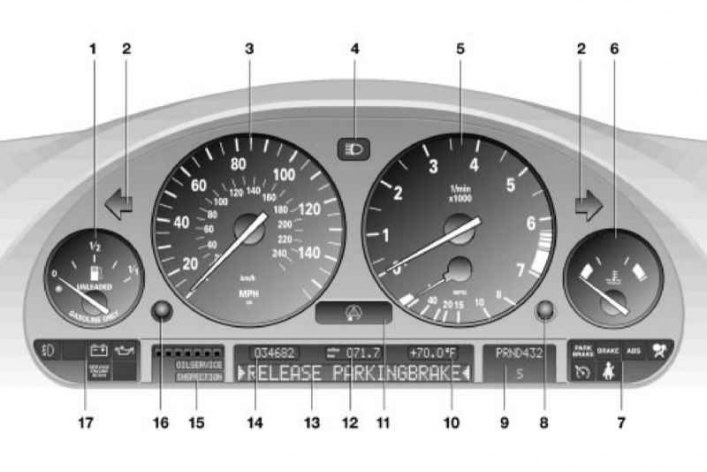
Location of control and measuring instruments
1 — Fuel reserve indicator with built-in K/L of fuel reserve use
2 - Direction indicator lights
3 - Speedometer
4 — High beam indicator
5 - Tachometer and fuel consumption indicator
6 — Coolant temperature gauge
7, 17 — Control lamps and indicators
8 — Diagnostic button ("CHECK")
9 — Indicator of the selector lever position and the selected AT program (see section Using an automatic transmission (AT))
10 — Outside air temperature gauge
11 — K/L of ASC T/DSC systems
12 — Resettable odometer
13 - Text display
14 — Odometer
15 — Maintenance indicator (see section Schedule of current maintenance Chapters Vehicle settings and routine maintenance)
16 — Counter reset button 12
Speedometer and tachometer
Speedometer shows the speed of the car in km/h; tachometer shows the engine crankshaft rotation frequency in thousands of rpm and is designed to monitor engine speed – the arrow should not enter the red zone of the scale.
Early upshifting saves fuel and reduces engine noise. During the vehicle's break-in period, avoid excessive crankshaft speed. When critical crankshaft speeds are reached, the control system automatically interrupts the fuel supply, which is accompanied by a sudden loss of power.
Fuel consumption indicator
The fuel consumption indicator is designed to visually represent fuel consumption (l/100 km), allowing you to draw conclusions about the efficiency of your driving style. When the car is stationary, the indicator needle is at zero.
Fuel reserve indicator and fuel reserve usage K/L
The fuel gauge serves for visual monitoring of the fuel remaining in the tank. The error in the fuel gauge readings is minimal when the vehicle is in a strictly horizontal position, and increases when the vehicle is moving on winding or hilly roads. The gauge operates when the ignition is on. When the gauge enters the reserve fuel zone, the corresponding K/L is switched on. In this case, the vehicle should be refueled at the first opportunity. K/L also switches on when the ignition is switched on and should go out after a short time, indicating that the fuel gauge is working properly. If K/L does not switch off, there is a reserve volume of fuel left in the tank.
Resettable trip meter and odometer
Resettable odometer allows you to monitor the vehicle's mileage starting from the moment its readings are reset (for example, for the current trip). To reset the counter, when in position "1" or "2" press the reset button in the ignition switch (Location of control and measuring instruments).
Odometer is intended to indicate the total mileage of the vehicle.
Temperature gauge outside the car
This indicator works already when the key in the ignition switch is turned to the position "1". If the reset button is pressed in this position of the ignition key (Location of control and measuring instruments) and, holding it, turn the ignition key to the position "0", the temperature units are switched. When the temperature drops to approximately 3°C, the thermometer readings start flashing and an audible signal sounds to warn of possible ice. The warning is repeated until the temperature rises to 6°C.
Coolant temperature indicator and engine overheating K/L
It is designed to visually display the coolant temperature in order to prevent engine damage. The engine overheating K/L, built into the gauge, lights up when the ignition is turned on and should go out after a short time, indicating that the gauge is working properly. If the gauge needle is in the blue zone, i.e. the engine is not warmed up, avoid driving at high speed and high engine speeds. When the gauge needle enters the red zone of the scale, the engine overheating K/L lights up and/or a message is displayed on the text display in the instrument cluster "COOLANT TEMPERATURE". This indicates that the engine is overheating - turn off the engine and let it cool down. Check the coolant level and the tightness of the cooling system (see chapter Vehicle settings and routine maintenance). Correct any faults found. The normal range of engine operating temperatures is the area between the blue and red zones on the coolant temperature gauge dial.
Text display in the instrument cluster
The display in the instrument cluster is designed to display various warnings and fault messages in text form. The display operates when the ignition is on.
According to their priority, fault messages are divided into two groups.
First priority group
Information about these faults is accompanied by a sound signal and flashing signal symbols in the form of triangles at the edges of the display. If there are several faults, the messages are displayed one after the other. The messages do not disappear until the defects are corrected and cannot be erased by pressing the automatic diagnostics button (Location of control and measuring instruments). Below is a list of messages of the first priority group (with English language selected).
- "RELEASE PARKING BRAKE" (Release the parking brake);
- "COOLANT TEMPERATURE" (Engine overheated, stop engine and troubleshoot);
- "STOP! ENGINE OILPRESS" (Low engine oil pressure, stop engine and troubleshoot);
- "CHECK BRAKE FLUID" (Low brake fluid level, add fluid and repair as necessary);
- "FLAT TIRE" * or "TIRE DEFECT" * (The tire is flat, slow down and stop the car);
- "LEVEL CONTROL INACTIVE" * (The ride height adjustment system is faulty);
- "SPEED LIMIT" * (The speed is higher than the preset speed in the trip computer).
Second priority group
Warnings in this group appear for approximately 20 seconds when the ignition is on. After the message goes out, the warning symbols remain at the edges of the display. To recall the messages, press the self-diagnosis button. Below is a list of messages in the first priority group (with English language selected).
- "TRUNK LID OPEN" (The trunk is open, the message appears only when you first start moving with the trunk open);
- "DOOR OPEN" (One of the doors is open, the message appears as soon as the speed of movement exceeds a certain insignificant value);
- "FASTEN SEAT BELTS" * (Fasten your seat belts, the corresponding K/L light comes on at the same time);
- "WASHER FLUID LOW" (Low washer fluid level);
- "CHECK ENGINE OIL" (Low engine oil level);
- "OUTSIDE TEMPERATURE -5°C" (The message appears when the air temperature outside the car is below 3°C, warning of the possibility of black ice);
- "TIRE PRESSURE SET" * (Setting the tire inflation pressure, see Section Interior controls and equipment);
- "CHECK TIRE PRESSURE" * (Check tire inflation pressure);
- "TIRE CHECK INACTIVE" * (Fault in RDC system, see Section Interior controls and equipment);
- "BREAK LAMP CIRCUIT" (Malfunction in the brake light circuit, or the brake light bulb has burned out);
- "CHECK LOWBEAMS" (Malfunction in the low beam circuit);
- "CHECK SIDE LAMPS" (Malfunction in the parking light circuit);
- "CHECK REAR LAMPS" (Malfunction in the rear light circuit);
- "CHECK FRONT FOGLAMP" (Fault in fog lamp circuit);
- "CHECK LICPLATE LAMP" (Malfunction in the license plate light circuit);
- "CHECK TRAILER LIGHTS" (Trailer lighting circuit fault);
- "CHECK HIGHBEAMS" (Malfunction in the high beam circuit);
- "CHECK BACKUP LIGHTS" (Malfunction in the reverse light circuit);
- "TRANS. FAILSAFE PROG" (Gearbox control emergency program);
- "CHECK BRAKE LININGS" (Check the brake pads, see Chapter Brake system)
- "CHECK COOLANT LEVEL" (Low coolant level, add coolant and troubleshoot as necessary);
- "ENGINE FAILSAFE PROG" (ECM is running in failsafe mode).
End of trip messages
All fault messages that appeared during the trip are displayed one after another on the display after turning the ignition key to position "0".
When you open the driver's door at the end of a trip, one of the following messages may also appear, accompanied by an audible signal:
- "LIGHTS ON" (The lights are not turned off);
- "KEY IN IGNITION LOCK" (The key is not removed from the ignition switch);
- "CHECK ENGINE OIL LEV" (Check your engine oil level at your next fill up).
Using the diagnostic button, you can call up messages for about three minutes after the end of the trip, even if the key has already been removed from the ignition and the indicator has gone out. If there are several messages, press the diagnostic button several times.
Checking the operability of the self-diagnostic system
If after turning the ignition key to position "2" press the diagnostic button, the display should show confirmation that the system is working properly ("CHECK CONTROL OK").
Control lamps and indicators
Below is a description of the K/L and indicators located in the instrument cluster. The K/L and indicators that light up when the ignition is turned on for a while to check for functionality and go out after a few seconds are marked with "*". If any K/L does not light up during the check, it may be burnt out or there is a break in its circuit.
K/L red color*
When these K/L are turned on, the vehicle should be stopped at the first opportunity and the faults should be corrected.
 — K/L of the charging system, its activation during movement indicates a malfunction in the charging circuit (broken wiring, generator malfunction, broken or loose generator drive belt). A defective alternator drive belt is also indicated by the need to apply great force to turn the steering wheel. Driving with a faulty alternator drive is not allowed, as this may lead to engine overheating.
 — K/L low engine oil pressure, its activation with the engine running indicates low engine oil pressure and is accompanied by a corresponding message on the text display. Check and, if necessary, adjust the engine oil level (see section Access, protection). If the level is within the normal range, contact the service station for diagnostics and engine repair. Continuing to drive with the engine running is not allowed, as this will lead to its breakdown due to lack of lubrication.
BRAKE or
 K/L low brake fluid level or brake pad wear, accompanied by a corresponding message on the text display.
K/L and red indicators
The K/L data and indicators point out important points when driving.
PARK BRAKE or
 Parking brake engaged indicator, illuminated when the parking brake is engaged.
 * K/L of unfastened seat belts (see section Seat belts), is not installed on all models.
 SRS system K/L (see section Supplemental Restraint System (SRS)).
K/L and yellow indicators*
These K/L and indicators indicate the need to check the corresponding vehicle system at the earliest opportunity.
BRAKE or
 K/L of the DBC system (dynamic brake control), its activation indicates a malfunction in the DBC system. However, the braking system continues to operate properly.
ABS or
 K/L of the ABS system, its activation indicates that the system is disabled due to its malfunction. At the same time, the braking system continues to operate properly.
 ASC T/DSC system K/L, if this K/L does not turn off after starting the engine or lights up while driving, the system is faulty or has been forcibly turned off (see section Interior controls and equipment). Blinking K/L indicates system activity.
SERVICE ENGINE SOON or
 OBD system K/L, when this K/L is on, it indicates a fault in the power supply system. Although the vehicle remains operational, the engine management system should be diagnosed and/or repaired as soon as possible.
K/L and yellow and blue indicators
 The direction indicator indicators flash when the corresponding direction indicators are turned on. Rapid flashing indicates a fault in the direction indicator circuit.
 Tempostat activation indicator, indicates the possibility of using the Tempostat functions (see Part Comfort devices).
 Fog lights on indicator.
 The high beam indicator lights up when the high beam headlights are turned on or when the high beam headlights are signaled.
This article is available at russian, bulgarian, belarusian, ukrainian, serbian, croatian, romanian, polish, slovak, hungarian
Article verified: Polikarpov Saveliy
Share information:
Previous articles
БМВ E38: Manual
Next articles
Similar articles on other types of BMW cars:
Instrument cluster BMW 3 Series E46 (1998-2006)
Removal and installation the instrument panel BMW 3 Series E30 (1982-1994)
Removal and installation the instrument cluster BMW 5 Series E12 (1972-1981)
Instrument cluster BMW 5 Series E34 (1988-1996)
Instrument cluster BMW X3 E83 (2003-2010)
Controls and instrument panel BMW X5 E53 (1999-2006)
Instrument cluster BMW 3 Series E46 (1998-2006)
Removal and installation the instrument panel BMW 3 Series E30 (1982-1994)
Removal and installation the instrument cluster BMW 5 Series E12 (1972-1981)
Instrument cluster BMW 5 Series E34 (1988-1996)
Instrument cluster BMW X3 E83 (2003-2010)
Controls and instrument panel BMW X5 E53 (1999-2006)
Link in different formats to this page
Visitor comments
No comments yet
- General information
- Introduction to guide
- Manual
- Maintenance
- Power unit
- Engine M60/1, M60/2 (petrol)
- M62 engine (petrol)
- M57 engine (diesel)
- M67 engine (diesel)
- Cooling system
- Fuel system (petrol)
- Fuel system (diesel)
- Exhaust system
- Ignition and control systems
- Charge and launch systems
- Transmission
- Clutch
- Mechanical gearbox
- Automatic gearbox
- Cardan and drive shafts
- Chassis
- Brake system
- Front suspension
- Rear suspension
- Steering
- Body
- Exterior
- Interior
- Electrical equipment
- Equipment and devices
- Lighting
- Heating and air conditioning
- Electrical circuits
- General information
- Care and maintenance
- Power unit
- Minor engine repair
- Engine overhaul
- Lubrication system
- Cooling system
- Ignition system
- Supply system
- Injection system (petrol)
- Injection system (diesel)
- Exhaust system
- Transmission
- Clutch
- Manual gearbox
- Automatic gearbox
- Cardan gear
- Rear axle and shafts
- Chassis
- Front suspension
- Rear suspension
- Steering
- Wheels and tires
- Brake system
- Body
- Body elements
- Electrical equipment
- Equipment and devices
- Electrical circuits