



- Home
- BMW 7 Series
- E38
- General information
- Manual
- Automatic ventilation, heating and air conditioning (HVAC) system
Automatic ventilation, heating and air conditioning (HVAC) system (BMW 7 Series E38)
General information
The vehicles in question are equipped with an HVAC system with automatic control capability.
Air is drawn in through the windshield cowl grille and into the cabin, passing through the filter and, if the heater is on, through the heater core. Keep the windshield cowl grille clear of leaves and other debris, and replace the cabin filter periodically to get the most out of your ventilation system.
Air deflectors are used to regulate the direction of air flow in the cabin (two side, two central front and two central rear). An additional regulator for the temperature of the air coming from the central deflectors is installed between them. When the rear deflectors are closed, air is supplied only through the front deflectors. When the front deflectors are closed, air is supplied to blow the windshield.
The air conditioner only operates when the engine is running and the ambient temperature is above 5°C. On some models
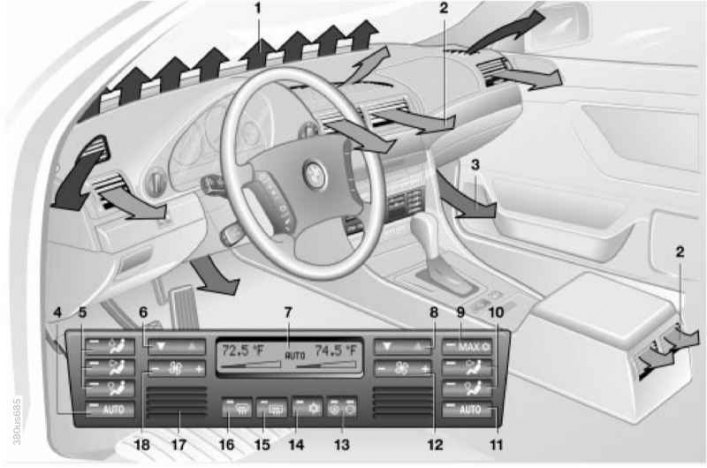
General view of the HVAC system control unit
1 — Air flows for blowing windshield and side windows
2 - Air flow to the face
3 - Air flows to the feet
4 — Automatic air distribution switch in the left part of the cabin
5 - Switches for specific air distribution in the left part of the cabin
6 — Temperature control button on the left side of the cabin
7 — Display of temperature and air flow intensity in the left and right parts of the cabin
8 — Temperature control button on the right side of the cabin
9 — Switch for cooling modes and use of engine residual heat
10 - Switches for specific air distribution on the right side of the cabin
11 — Automatic air distribution switches on the right side of the cabin
12 — Air flow intensity control button on the right side of the cabin
13 — Automatic air circulation mode switch (AUC)
14 — K/V switch
15 — Rear window heating switch
16 — Windscreen defroster switch
17 — Interior temperature sensor grille
18 — Air flow intensity control button on the right side of the cabin
Independent ventilation system
This system uses the HVAC fan to ventilate the cabin and reduce the cabin temperature when the vehicle is parked. The independent ventilation system is controlled via the multi-function display (see section Comfort devices).
Avoid turning on the independent ventilation system twice while the vehicle is parked to avoid draining the battery.
Rear window defroster switch
The switch has a built-in heating indicator light. Turn on the heating to remove condensation and frost from the rear window. The heating turns off automatically after a certain time after it is turned on, but if the desired result is achieved before this time, turn off the heating manually. While the indicator in the switch is on, the heating operates at maximum power, and after the indicator turns off, it operates at reduced power for some time before the heating is automatically turned off.
The rear window heating should be turned on when the engine is running to prevent the battery from discharging.
Optimal system settings
It is recommended to use the automatic control mode of the HVAC system. To do this, press the AUTO button (General view of the HVAC system control unit), select the desired temperature (22°C is recommended) and direct the air flow from the center vents so that it blows over the occupants of the seats, but not directly on them. The following describes how to use the manual HVAC controls.
To select one of the specified air supply modes (to the face, to the legs or to the glass blowing) press the corresponding switch (General view of the HVAC system control unit). In this case, the automatic mode is switched off.
For quick removing frost and condensation from glass press the windshield defroster switch (General view of the HVAC system control unit).
For on/off K/V press the corresponding switch (General view of the HVAC system control unit). When the air conditioning is running, the air entering the passenger compartment is cooled and dried. This speeds up the removal of condensation from the glass when the air humidity is high.
The moisture taken from the air when the air conditioning system is running condenses and drains from under the vehicle, so it is normal for a puddle to form under the vehicle after it has been parked with the air conditioning system on. To get the most out of the air conditioning system, keep the windows and sunroof closed when using it.
For maximum cooling air supplied to the cabin, press the corresponding switch (General view of the HVAC system control unit), when the key in the ignition switch is in the position starting from "1". If you press this switch when the key is in the on position "0", turns on residual heat utilization mode engine. This mode is only available when the warm engine is turned off, the battery has sufficient charge and the outside temperature is less than 15°C.
When pressed in sequence automatic air circulation switch you can switch between automatic mode (the circulation mode switches on and off automatically, depending on the quality of the outside air, while the indicator on the left side of the switch lights up), supply ventilation mode (outside air constantly enters the cabin, but the indicators do not light) and recirculation mode (outside air is not supplied to the cabin, while the indicator on the right side of the switch is on).
When equipped with a multi-function steering wheel, switch between automatic mode and fresh air ventilation mode using the switch located on it.
The circulation mode should be used when driving on dusty roads or in heavy traffic to prevent dust, unpleasant odors and exhaust gases from entering the cabin. In addition, the circulation mode allows you to significantly speed up the reduction of the temperature in the cabin when using the air conditioning.
Do not turn on the air circulation mode for a long time, as this will make the air in the car interior stale and condensation will appear on the windows.
With the help of temperature and air flow intensity switches separately for the left and right parts of the cabin, in which you can set different temperatures and air flow rates. These parameters are displayed on the display (General view of the HVAC system control unit). When you press the air flow intensity reduction button at its minimum value, the fan, heater and air conditioner are switched off and the circulation mode is selected. To return to the normal operating mode of the HVAC system, press any button on its control unit.
Rear A/C system
If equipped accordingly, a control unit for the rear air conditioning system is installed in the rear of the central console.
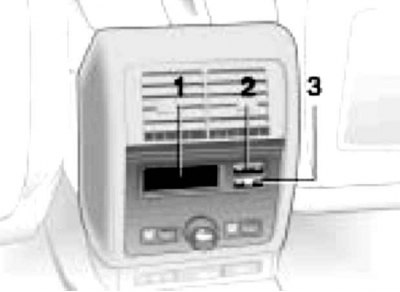
Rear HVAC control unit
1 — Display of temperature and air flow intensity values
2 — Temperature controller/system switch
3 — Air supply intensity regulator/system switch
The original article is posted on the resource: BMWMAN.RU
This article is available at russian, bulgarian, belarusian, ukrainian, serbian, croatian, romanian, polish, slovak, hungarian
Article verified: Polikarpov Saveliy
Share information:
Previous articles
БМВ E38: Manual
Next articles
Similar articles on other types of BMW cars:
Heating and ventilation system elements — removal and installation BMW 3 Series E46 (1998-2006, petrol)
Diagnostics of heating system faults BMW 3 Series E30 (1982-1994)
Autonomous heating and ventilation system with timer BMW 5 Series E34 (1988-1996)
Heating, ventilation and air conditioning BMW 5 Series E28 (1981-1988)
Automatic heating and air conditioning system BMW X3 E83 (2003-2010)
Automatic diagnostic system BMW X5 E53 (1999-2006)
Heating and ventilation system elements — removal and installation BMW 3 Series E46 (1998-2006, petrol)
Diagnostics of heating system faults BMW 3 Series E30 (1982-1994)
Autonomous heating and ventilation system with timer BMW 5 Series E34 (1988-1996)
Heating, ventilation and air conditioning BMW 5 Series E28 (1981-1988)
Automatic heating and air conditioning system BMW X3 E83 (2003-2010)
Automatic diagnostic system BMW X5 E53 (1999-2006)
Link in different formats to this page
Visitor comments
No comments yet
- General information
- Introduction to guide
- Manual
- Maintenance
- Power unit
- Engine M60/1, M60/2 (petrol)
- M62 engine (petrol)
- M57 engine (diesel)
- M67 engine (diesel)
- Cooling system
- Fuel system (petrol)
- Fuel system (diesel)
- Exhaust system
- Ignition and control systems
- Charge and launch systems
- Transmission
- Clutch
- Mechanical gearbox
- Automatic gearbox
- Cardan and drive shafts
- Chassis
- Brake system
- Front suspension
- Rear suspension
- Steering
- Body
- Exterior
- Interior
- Electrical equipment
- Equipment and devices
- Lighting
- Heating and air conditioning
- Electrical circuits
- General information
- Care and maintenance
- Power unit
- Minor engine repair
- Engine overhaul
- Lubrication system
- Cooling system
- Ignition system
- Supply system
- Injection system (petrol)
- Injection system (diesel)
- Exhaust system
- Transmission
- Clutch
- Manual gearbox
- Automatic gearbox
- Cardan gear
- Rear axle and shafts
- Chassis
- Front suspension
- Rear suspension
- Steering
- Wheels and tires
- Brake system
- Body
- Body elements
- Electrical equipment
- Equipment and devices
- Electrical circuits