
- Home
- BMW 7 Series
- E38
- General information
- Manual
- Supplemental Restraint System (SRS)
Supplemental Restraint System (SRS) (BMW 7 Series E38)
Do not place hard or sharp objects between your body and the airbags, do not carry hard or sharp objects on your lap, and do not smoke a pipe while driving, as this may result in serious injury in an accident. To prevent the risk of unauthorized deployment of the airbags, try not to press your hands to the locations of the airbags and their modules. The locations of the airbags are marked with the words "AIRBAG".
The Supplemental Restraint System (SRS) devices and components include:
- Two front airbags, as well as (with appropriate equipment) side airbags and side curtains. The front driver's airbag module is housed in the steering wheel hub; the front passenger airbag is located in a special cavity on the right side of the car's instrument panel, above the glove compartment. The side airbags are located in the door trim panels. The side curtains are located under the headliner above the door openings;
- Directional overload sensors that are triggered in the event of a severe frontal or side impact (when the vehicle is equipped with side airbags and curtains);
- An electronic self-diagnostic system which, when the ignition is on, continuously tests the overload sensors, control unit, airbag gas generators, seat belt pretensioner pyropatrons and the connecting electrical wiring of the corresponding circuits;
- Automatic emergency seat belt tensioners built into the front seat belt retractors;
- SRS indicator lamp in the instrument cluster.
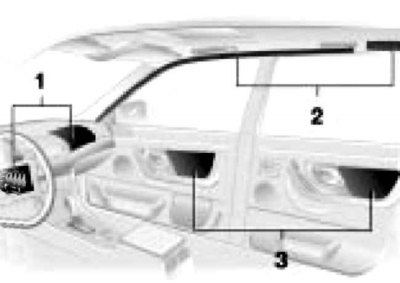
Location of airbags
1 - Front
2 - Side
3 - Side curtains
The rear airbags can be deactivated – please contact your BMW representative.
The operating principle of airbags
In minor frontal and side collisions, as well as in the event of a vehicle rollover, the airbags should not deploy.
Directional overload sensors react to the excess of a certain limit value, which may occur during a strong frontal or side collision. At the signal from the sensors, the control unit turns on the airbag gas generators, causing their immediate filling.
During a collision, the seat belt keeps the lower part of the occupant's body from moving. Front airbags help prevent injury to the driver and front passenger when their head and chest hit the steering wheel/dashboard or when their head hits the pillars/door windows.
Both front airbags are deployed simultaneously. However, it is possible that only one of the pair of airbags will be deployed – this becomes possible when the magnitude of the directional overloads that arose during the collision was on the edge of the sensitivity range of the sensors. In this case, the seat belts provide sufficiently reliable protection for the driver and front passenger, while the effect of the airbag deployment will be minimal. The side airbag and inflatable curtain are deployed only on the side of the impact.
Immediately after the airbags are triggered and perform their functions, the gas is released from them, which allows the driver to maintain visibility and freely manipulate all vehicle controls.
The entire duration of the process from the moment the overload sensors send a signal to the release of gas from the cushions takes no more than a tenth of a second. The modules are triggered so quickly that the human ear is simply unable to perceive the pop of the gas generators when filling the cushions.
After the airbags have deployed, the interior of the car may appear slightly smoky due to the fine powder suspension that is usually sprinkled on the folded airbag shells. People with respiratory diseases may experience some discomfort from the airborne gaseous products emitted by the airbag gas generators.
SRS warning light
The SRS warning lamp (K/L) is mounted in the vehicle's instrument cluster (see section Vehicle equipment, arrangement of instruments and controls).
When the ignition is turned on, the K/L lights up briefly and then goes out, confirming the proper functioning of all SRS system components.
If the lamp does not turn on, does not go out, flashes, or goes off at any other time, the car owner should contact a service station specialist at the first opportunity, since the SRS system may fail during an accident if the above symptoms are present.
Seat belts with automatic emergency tensioners
The front seat belt return devices are equipped with emergency automatic tensioners. The tensioners are activated in the event of severe frontal overloads (simultaneously with the front airbags), arising during a frontal collision, and provide instantaneous selection of slack in the belts, as a result of which the latter's straps tightly encircle the body of the occupant, significantly increasing the level of protection for the driver and front passenger.
The activation of the modules is accompanied by a loud bang and a small emission of smoke.
The smoke released when the tensioners are triggered is safe for human health, but when inhaled directly it can cause irritation of the mucous membranes.
The procedure for using such seat belts is similar to the procedure for using conventional belts equipped with inertial return devices. The tensioner mechanism does not require any additional skills or knowledge from the user.
As in the case of airbags, emergency tensioner modules are designed for a single activation and after that they are subject to replacement together with the belts – contact a service station.
This article is available at russian, bulgarian, belarusian, ukrainian, serbian, croatian, romanian, polish, slovak, hungarian
Article verified: Polikarpov Saveliy
Share information:
Previous articles
БМВ E38: Manual
Next articles
Similar articles on other types of BMW cars:
Supplemental Restraint System (SRS) BMW 3 Series E46 (1998-2006)
Power supply system BMW 3 Series E21 (1975-1983)
General information about the Supplemental Restraint System (SRS) BMW 5 Series E28 (1981-1988)
Cooling system BMW 5 Series E12 (1972-1981)
Precautions when working with Supplemental Restraint System (SRS)… BMW X3 E83 (2003-2010)
Automatic diagnostic system BMW X5 E53 (1999-2006)
Supplemental Restraint System (SRS) BMW 3 Series E46 (1998-2006)
Power supply system BMW 3 Series E21 (1975-1983)
General information about the Supplemental Restraint System (SRS) BMW 5 Series E28 (1981-1988)
Cooling system BMW 5 Series E12 (1972-1981)
Precautions when working with Supplemental Restraint System (SRS)… BMW X3 E83 (2003-2010)
Automatic diagnostic system BMW X5 E53 (1999-2006)
Link in different formats to this page
Visitor comments
No comments yet
- General information
- Introduction to guide
- Manual
- Maintenance
- Power unit
- Engine M60/1, M60/2 (petrol)
- M62 engine (petrol)
- M57 engine (diesel)
- M67 engine (diesel)
- Cooling system
- Fuel system (petrol)
- Fuel system (diesel)
- Exhaust system
- Ignition and control systems
- Charge and launch systems
- Transmission
- Clutch
- Mechanical gearbox
- Automatic gearbox
- Cardan and drive shafts
- Chassis
- Brake system
- Front suspension
- Rear suspension
- Steering
- Body
- Exterior
- Interior
- Electrical equipment
- Equipment and devices
- Lighting
- Heating and air conditioning
- Electrical circuits
- General information
- Care and maintenance
- Power unit
- Minor engine repair
- Engine overhaul
- Lubrication system
- Cooling system
- Ignition system
- Supply system
- Injection system (petrol)
- Injection system (diesel)
- Exhaust system
- Transmission
- Clutch
- Manual gearbox
- Automatic gearbox
- Cardan gear
- Rear axle and shafts
- Chassis
- Front suspension
- Rear suspension
- Steering
- Wheels and tires
- Brake system
- Body
- Body elements
- Electrical equipment
- Equipment and devices
- Electrical circuits