
- Home
- BMW 7 Series
- E38
- General information
- Manual
- Adjusting seats and headrests
Adjusting seats and headrests (BMW 7 Series E38)
It is not permitted to adjust the seats while the vehicle is moving.
The design of car seats ensures maximum comfort for the person sitting in them, while simultaneously providing conditions for the most effective performance of their functions by seat belts and airbags. The choice of seat position also affects the safety of the person sitting in it. For example, if the front seat is moved too far forward, the risk of injury to the occupant increases when the airbag is triggered, as well as the risk of being thrown through the windshield in a frontal collision.
Increasing the angle of the seat back will worsen the fixation of the body by the seat belt - the more the seat back is tilted back, the higher the probability of the occupant's body sliding under the lap section of the belt in the event of a strong frontal impact, and the more severe the injuries may be.
Fix the front seat in the position that is as far away from the steering wheel/dashboard as possible, while still being comfortable for driving the car, and bring the backrest to an upright position.
Headrests prevent injury to the cervical spine and head in the event of a rear impact. The headrest should be adjusted in height so that its upper edge is level with the upper edge of the occupant's ear.
Adjustment the front seats are operated by means of an electric drive controlled by switches located on the outer side of the seat cushion.
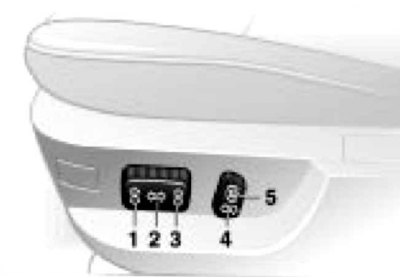
Electric seat control switches
1 - Adjusting the tilt of the seat cushion (driver's seat only)
2 - Move forward and backward
3 - Adjusting the height of the seat cushion
4 — Backrest tilt adjustment
5 - Headrest height adjustment
The headrest angle is manually adjusted.
It is possible to store up to three positions of the seat, outside rear-view mirrors and steering column.
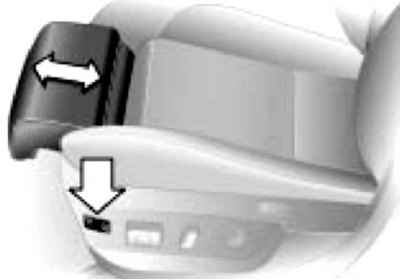
On models with sportsand the seats also have adjustable thigh support.
Adjusting the position of the hip support
On models with improved the seats also have adjustable lumbar and shoulder support.
Adjustable lumbar and shoulder support
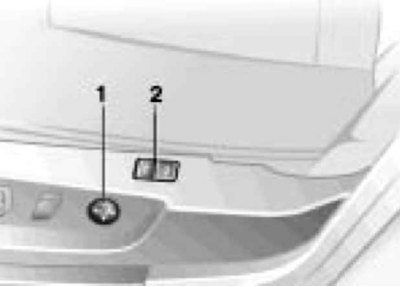
1 - Adjusting the lumbar support
2 - Adjusting the shoulder support
The degree of curvature of the lumbar support can be adjusted (when pressing the front or back edge of the switch) and the height of the convex region (when you press the top or bottom edge of the switch).
Some models are equipped with massage seats in the cushion of which fluid circulates, which stimulates the blood supply to the intervertebral discs and surrounding tissues.
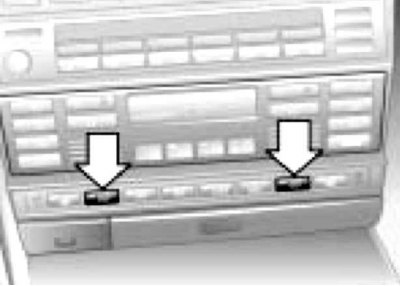
The circulation of fluid in the driver's or front passenger's massage seat is activated by pressing the corresponding button.
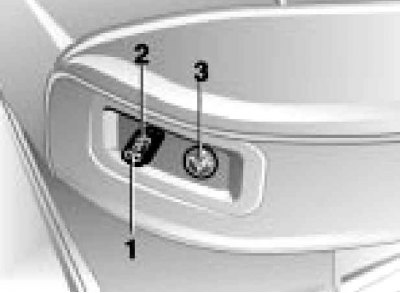
Some models are equipped with back seat with electric drive for adjusting the backrest angle (1), headrest height (2) and lumbar support (3).
Memory for seat, outside rearview mirrors and steering column position
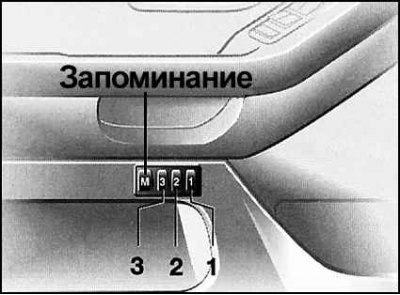
The switch block for calling and storing the positions of the seat, outside rear-view mirrors and steering column is located in the driver's door trim panel.
The position of the seat lumbar support is not stored in memory.
To commit to memory current settings, when set to position "1" or "2" press the button in the ignition switch "M" (the indicator built into it will turn on), and then one of the buttons "1", "2" or "3" (the indicator will turn off).
If the "M" button is pressed accidentally, press it again to turn off the indicator.
To recall the settings stored in memory, use one of the following methods:
- Unlock and open the driver's door or turn the ignition switch to position "1", then press the button briefly "1", "2" or "3". The movement of the seat, mirrors and steering column is interrupted if one of the seat adjustment switches or one of the memory buttons is pressed at this time;
- If the driver's door is closed and the key in the ignition is in position "0" or "2", or is completely removed from the lock, press the button "1", "2" or "3" and hold it until the seat, mirrors and steering column stop moving.
It is possible to automatically call up personal settings when unlocking the car using a personal remote control. To personalise remote controls, contact your BMW representative.
[The original is located on the internet portal BMWMAN]
This article is available at russian, bulgarian, belarusian, ukrainian, serbian, croatian, romanian, polish, slovak, hungarian
Article verified: Polikarpov Saveliy
Share information:
Previous articles
БМВ E38: Manual
Next articles
Similar articles on other types of BMW cars:
Adjusting clearances in the valve drive mechanism BMW 3 Series E21 (1975-1983)
Adjusting clearances in the valve drive mechanism BMW 5 Series E12 (1972-1981)
Adjusting the headlight range BMW X3 E83 (2003-2010)
Seat headrests BMW X5 E53 (1999-2006)
Adjusting clearances in the valve drive mechanism BMW 3 Series E21 (1975-1983)
Adjusting clearances in the valve drive mechanism BMW 5 Series E12 (1972-1981)
Adjusting the headlight range BMW X3 E83 (2003-2010)
Seat headrests BMW X5 E53 (1999-2006)
Link in different formats to this page
Visitor comments
No comments yet
- General information
- Introduction to guide
- Manual
- Maintenance
- Power unit
- Engine M60/1, M60/2 (petrol)
- M62 engine (petrol)
- M57 engine (diesel)
- M67 engine (diesel)
- Cooling system
- Fuel system (petrol)
- Fuel system (diesel)
- Exhaust system
- Ignition and control systems
- Charge and launch systems
- Transmission
- Clutch
- Mechanical gearbox
- Automatic gearbox
- Cardan and drive shafts
- Chassis
- Brake system
- Front suspension
- Rear suspension
- Steering
- Body
- Exterior
- Interior
- Electrical equipment
- Equipment and devices
- Lighting
- Heating and air conditioning
- Electrical circuits
- General information
- Care and maintenance
- Power unit
- Minor engine repair
- Engine overhaul
- Lubrication system
- Cooling system
- Ignition system
- Supply system
- Injection system (petrol)
- Injection system (diesel)
- Exhaust system
- Transmission
- Clutch
- Manual gearbox
- Automatic gearbox
- Cardan gear
- Rear axle and shafts
- Chassis
- Front suspension
- Rear suspension
- Steering
- Wheels and tires
- Brake system
- Body
- Body elements
- Electrical equipment
- Equipment and devices
- Electrical circuits