
Cars Mazda Cars Mitsubishi Cars Toyota Cars Chevrolet Cars AvtoVAZ Cars Kia Cars Nissan
English Русский
Български
Беларускі
Український
Српски
Hrvatski
Română
Polski
Slovenský
Magyar
| Articles | Contacts | Sitemap |   
BMWman.ru


3 series   5 series   7 series   BMW X3   BMW X5   BMW X6

E38 (1994-2001) E32 (1986-1994)
  • Home
  • BMW 7 Series
  • E38
  • General information
  • Manual
  • Tempostat

Tempostat (BMW 7 Series E38)

            0

Using the tempostat during heavy traffic (for example, in the city), on slippery and winding roads, as well as in other driving situations that may require changing speed, may lead to loss of control of the vehicle. To avoid accidental activation of the cruise control, do not leave it on when not in use.


The cruise control is designed to maintain a constant vehicle speed (not less than 30 km/h) without having to keep your foot on the gas pedal (if the engine can provide it).
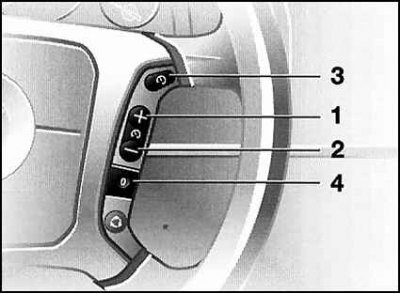
The cruise control is designed to maintain a constant vehicle speed (not less than 30 km/h) without…


The cruise control is controlled using buttons located on the right side of the steering wheel.

1. For activations tempostat set the key in the ignition switch to position "1" or "2" and press button 4 – the tempostat activation indicator will turn on (see section Instrument cluster).

2. For deactivation cruise control after canceling the maintenance of the set speed, press button 4 - the indicator in the instrument cluster will turn off. Cruise control is also deactivated when the ignition is turned off.

3. For installations constant speed of movement, activate the cruise control, accelerate the car to the required speed (not less than 30 km/h) and press button 1 briefly. Now you can take your foot off the gas pedal. Each subsequent short press of button 1 will increase the constant speed by 1 km/h. If you hold down button 1, the car will accelerate and when the button is released, the current speed will be set as the constant speed.


On steep climbs/descents, when using cruise control, the vehicle may decrease/increase speed.


4. For temporary increase in speed (for example, when overtaking) press the gas pedal; after releasing the gas pedal, the previously selected constant speed will be automatically set.

The previously selected constant speed is not restored if it has been exceeded for a long time.


5. For decrease the current set speed use button 2: Each time you press it once, the set speed decreases by 1 km/h, and if you hold the button down, the speed decreases continuously and is set as constant when you release the button.

6. For cancellations to maintain the set speed, press button 4 – the indicator does not go out and, if necessary, you can return to the previously set speed (see below). In addition, the cancellation of maintaining the set speed occurs automatically when:

7. Pressing the brake pedal;

8. Moving the AT selector lever from position "D" to position "N";

9. In case of prolonged excess or reduction of the established speed.

10. For return to the previously set constant speed after canceling it, press button 3.

This article is available at russian, bulgarian, belarusian, ukrainian, serbian, croatian, romanian, polish, slovak, hungarian
Article verified: Polikarpov Saveliy

Share information:
Previous articles
БМВ E38: Manual
Next articles

Automatic ventilation, heating and air conditioning (HVAC) system
Multifunctional display
Instrument cluster
Interior controls and equipment
The dangers of carbon monoxide poisoning
Starting and stopping the engine, starting the movement
Running in a car
Using an automatic transmission (AT)
Brake system
Features of operation of cars with a catalytic converter


Similar articles on other types of BMW cars:
Tempostat (automatic system for maintaining a set speed) BMW 3 Series E46 (1998-2006)
Tempostat (speed control system) BMW 5 Series E39 (1995-2003)
Automatic speed control (tempostat) BMW 5 Series E28 (1981-1988)
Link in different formats to this page


Visitor comments

No comments yet


How much 38 + 30 =


BMW E38 (1994-2001) 
  • General information
  • Introduction to guide
  • Manual
  • Maintenance
  • Power unit
  • Engine M60/1, M60/2 (petrol)
  • M62 engine (petrol)
  • M57 engine (diesel)
  • M67 engine (diesel)
  • Cooling system
  • Fuel system (petrol)
  • Fuel system (diesel)
  • Exhaust system
  • Ignition and control systems
  • Charge and launch systems
  • Transmission
  • Clutch
  • Mechanical gearbox
  • Automatic gearbox
  • Cardan and drive shafts
  • Chassis
  • Brake system
  • Front suspension
  • Rear suspension
  • Steering
  • Body
  • Exterior
  • Interior
  • Electrical equipment
  • Equipment and devices
  • Lighting
  • Heating and air conditioning
  • Electrical circuits
BMW E32 (1986-1994) 
  • General information
  • Care and maintenance
  • Power unit
  • Minor engine repair
  • Engine overhaul
  • Lubrication system
  • Cooling system
  • Ignition system
  • Supply system
  • Injection system (petrol)
  • Injection system (diesel)
  • Exhaust system
  • Transmission
  • Clutch
  • Manual gearbox
  • Automatic gearbox
  • Cardan gear
  • Rear axle and shafts
  • Chassis
  • Front suspension
  • Rear suspension
  • Steering
  • Wheels and tires
  • Brake system
  • Body
  • Body elements
  • Electrical equipment
  • Equipment and devices
  • Electrical circuits
BMWman.ru © 2017-2026 · Mobile version · News and articles · Sitemap: EN BG BY UA RS HR RO PL SK HU · Feedback · Site search
3er E21 · 3er E30 · 3er E36 · 3er E46 [petrol] · 3er E46 · 5er E12 · 5er E28 · 5er E34 · 5er E39 · 7er E32 · 7er E38 · X3 E83 · X5 E53 ·
This site uses cookies 🍪, without them some features simply would not work.