



Table of contents: Control lamps, signaling devices and…↓ Odometers ↓ Tachometer ↓ Econometer ↓ Fuel tank indicator ↓ Coolant temperature gauge ↓ Arrow on the blue sector ↓ Arrow on the red sector ↓ The area between the colored sectors ↓ Maintenance due indicator ↓ Indication of open doors or lights…↓ Watch ↓ Trip computer* ↓ Emergency light signaling ↓ Multifunction steering wheel (MFL)* ↓
- Home
- BMW 3 Series
- E46
- General information
- Manual
- Controls and instruments
Controls and instruments (BMW 3 Series E46)
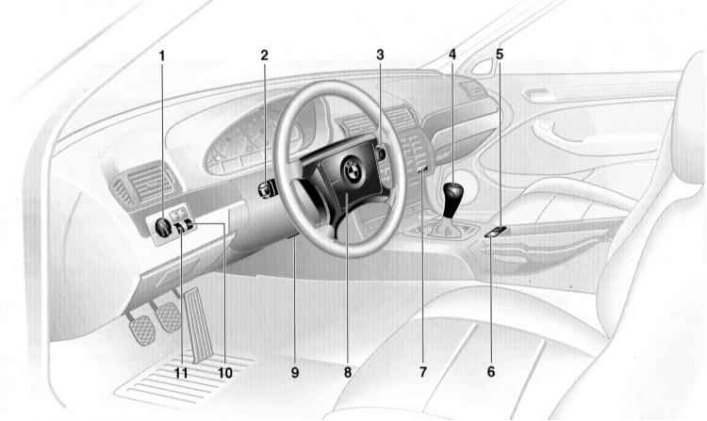
1 - Parking light/low beam (Section Lighting and lighting fixtures)
2 - Direction indicators (Section Turn signal/light switch lever)
Parking lights (Section Lighting and lighting fixtures)
High beam (Section Lighting and lighting fixtures)
Light signal (Section Turn signal/light switch lever)
Trip computer*
3 — Windscreen wipers/washers (Section Windscreen wipers and washers)
4 — Manual transmission/AT selector lever (Sections Manual transmission (MT) and Automatic transmission (AT))
If the car is equipped with a manual transmission, then to engage reverse gear, you should push the lever to the left, overcoming slight resistance
5 - Single Lock (Section Keys, single lock and anti-theft system)
6 — Emergency light signaling
7 — Rear window heating (Section Rear window defroster)
8 - Sound signal
9 — Steering wheel adjustment (Section Adjusting the position of the steering wheel)
10 — Rear fog light* (Section Lighting and lighting fixtures)
11 — Fog lights* (Section Lighting and lighting fixtures)
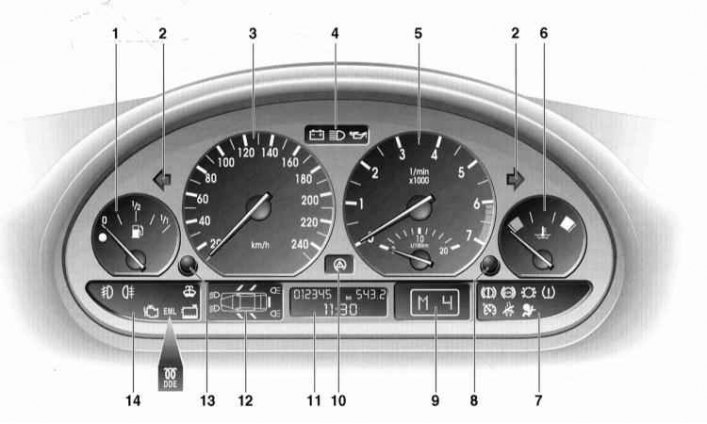
Dashboard
1 — Fuel gauge with reserve indicator lamp
2 — Direction indicator lamps
3 - Speedometer
4 — Control lamps:
- battery discharge
- high beam
- engine oil pressure / engine oil level
5 — Tachometer and econometer
6 — Coolant temperature gauge with "Coolant temperature too high" lamp
7 — Control and signal lamps (clockwise):
- parking brake / Brake fluid level / Cornering Brake Control (CBC)
- ABS
- brake pad wear
- tire Pressure Monitoring Systems (RDC)*
- inflatable airbags reminders to fasten your seat belt*
- tempostat*
8 — Settings button:
- hours
- upcoming maintenance indicator
9 — Indicator of the selected gear shift program for AT* (Section Automatic transmission (AT))
Control lamp AT* (Section Automatic transmission (AT))
10 — Automatic Stability Control with Engine Torque Control (ASC+T) / Dynamic Stability Control (DSC) indicator light
11 — Display for indication of readings:
- mileage counter
- odometer since reset
- hours
- indicator of the upcoming
- maintenance
Indication of trip computer readings*, control from the direction indicator lever:
- watch
- outside air temperature
- average fuel consumption
- estimated power reserve
- average speed
12 — Display of the indicator of open doors and lights not switched off
13 — Button to reset the odometer readings to zero from the moment of reset
14 — Control and signal lamps (clockwise):
- fog lights*
- rear fog lights*
- washer fluid level
- coolant level
- preheating* / digital diesel electronics (DDE)*
- electronic Engine Management (EML)*
- engine management systems
# You can display the outside air temperature and distance traveled in other units of measurement.
Control lamps, signaling devices and indicators
Self-diagnosis of vehicle systems
All important electrical and electronic systems in the car are subject to regular automatic testing. You do not need to turn on or adjust anything.
Thus, when the ignition is turned on, all control lamps are checked. If one of them is faulty, then information about this is recorded in the memory of the fault diagnostic system, from where it can be read later.
During the trip, constant measurements of the current in the servo motor relay (windshield wipers, window lifters, seats, sunroof, etc.) allow you to control their performance.
The electrical resistance of the ignition generators of the airbag and all other elements of this system is also constantly measured. Any malfunction is registered due to the accompanying voltage fluctuations, and the corresponding signal about the malfunction will be given by the airbag control lamp on the instrument panel.
Even after the engine is switched off, your car's functionality is fully monitored. For example, all the flaps of the heating and ventilation system are moved to the nearest end position. This ensures that the defrosting function is maintained in any case, even if, for example, a defect occurs in the heating or ventilation system in the car during the night.
After each engine shutdown, a verification process is performed, during which all servomotors move the flaps of the heating and ventilation system to both extreme positions. In this case, the end positions and the stroke of the flaps are monitored, which subsequently ensures correct adjustment in accordance with the position of the regulators.
The process of self-diagnosis of the heating/ventilation system is indicated by the noise from the operation of the dampers, which is heard after the ignition is turned off. All other self-test functions are not accompanied by noise and are not noticeable.
Information about all defects detected during self-testing is entered into memory and can be read using special devices, which allows you to quickly identify and eliminate them (refer to Section Troubleshooting). At the service station, this work is carried out on a planned basis, during routine maintenance.
The control and signal lamps marked with the "o" sign light up for a while to check the functionality when the ignition key is turned, and go out after different times after the engine starts.
If a defect is detected in one of the systems, the corresponding lamp does not go out after the engine is started or lights up again during the trip. The actions that must be taken in this case are described below.
Red lights: stop immediately
Battery discharge o
 The lamp lights up as a signal that the battery is not charging. The cause may be a defective V-belt in the generator drive or a fault in the generator charging current circuit. Contact your nearest BMW service station.
Driving cannot be continued, as there is a risk of engine damage due to overheating. If the V-belt is defective, the force that must be applied to the steering wheel increases when driving the car.
Engine oil pressure o
 You should stop immediately, turn off the engine, check the oil level and, if necessary, top it up to normal. If the level is normal, refer to Section Troubleshooting.
Do not continue driving as there is a risk of engine damage due to insufficient lubrication.
Tire Pressure Monitoring (RDC)*
 Additionally, an acoustic signal sounds: a tire defect has occurred. Stop immediately, avoiding sudden braking or maneuvers. More details in Section Tire Pressure Monitoring System (RDC).
Hydraulic drive of the brake system o
 If the light comes on when the parking brake is released, it means that the brake fluid level needs to be checked. Before driving, be sure to follow the instructions in Section Brake system.
Red and yellow lights: you can continue driving with precautions
Cornering Brake Control (CBC) o
 If the lamp lights up together with the yellow ABS and ASC+T|DSC* control lamps, this indicates that the entire ABS, CBC and ASC+T|DSC control system has failed. You can continue driving, taking the necessary precautions. Refer to Section Troubleshooting.
Red Lights: As an Important Reminder
Parking brake
 The lamp lights up when the parking brake is applied - when starting off, an acoustic signal sounds in addition. More details in Section Parking brake.
Please fasten your seat belts*
 Depending on the vehicle's equipment, when the lamp lights up, a sound signal may sound simultaneously*. Depending on the vehicle's equipment, the lamp lights up either for a few seconds or until you fasten your seat belt. For more information on seat belts, see Section Security systems.
Inflatable airbags o
 Please refer to Section Troubleshooting. More details in the Section Security systems.
Orange light: you should go to the nearest BMW service station
Automatic transmission*
 Due to a malfunction of the automatic transmission, gear shifting is performed only according to the emergency program. Refer to Section Troubleshooting. More details in the Section Automatic transmission (AT).
Yellow lights: contact a service station for inspection
Anti-lock brake system (ABS) o
 When the lamp lights up, it means that the ABS is disabled due to a malfunction. However, the brakes function without restrictions. Refer to Section Troubleshooting. More details in the Section Anti-lock braking system (ABS).
Engine oil level
 When the light comes on, check the oil level.
Brake pads o
 Check the condition of the brake pads. More details in Section Brake system.
Tire Pressure Monitoring System (RDC)* o
 Check the air pressure in your tires. More details in Section Tire Pressure Monitoring System (RDC) and Specifications.
Automatic Stability Control with Engine Torque Control (ASC+T)/Dynamic Stability Control (DSC)* o
 ASC+T/DSC is disabled due to a key press or malfunction. In case of malfunction, refer to Section Troubleshooting.
Adding washer fluid
 The washer fluid level is too low. Top it up as soon as possible.
Engine management system
 Defect in the system. Refer to Section Troubleshooting.
Electronic Engine Management (EML) o
 Defect in EML system; when braking, you may need to apply more force to the brake pedal and its travel may increase. Refer to Section Troubleshooting.
Digital Diesel Engine Electronics (DDE)*
 If the DDE system warning light comes on while driving, this means that there is a fault in the electronic injection system.
If the engine has not stalled, you can continue driving, since the engine will be controlled by the emergency program. However, when driving by such a program, the power may be reduced. Refer to Section Troubleshooting.
Top up the coolant
 The coolant level is too low. Top it up as soon as possible.
Yellow lights: for your information
Rear fog lights*
 The lamp lights up when the rear fog lights are on. More details in Section Lighting and lighting fixtures.
Preheat* o
 The engine can be started only after the lamp goes out. More details in the Section Ignition switch and engine start.
Green lights: for your information
Direction indicator
 The lamp flashes when the direction indicators are turned on. When driving with a trailer, the lamp also flashes when the direction indicators on the trailer are turned on. Rapid flashing indicates a defect in the system. More details in Section Turn signal/light switch lever.
Tempostat (automatic speed control)*
 The lamp lights up when the system is on. The system can be controlled from the multifunction steering wheel. More details in Section Tempostat (automatic speed control).
Fog lights*
 The lamp lights up when the fog lights are on. More details in the Section Lighting and lighting fixtures.
Blue lamp
High beam
 The lamp lights up when the high beam is on and the light signal is used. More details in Sections Turn signal/light switch lever and Lighting and lighting fixtures.
Odometers
1. Total mileage counter
When the ignition key is set to position "0", you can display the readings of the counters shown in the illustration by pressing the button on the instrument panel (shown by arrow).
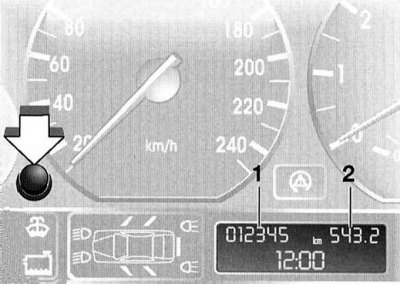
2. Odometer since reset
Resetting to zero occurs by pressing the button shown by the arrow, if the ignition key is in position 1 or 2.
Tachometer
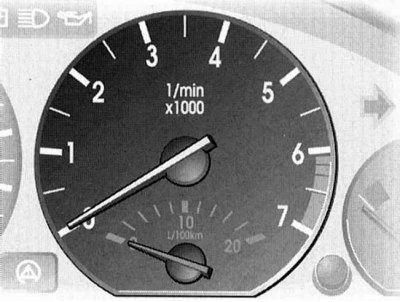
Avoid bringing the engine speed to the red sector of the scale.
In this range, the fuel supply is interrupted to protect the engine, which is noticeable by a drop in power.
Econometer
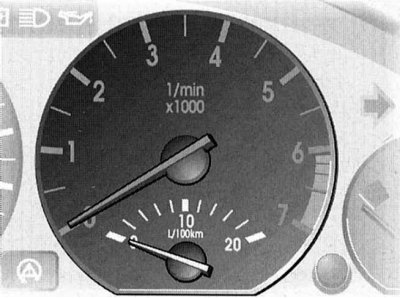
The economizer registers the actual fuel consumption in l/100 km. You can monitor at any time how economical and environmentally friendly your driving style is.
When the car stops, the arrow returns to zero.
Fuel tank indicator
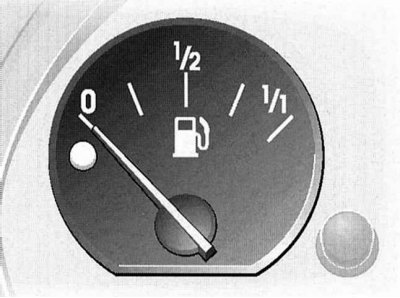
To check the operation of the device, its control lamp lights up for a while when the ignition is turned on.
If the lamp is constantly on, it means that there are about 8 liters of fuel left in the tank.
Fuel tank capacity data is given in the Specifications.
Different angle of inclination of the car (for example, when driving for a long time on a mountain road) may cause minor fluctuations in instrument readings.
Refuel promptly, as running out of fuel "to the last drop" can cause damage to the engine or catalytic converter.
Coolant temperature gauge
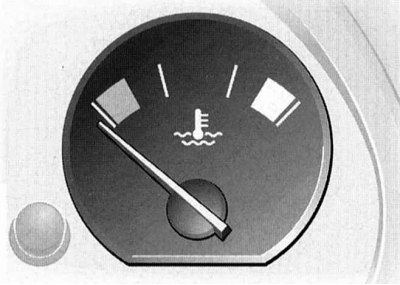
Arrow on the blue sector
The engine is still cold. Movement should occur at moderate speeds and revs.
Arrow on the red sector
If the control lamp is on, it means that the engine is overheated. In this case, you should stop immediately and let the engine cool down.
The area between the colored sectors
Corresponds to normal operating temperature. At high air temperatures or under heavy engine loads, the needle may approach the red sector.
Checking the coolant level is performed according to the instructions in Section Checking fluid levels.
Maintenance due indicator
Mileage until next maintenance
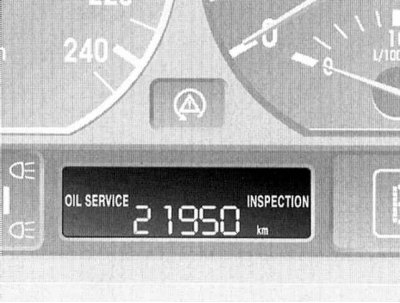
The indication shown in the illustration appears for a few seconds after turning the ignition key to position 1 or 2 or after starting the engine.
The OILSERVICE or INSPECTION inscriptions indicate the need for maintenance. The remaining mileage in km is also displayed. The remaining mileage is calculated based on driving style data.
The minus sign "-" in front of the remaining mileage figure means that this is the number of kilometers ago that maintenance should have been performed.
Replacing brake fluid
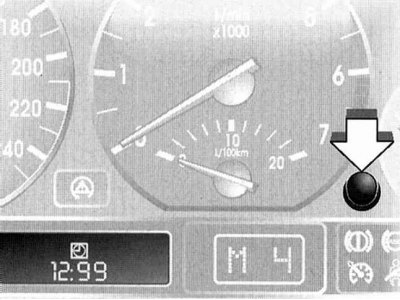
The display can show the month and year in which the brake fluid should be replaced. To do this, press the button while the next maintenance date is displayed (shown by arrow) on the dashboard. Each time the button is pressed, the display alternately shows the due date for the next maintenance and the due date for replacing the brake fluid.
When the time comes to replace the brake fluid, the clock symbol lights up continuously.
The indicator does not take into account the time the vehicle is parked with the battery terminals disconnected.
Therefore, make sure that the brake fluid is replaced at least once every two years, regardless of the indicator readings.
Indication of open doors or lights not switched off
Graphic indication
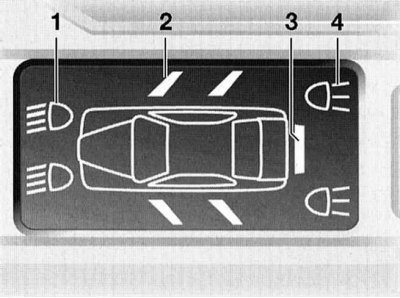
When the ignition key is in position 2, the following warnings are displayed on the display in the form of symbols: (states). These symbols do not go out until the reasons that caused their appearance are eliminated.
1. Check the low beam.
2. The door is open.
3. The trunk is open.
4. Check the reversing lights or brake lights. The upper symbol indicates a faulty middle brake light.
If at the end of the trip you open the door and forget to turn off the light, a warning signal sounds (no indication appears), reminding of this.
Watch
Setting
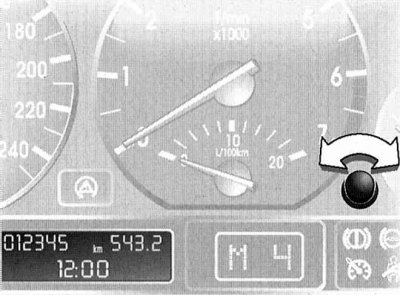
It is performed after turning the ignition key to position 1 or 2.
Set the clock forward: turn the button to the right.
Set the clock back: Turn the button to the left.
The longer you hold the button in the turned position, the faster the readings change.
Changing the display mode: Press and immediately release the button.
Each time you press the button, the time display changes from 12-hour to 24-hour and back.
If the ignition key is in position 0, then a short (for a few seconds) the time display is called up by pressing the left adjustment button (see mileage counters, above).
Trip computer*
Information call
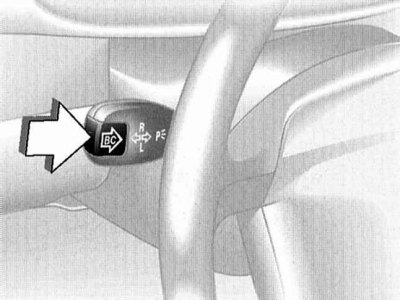
After turning the ignition key to position 1, you can use the button in the turn signal lever to display the trip computer information on the instrument panel display. Each short press of the button in the direction of the steering column displays the next piece of information.
The information is displayed in the following sequence: time, outside air temperature, average fuel consumption, estimated range, average speed.
When the ignition key is turned to position 1, the corresponding last value is displayed.
Outside air temperature
You can change the unit of measurement for the outside air temperature (celsius/Fahrenheit).
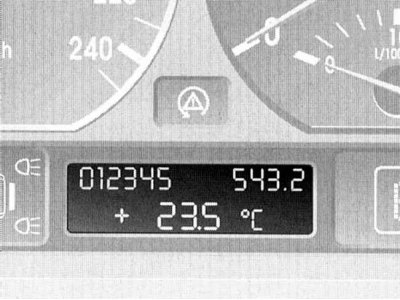
To do this, press the right control button on the instrument panel while the temperature is displayed.
Ice warning
When the temperature drops below +3°C, a warning sound is heard and the indicator flashes for a while.
The warning is repeated if, since the last signal, the temperature has risen to +6°C at least once and then dropped to +3°C.
Despite the presence of an ice warning system, the possibility of its formation cannot be ruled out (for example, on bridges and shaded areas of roads) also at temperatures above +3°C.
Average fuel consumption
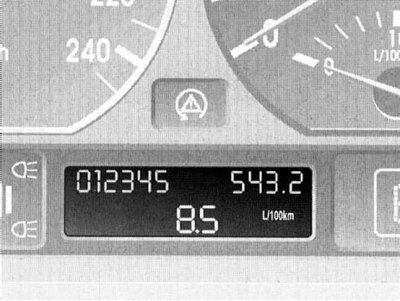
If you press the button and hold it for a while during the average fuel consumption indication, the calculation will start again from that moment. The engine must be running. Power reserve
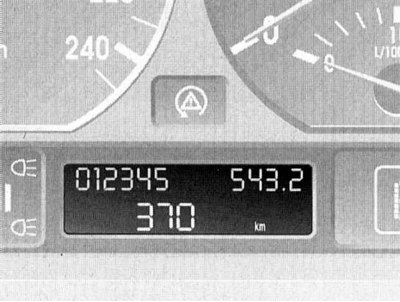
The range is calculated taking into account the actual driving style in the last kilometers of the journey.
Average speed
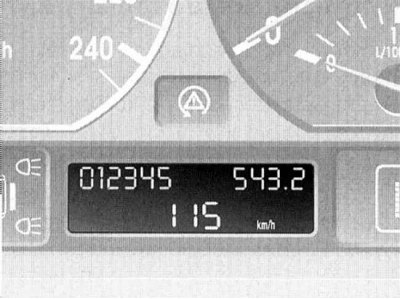
If you press the button and hold it for a while during the average speed indication, the calculation will start again from that moment. The engine must be running.
The time spent parked with the engine off is not taken into account in the calculation.
Emergency light signaling
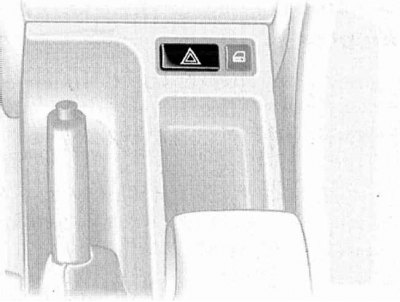
The button backlight flashes periodically when the alarm is on.
When the vehicle's lights are on, the button is illuminated, making it easier to find.
The turn signal function has priority over the hazard warning light function. Therefore, after the ignition key is turned to position 1, the turn signals may flash even if the hazard warning light is on.
Multifunction steering wheel (MFL)*
The multifunctional steering wheel has built-in keys that allow you to quickly use the system without being distracted from what is happening on the road
- some functions of the radio receiver,
- tempoatom,
- some functions of the phone.
To control the various systems from the multifunction steering wheel, they must first be switched on.
The illustration shows a possible example of a complete set. Details are contained in the descriptions of specific options.
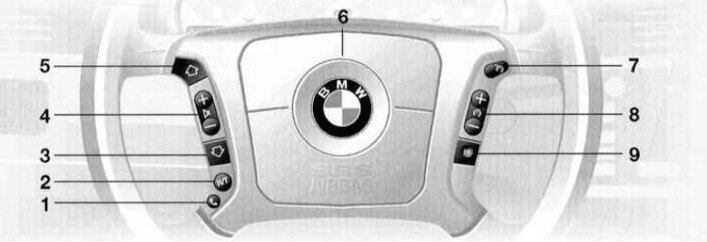
1 - Phone: accept a call, start dialing, end a call
2 - Switching from radio to phone and back
3 - Search for a station/phone number down the range/phone list
4 - Radio and telephone volume
5 - Search for a station/phone number up the range/phone list
6 - Sound signal, entire panel
7 - Tempostat: recall of the value stored in memory
8 — Cruise control: entering the actual speed as the set speed and then increasing it (+) or decreasing the speed and entering the achieved value into memory (-)
9-Tempostat: enabling / interrupting operation / switching off
[The article text was copied from an online resource «BMWman.ru»]
This article is available at russian, bulgarian, belarusian, ukrainian, serbian, croatian, romanian, polish, slovak, hungarian
Article verified: Sevastyanov Nikolay
Share information:
Previous articles
БМВ E46: Manual
Next articles
Similar articles on other types of BMW cars:
Controls and instruments BMW 5 Series E39 (1995-2003)
Controls and instrumentation BMW 5 Series E12 (1972-1981)
Measuring instruments BMW 7 Series E32 (1986-1994)
Controls and operating techniques BMW 7 Series E38 (1994-2001)
Controls BMW X3 E83 (2003-2010)
Controls and instrument panel BMW X5 E53 (1999-2006)
Controls and instruments BMW 5 Series E39 (1995-2003)
Controls and instrumentation BMW 5 Series E12 (1972-1981)
Measuring instruments BMW 7 Series E32 (1986-1994)
Controls and operating techniques BMW 7 Series E38 (1994-2001)
Controls BMW X3 E83 (2003-2010)
Controls and instrument panel BMW X5 E53 (1999-2006)
Link in different formats to this page
Visitor comments
No comments yet
- General information
- Manual
- Maintenance
- Power unit
- Engine repair
- Cooling system
- Power system (gasoline)
- Injection system (gasoline)
- Fuel system (diesel)
- Exhaust system
- Ignition system
- Charge and launch systems
- Transmission
- Car gearbox
- Clutch and drive shafts
- Chassis
- Brake system
- Suspension front and rear
- Steering
- Body
- Body care and repair
- Exterior
- Interior
- Electrical equipment
- Troubleshooting
- Lighting and signaling
- Equipment and devices
- Heater and air conditioner
- Electrical circuits
- General information
- Manual
- Repair on the road
- Weekly checks
- Maintenance
- Troubleshooting
- Power unit
- 4 cylinder engines
- 6 cylinder engines
- Engine overhaul
- Cooling and heating
- Fuel and exhaust system
- Starting and charging system
- Ignition system
- Transmission
- Clutch
- Mechanical gearbox
- Automatic gearbox
- Cardan and drive shafts
- Chassis
- Brake system
- Wheel suspension
- Steering
- Body
- Exterior
- Interior
- Electrical equipment
- Equipment and devices
- Electrical circuits
- General information
- Maintenance
- Power unit
- Engine repair
- Cooling system
- Ignition system
- Supply system
- Fuel injection system
- Exhaust system
- Transmission
- Clutch
- Car gearbox
- Front and rear axle
- Chassis
- Steering
- Brake system
- Body
- Exterior
- Interior
- Electrical equipment
- Heating system
- Equipment and devices
- Power devices
- Electrical circuits
- Power unit
- M10/M20 engine
- M40 engine
- Ignition system
- Lubrication system
- Cooling system
- Supply system
- Fuel injection
- Exhaust system
- Transmission
- Clutch
- Manual gearbox
- Front axle
- Rear axle
- Chassis
- Steering
- Brake system
- Body
- Exterior
- Interior
- Electrical equipment
- Heating system
- Equipment and devices
- Electrical circuits
- General information
- Specifications
- Operation and maintenance
- 4-cylinder engine
- Engine repair
- Cooling and lubrication system
- Supply system
- Ignition system
- 6-cylinder engine
- Engine repair
- Cooling and lubrication system
- Supply system
- Fuel injection system
- Ignition system
- Transmission
- Clutch
- 4-speed manual gearbox
- 5-speed manual gearbox
- Automatic gearbox
- Cardan and rear axle
- Chassis
- Steering
- Front suspension
- Rear suspension
- Brake system
- Electrical equipment
- Equipment and devices
- Electrical circuits