
- Home
- BMW 3 Series
- E46
- General information
- Manual
- Tire Pressure Monitoring System (RDC)
Tire Pressure Monitoring System (RDC) (BMW 3 Series E46)
Operating principle
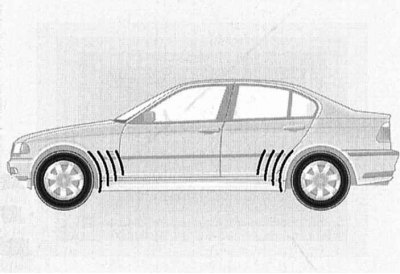
The RDC system monitors the air pressure in the tires of all four wheels and while driving. The system reports a significant drop in pressure in one or more tires.
Each wheel has a pressure sensor, transmitter and power source behind the valve. The pressure is measured at short intervals.
The received data is transmitted via radio channel. If the pressure deviates from the norm, the frequency of data transmission increases.
There are antennas next to each wheel in the body that receive signals from transmitters. The on-board processor processes the incoming signals and informs the driver of changes.
In order for the system to "understand" what pressure is normal, you should check the pressure in all four wheels, compare with the Specifications and, if necessary, bring it to the norm. Then you should activate the system.

This warning light on the instrument panel informs you that the air pressure in the tires is not correct.
System activation
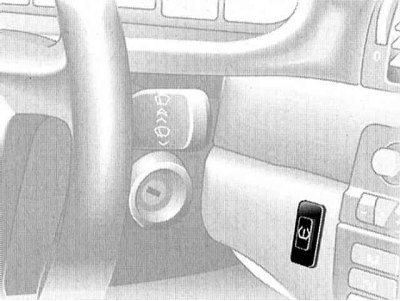
1. Turn the key to position 2.
2. Keep the button pressed until the indicator lamp on the instrument panel lights up yellow.
3. After a few minutes of driving, the RDC system will remember the actual tire pressure as a reference value to be used in the future.
This procedure should only be repeated after the tires have been inflated. Otherwise, the RDC system is automatically activated when the ignition key is turned to position 2 and is active during every trip.
When the pressure drops
If the air pressure in the tires drops significantly after some time (which is basically a normal phenomenon), the indicator lamp lights up yellow.
Thus, you are advised to bring the tire pressure of your car to the norm as soon as possible.
If after some time after bringing the pressure to the norm you are again asked to repeat this operation, it means that you have not inflated the tires correctly. Check the pressure again and compare its values with the values given in the Specifications.
When a tire is punctured
When a tire is punctured with loss of pressure, the indicator lamp lights up red. In addition, an audible signal sounds.
In this case, immediately reduce the speed until the car comes to a complete stop, while avoiding sudden braking and sharp steering movements. Replace the punctured tire.
Compact puncture-proof wheel* (can only be used temporarily) is not part of the tire pressure monitoring system. A spare wheel* of the same size as the other wheels installed on the vehicle, on the contrary, is equipped with the necessary electronic means to monitor the air pressure in it after it has been installed in place of the defective wheel and the RDC system has been activated.
The RDC system cannot warn of sudden tire failure due to external influences.
To change tires, please contact a BMW service station.
Interference
The performance of the RDC system may be adversely affected by other systems or devices that use the same radio frequency.
When interference occurs, the indicator lamp lights up yellow.
The yellow light of the lamp also indicates:
- about a system failure,
- about installing a wheel without the appropriate electronics,
- about the presence in the vehicle, along with the spare wheel*, of other wheels with electronics for RDC.
In such cases, please contact a BMW service station.
This article is available at russian, bulgarian, belarusian, ukrainian, serbian, croatian, romanian, polish, slovak, hungarian
Article verified: Sevastyanov Nikolay
Share information:
Previous articles
БМВ E46: Manual
Next articles
Similar articles on other types of BMW cars:
Tire pressure BMW 5 Series E34 (1988-1996)
Control pressure regulator of the K-Jetronic system BMW 5 Series E12 (1972-1981)
Wheel and tire sizes, tire pressure BMW 7 Series E32 (1986-1994)
Types of tire tread wear BMW X3 E83 (2003-2010)
Tire pressure monitoring system BMW X5 E53 (1999-2006)
Tire pressure BMW 5 Series E34 (1988-1996)
Control pressure regulator of the K-Jetronic system BMW 5 Series E12 (1972-1981)
Wheel and tire sizes, tire pressure BMW 7 Series E32 (1986-1994)
Types of tire tread wear BMW X3 E83 (2003-2010)
Tire pressure monitoring system BMW X5 E53 (1999-2006)
Link in different formats to this page
Visitor comments
No comments yet
- General information
- Manual
- Maintenance
- Power unit
- Engine repair
- Cooling system
- Power system (gasoline)
- Injection system (gasoline)
- Fuel system (diesel)
- Exhaust system
- Ignition system
- Charge and launch systems
- Transmission
- Car gearbox
- Clutch and drive shafts
- Chassis
- Brake system
- Suspension front and rear
- Steering
- Body
- Body care and repair
- Exterior
- Interior
- Electrical equipment
- Troubleshooting
- Lighting and signaling
- Equipment and devices
- Heater and air conditioner
- Electrical circuits
- General information
- Manual
- Repair on the road
- Weekly checks
- Maintenance
- Troubleshooting
- Power unit
- 4 cylinder engines
- 6 cylinder engines
- Engine overhaul
- Cooling and heating
- Fuel and exhaust system
- Starting and charging system
- Ignition system
- Transmission
- Clutch
- Mechanical gearbox
- Automatic gearbox
- Cardan and drive shafts
- Chassis
- Brake system
- Wheel suspension
- Steering
- Body
- Exterior
- Interior
- Electrical equipment
- Equipment and devices
- Electrical circuits
- General information
- Maintenance
- Power unit
- Engine repair
- Cooling system
- Ignition system
- Supply system
- Fuel injection system
- Exhaust system
- Transmission
- Clutch
- Car gearbox
- Front and rear axle
- Chassis
- Steering
- Brake system
- Body
- Exterior
- Interior
- Electrical equipment
- Heating system
- Equipment and devices
- Power devices
- Electrical circuits
- Power unit
- M10/M20 engine
- M40 engine
- Ignition system
- Lubrication system
- Cooling system
- Supply system
- Fuel injection
- Exhaust system
- Transmission
- Clutch
- Manual gearbox
- Front axle
- Rear axle
- Chassis
- Steering
- Brake system
- Body
- Exterior
- Interior
- Electrical equipment
- Heating system
- Equipment and devices
- Electrical circuits
- General information
- Specifications
- Operation and maintenance
- 4-cylinder engine
- Engine repair
- Cooling and lubrication system
- Supply system
- Ignition system
- 6-cylinder engine
- Engine repair
- Cooling and lubrication system
- Supply system
- Fuel injection system
- Ignition system
- Transmission
- Clutch
- 4-speed manual gearbox
- 5-speed manual gearbox
- Automatic gearbox
- Cardan and rear axle
- Chassis
- Steering
- Front suspension
- Rear suspension
- Brake system
- Electrical equipment
- Equipment and devices
- Electrical circuits