
Table of contents: Braking ↓ Hydroplaning ↓ Puddles on the road ↓ Shelf behind the rear seat ↓ Clothes hooks ↓ Features of driving a car in winter ↓ Parking ↓ Towing a trailer ↓ Towing hitch* ↓ Towing hitch socket cover* ↓ Movement on the rise ↓ Downhill movement ↓ Maximum speed ↓ Tire pressure ↓ Rear view mirrors ↓ Electrical equipment ↓
- Home
- BMW 3 Series
- E46
- General information
- Manual
- Peculiarities of driving a car
Peculiarities of driving a car (BMW 3 Series E46)
Braking
When driving, do not keep your foot on the brake pedal. Even a slight but prolonged pressure on the pedal can result in the brakes heating up, wearing out, and possibly even failure of the entire system.
Hydroplaning
When driving on roads covered with water or wet mud, reduce speed as a wedge of water may form between the tire and the supporting surface. This condition, known as hydroplaning, can lead to partial or complete loss of contact with the road surface, loss of control of the vehicle and the ability to brake.
Puddles on the road
If you have to drive through puddles, their depth should not exceed 30 cm. At this depth, you should drive at a walking speed, otherwise damage to the engine, electrical equipment and gearbox cannot be ruled out.
Shelf behind the rear seat
Do not place heavy or hard objects on the shelf, as they may injure people in the vehicle during braking maneuvers.
Clothes hooks
Clothes should be hung on hooks so that they do not obstruct the driver's view. To avoid injury during sudden braking, heavy objects should not be hung on these hooks.
Features of driving a car in winter
Moving off
When starting off, if the car is parked in deep snow, or when driving off "swaying", it is recommended to turn off the ASC+T/DSC* system, refer to Section Automatic stability control system with engine torque control ASC+T/ Dynamic stability control DSC.
Driving in icy conditions
When operating the accelerator pedal, try to feel the car's reaction. Also avoid high-speed modes and shift to higher gears in a timely manner. When driving downhill or on climbs, shift to lower gears in a timely manner. Maintain a safe distance from the car in front.
Braking
Road conditions in winter are such that the grip of the tires on the road surface is significantly reduced. In any situation, the driver must take into account the significant increase in braking distance caused by this.
When braking, ABS prevents the wheels from locking, allowing the vehicle to remain controllable and stable.
If, in the event of ABS failure, the wheels still lock, then, without stopping braking, release the pressure on the pedal just enough to resume rolling the wheels.
Then increase the force on the pedal, from the moment the wheels lock, decrease it again, then increase it again, etc.
This periodic braking reduces the braking distance while still allowing you to maintain control of the vehicle.
Therefore, you can always try to go around the dangerous place after releasing the pressure on the pedal.
On slippery roads, you should not downshift to slow down the car, as this may cause the rear wheels to skid and, as a result, you may lose control of the car.
When braking sharply on a slippery road or when the road surface is unevenly slippery, you should always depress the clutch pedal.
Skidding
Press the clutch and release the gas or move the AT selector lever to position N. Using the steering wheel, try to straighten the car and regain control.
Parking
Engage first or reverse gear, or move the AT selector lever to position P. Depending on the slope of the road, apply the parking brake. To prevent the parking brake linings from sticking to the drums due to frost or corrosion, dry the brake beforehand by lightly tightening it at low speed until the vehicle comes to a complete stop. Do not interfere with other road users driving behind you.
When the parking brake is applied, the brake lights do not come on.
Towing a trailer
Driving with a trailer places increased demands on both the towing vehicle and the driver.
The trailer limits maneuverability, climbing ability, acceleration and braking capabilities, affecting the dynamic properties and controllability of the vehicle.
You will find information about the permissible towable load mass and the permissible drawbar load in the Specifications. The permissible towable load mass is also indicated in the vehicle registration document. You can inquire about the possibility of increasing it at any BMW service station.
Towing hitch*
The optimal design of your car's chassis guarantees high driving safety and comfort, as well as the possibility of a sporty driving style.
If the towing hitch is installed at the factory, the vehicle is equipped with a reinforced rear axle suspension*, which compensates for the weight of the towing hitch and optimizes the dynamic characteristics when driving without a trailer.
When retrofitting a vehicle with a towing hitch*, it must be certified by BMW. And its installation must be technically competently performed at a branded service station. It is also recommended to retrofit the vehicle with a reinforced suspension.
Other suspension systems offered for sale in the automotive accessories trade system are not BMW-certified.
The ball-head towing hitch should be maintained in accordance with the manufacturer's instructions to ensure quick installation and removal of the hitch.
The installation of a towing hitch limits the effectiveness of the rear bumper system, which absorbs low-speed collision energy through elastic deformation.
Stabilizing devices are recommended to be used primarily when towing a heavy trailer. You can inquire about this at any BMW service station.
Towing hitch socket cover*
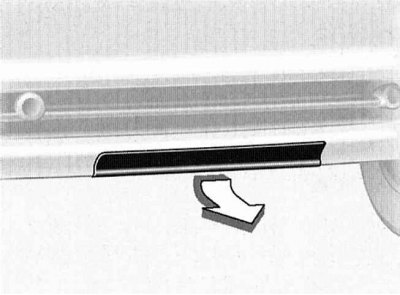
Removal
1. Grasp the notch at the bottom of the socket cover and pull it back.
2. Before removing and installing the ball head, read the enclosed instructions.
Installation
Insert the cover into the guide and then press it down.
Permissible load on drawbar support
We are talking about the load with which the trailer drawbar presses on the ball head of the towing hitch. It can be determined, for example, using household floor scales.
According to the regulations in force in Germany, this value must be at least 25 kg.
The permissible value must not be exceeded (refer to Specifications), however, its maximum use is desirable.
The weight with which the trailer drawbar presses on its support affects the vehicle's behavior. Therefore, when driving with a trailer, the permissible values of the total vehicle weight and the load on the road from its rear axle must not be exceeded. The load capacity is partially reduced by subtracting the weight of the towing hitch from it, and when driving with a trailer, also the weight with which the trailer drawbar presses on its support. The permissible total weight of the vehicle with a trailer must not be exceeded either.
Loading
The trailer must be loaded in such a way that the load is placed as low as possible and as close to the axle axis as possible.
Lowering the trailer's centre of gravity significantly improves the safety of driving a vehicle with a trailer.
The total trailer weight and the permissible towed load weight must not be exceeded. The smaller value is decisive.
When purchasing a trailer, it is recommended to request from the seller a warranty confirmation from the manufacturer of its actual weight and load capacity.
Movement on the rise
The magnitude of the slope to be overcome (measured at sea level) is limited to 12% for safety reasons and to avoid creating obstacles to traffic flow, and with increased mass of the towed load (in permitted cases) - 8%.
Experience shows that engine power decreases as altitude increases. When driving on mountain roads, one should remember, in particular, that the ability to start off on an incline is reduced, which means that the maximum permissible weight of the vehicle and trailer must be avoided.
Downhill movement
Road descents require special attention. When approaching them, it is necessary to switch to a lower gear, if necessary, down to first (when equipped with AT, the selector lever is moved to position 2), then move downhill at low speed.
Maximum speed
The maximum speed with a trailer on German roads is limited to 80 km/h. The permissible towable load masses are defined so that normal trajectory stability is ensured at this speed. Even if higher speeds are permitted in other countries, you should still not drive faster for safety reasons.
Trailer sway can only be stopped by immediate braking.
Tire pressure
The air pressure in the tires of the car and trailer should be the subject of special attention. For the trailer, the standards set by its manufacturer are decisive.
Rear view mirrors
If the viewing sector through the standard exterior rear-view mirrors is insufficient when driving with a trailer, the regulations require that two mirrors be installed instead, in which the driver can see the trailer up to the rear edge of each side. You can purchase such mirrors, including those with adjustable brackets, at BMW service stations.
Electrical equipment
When transporting a caravan, it is necessary to take into account the increased power consumption. Therefore, taking into account the limited capacity of the battery, the switching on of current consumers should be short-lived.
Before leaving, be sure to check the operation of the trailer's rear lights.
The website served as the basis for the text: www.bmwman.ru
This article is available at russian, bulgarian, belarusian, ukrainian, serbian, croatian, romanian, polish, slovak, hungarian
Article verified: Sevastyanov Nikolay
Share information:
Previous articles
БМВ E46: Manual
Next articles
Similar articles on other types of BMW cars:
Saving fuel while driving BMW 5 Series E39 (1995-2003)
Checks on the car before driving BMW X3 E83 (2003-2010)
Saving fuel while driving BMW 5 Series E39 (1995-2003)
Checks on the car before driving BMW X3 E83 (2003-2010)
Link in different formats to this page
Visitor comments
No comments yet
- General information
- Manual
- Maintenance
- Power unit
- Engine repair
- Cooling system
- Power system (gasoline)
- Injection system (gasoline)
- Fuel system (diesel)
- Exhaust system
- Ignition system
- Charge and launch systems
- Transmission
- Car gearbox
- Clutch and drive shafts
- Chassis
- Brake system
- Suspension front and rear
- Steering
- Body
- Body care and repair
- Exterior
- Interior
- Electrical equipment
- Troubleshooting
- Lighting and signaling
- Equipment and devices
- Heater and air conditioner
- Electrical circuits
- General information
- Manual
- Repair on the road
- Weekly checks
- Maintenance
- Troubleshooting
- Power unit
- 4 cylinder engines
- 6 cylinder engines
- Engine overhaul
- Cooling and heating
- Fuel and exhaust system
- Starting and charging system
- Ignition system
- Transmission
- Clutch
- Mechanical gearbox
- Automatic gearbox
- Cardan and drive shafts
- Chassis
- Brake system
- Wheel suspension
- Steering
- Body
- Exterior
- Interior
- Electrical equipment
- Equipment and devices
- Electrical circuits
- General information
- Maintenance
- Power unit
- Engine repair
- Cooling system
- Ignition system
- Supply system
- Fuel injection system
- Exhaust system
- Transmission
- Clutch
- Car gearbox
- Front and rear axle
- Chassis
- Steering
- Brake system
- Body
- Exterior
- Interior
- Electrical equipment
- Heating system
- Equipment and devices
- Power devices
- Electrical circuits
- Power unit
- M10/M20 engine
- M40 engine
- Ignition system
- Lubrication system
- Cooling system
- Supply system
- Fuel injection
- Exhaust system
- Transmission
- Clutch
- Manual gearbox
- Front axle
- Rear axle
- Chassis
- Steering
- Brake system
- Body
- Exterior
- Interior
- Electrical equipment
- Heating system
- Equipment and devices
- Electrical circuits
- General information
- Specifications
- Operation and maintenance
- 4-cylinder engine
- Engine repair
- Cooling and lubrication system
- Supply system
- Ignition system
- 6-cylinder engine
- Engine repair
- Cooling and lubrication system
- Supply system
- Fuel injection system
- Ignition system
- Transmission
- Clutch
- 4-speed manual gearbox
- 5-speed manual gearbox
- Automatic gearbox
- Cardan and rear axle
- Chassis
- Steering
- Front suspension
- Rear suspension
- Brake system
- Electrical equipment
- Equipment and devices
- Electrical circuits