



- Home
- BMW 3 Series
- E46
- General information
- Manual
- Automatic stability control system with engine torque control ASC+T / Dynamic stability control DSC
Automatic stability control system with engine torque control ASC+T / Dynamic stability control DSC (BMW 3 Series E46)
These systems improve driving stability, especially when starting off, accelerating, when changing tire grip conditions and when cornering.
The DSC system extends the benefits of ASC+T when cornering. However, the system is not able to provide safety beyond what is physically possible.
The system is activated after each engine start.
Special sensors determine the angular speed of the wheels, and if the DSC system is present, also the rotation of the wheels, lateral acceleration, braking pressure and the movement of the car relative to the vertical axis.
If the sensors detect a difference in the angular speeds of the wheels, the system concludes that there is a risk of slippage and reduces the torque directed to the wheels. In addition, if necessary, the rear wheels are braked.
If an unstable position of a vehicle equipped with the DSC system is detected, the front wheels may also be braked to stabilise the vehicle.
It takes some getting used to such system interventions. However, such interventions guarantee the maintenance of optimal traction with the best trajectory stability.
Wheel braking may be accompanied by noise.

The control lamp on the dashboard goes out almost immediately after the ignition is turned on
Flashing indicator light:
Flashing means that the system is adjusting traction forces based on the actual driving conditions.
If the indicator lamp does not go out after starting the engine or lights up while driving, this is a signal of a system malfunction, unless, of course, it was previously disabled. However, the car remains suitable for normal operation even without ASC+T/DSC*. Refer to Section Troubleshooting.
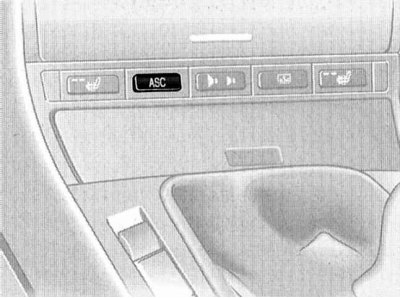
Press the key. The indicator lamp lights up.
Depending on the vehicle configuration, the button has the inscription ASC+T or DSC. The illustration shows the location of the button with a full configuration.
Depending on the vehicle's equipment volume, the location may vary.
With the ASC+T/DSC system switched off, you drive in normal mode.
In exceptional cases, it is advisable to disable the system:
Press the key again, the indicator lamp will go out.
ASC+T/DSC systems cannot override the laws of physics. Therefore, when exceeding the speed limit, the consequences of poor tire grip and lateral forces remain on the driver's conscience. Therefore, avoid unnecessary risks, despite the increased safety potential.
To ensure proper operation of the system, use only tires of the same manufacturer and with the same tread pattern.
This publication was borrowed from an online resource: «BMWMAN.RU»
The DSC system extends the benefits of ASC+T when cornering. However, the system is not able to provide safety beyond what is physically possible.
The system is activated after each engine start.
Special sensors determine the angular speed of the wheels, and if the DSC system is present, also the rotation of the wheels, lateral acceleration, braking pressure and the movement of the car relative to the vertical axis.
If the sensors detect a difference in the angular speeds of the wheels, the system concludes that there is a risk of slippage and reduces the torque directed to the wheels. In addition, if necessary, the rear wheels are braked.
If an unstable position of a vehicle equipped with the DSC system is detected, the front wheels may also be braked to stabilise the vehicle.
It takes some getting used to such system interventions. However, such interventions guarantee the maintenance of optimal traction with the best trajectory stability.
Wheel braking may be accompanied by noise.
Control lamp
The control lamp on the dashboard goes out almost immediately after the ignition is turned on
Flashing indicator light:
Flashing means that the system is adjusting traction forces based on the actual driving conditions.
If the indicator lamp does not go out after starting the engine or lights up while driving, this is a signal of a system malfunction, unless, of course, it was previously disabled. However, the car remains suitable for normal operation even without ASC+T/DSC*. Refer to Section Troubleshooting.
Shutting down the system
Press the key. The indicator lamp lights up.
Depending on the vehicle configuration, the button has the inscription ASC+T or DSC. The illustration shows the location of the button with a full configuration.
Depending on the vehicle's equipment volume, the location may vary.
With the ASC+T/DSC system switched off, you drive in normal mode.
In exceptional cases, it is advisable to disable the system:
- when driving off with a "rocking motion" or when starting off in deep snow or on a loose surface.
- when driving with snow chains, refer to Section Peculiarities of driving a car.
Restarting the system
Press the key again, the indicator lamp will go out.
ASC+T/DSC systems cannot override the laws of physics. Therefore, when exceeding the speed limit, the consequences of poor tire grip and lateral forces remain on the driver's conscience. Therefore, avoid unnecessary risks, despite the increased safety potential.
To ensure proper operation of the system, use only tires of the same manufacturer and with the same tread pattern.
This publication was borrowed from an online resource: «BMWMAN.RU»
This article is available at russian, bulgarian, belarusian, ukrainian, serbian, croatian, romanian, polish, slovak, hungarian
Article verified: Sevastyanov Nikolay
Share information:
Previous articles
БМВ E46: Manual
Next articles
Similar articles on other types of BMW cars:
Automatic stability and traction control system (ASC+T) BMW 5 Series E39 (1995-2003)
Automatic Stability Control (ASC) BMW 5 Series E34 (1988-1996)
Operating principles of the gasoline engine control system BMW 7 Series E38 (1994-2001)
Control dimensions and adjustment data. Cars produced since 1986 BMW 7 Series E32 (1986-1994)
Automatic transmission control system BMW X3 E83 (2003-2010)
Engine control/additional signals wiring diagram BMW X5 E53 (1999-2006)
Automatic stability and traction control system (ASC+T) BMW 5 Series E39 (1995-2003)
Automatic Stability Control (ASC) BMW 5 Series E34 (1988-1996)
Operating principles of the gasoline engine control system BMW 7 Series E38 (1994-2001)
Control dimensions and adjustment data. Cars produced since 1986 BMW 7 Series E32 (1986-1994)
Automatic transmission control system BMW X3 E83 (2003-2010)
Engine control/additional signals wiring diagram BMW X5 E53 (1999-2006)
Link in different formats to this page
Visitor comments
No comments yet
- General information
- Manual
- Maintenance
- Power unit
- Engine repair
- Cooling system
- Power system (gasoline)
- Injection system (gasoline)
- Fuel system (diesel)
- Exhaust system
- Ignition system
- Charge and launch systems
- Transmission
- Car gearbox
- Clutch and drive shafts
- Chassis
- Brake system
- Suspension front and rear
- Steering
- Body
- Body care and repair
- Exterior
- Interior
- Electrical equipment
- Troubleshooting
- Lighting and signaling
- Equipment and devices
- Heater and air conditioner
- Electrical circuits
- General information
- Manual
- Repair on the road
- Weekly checks
- Maintenance
- Troubleshooting
- Power unit
- 4 cylinder engines
- 6 cylinder engines
- Engine overhaul
- Cooling and heating
- Fuel and exhaust system
- Starting and charging system
- Ignition system
- Transmission
- Clutch
- Mechanical gearbox
- Automatic gearbox
- Cardan and drive shafts
- Chassis
- Brake system
- Wheel suspension
- Steering
- Body
- Exterior
- Interior
- Electrical equipment
- Equipment and devices
- Electrical circuits
- General information
- Maintenance
- Power unit
- Engine repair
- Cooling system
- Ignition system
- Supply system
- Fuel injection system
- Exhaust system
- Transmission
- Clutch
- Car gearbox
- Front and rear axle
- Chassis
- Steering
- Brake system
- Body
- Exterior
- Interior
- Electrical equipment
- Heating system
- Equipment and devices
- Power devices
- Electrical circuits
- Power unit
- M10/M20 engine
- M40 engine
- Ignition system
- Lubrication system
- Cooling system
- Supply system
- Fuel injection
- Exhaust system
- Transmission
- Clutch
- Manual gearbox
- Front axle
- Rear axle
- Chassis
- Steering
- Brake system
- Body
- Exterior
- Interior
- Electrical equipment
- Heating system
- Equipment and devices
- Electrical circuits
- General information
- Specifications
- Operation and maintenance
- 4-cylinder engine
- Engine repair
- Cooling and lubrication system
- Supply system
- Ignition system
- 6-cylinder engine
- Engine repair
- Cooling and lubrication system
- Supply system
- Fuel injection system
- Ignition system
- Transmission
- Clutch
- 4-speed manual gearbox
- 5-speed manual gearbox
- Automatic gearbox
- Cardan and rear axle
- Chassis
- Steering
- Front suspension
- Rear suspension
- Brake system
- Electrical equipment
- Equipment and devices
- Electrical circuits