
Electronic engine management components in the ME-Motronic system
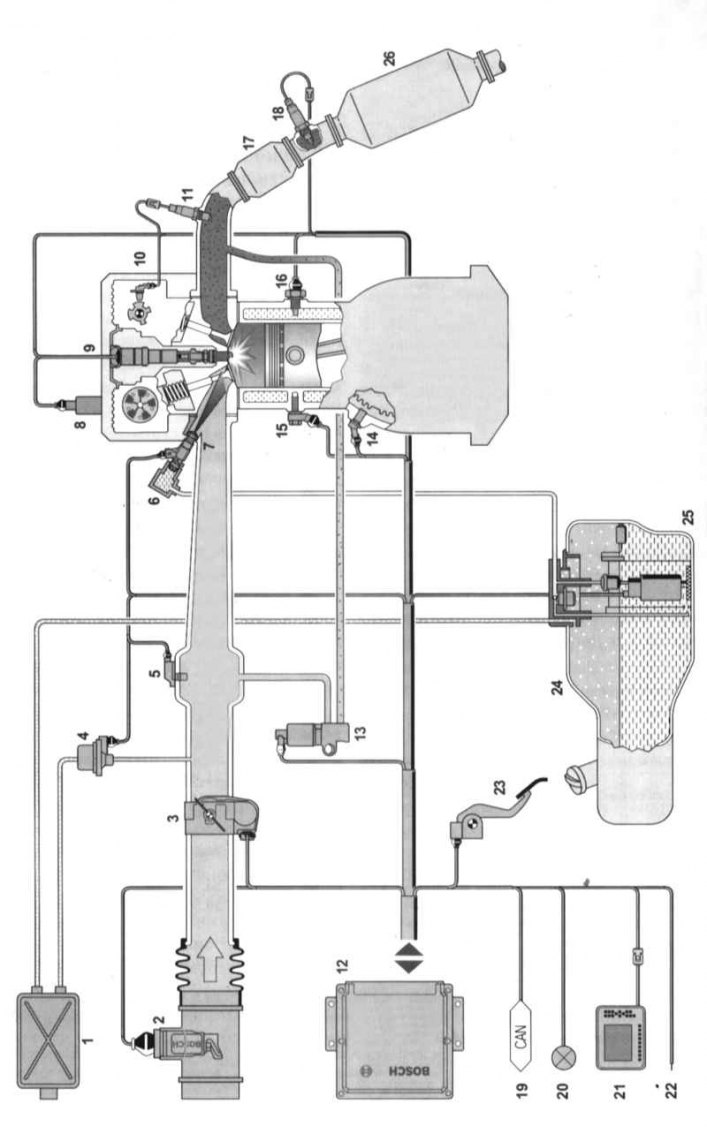
1 - Carbon absorber
2 - Hot-film air flow meter (MAF) with built-in intake air temperature (IAT) sensor
3 — Throttle valve
4 — EVAP valve
5 — Manifold Pressure (MAP) Sensor
6 — Fuel distribution line
7 — Injector
8 — Actuators and sensors of variable valve timing
9 - Coil and spark plug
10 — Camshaft Position (CMP) Sensor
12 — Lambda probe before catalytic converter 17
13 — Engine Control Module (ECM)
14 — Crankshaft Speed (CKP) Sensor
15 — Knock sensor (KS)
16 — Coolant temperature sensor (ECT)
17 - Additional 3-function catalytic converter
18 — Lambda probe behind the catalytic converter 17
19 — CAN data bus interface
20 — Malfunction Indicator Light (MIL)
21 — OBD diagnostic system interface
22 — Engine immobilizer control unit interface
23 — Gas pedal with its position sensor
24 — Fuel tank
25 — Fuel pump, filter and fuel pressure regulator unit
26 - Main 3-function catalytic converter
Fuel is drawn from the fuel tank by an electric fuel pump and supplied through a fuel filter to the fuel rail. The pressure regulator maintains the pressure in the fuel system at the level 3.5 atm.
Fuel is injected in pulses into the intake ports located just before the engine intake valves via electrically controlled injectors. The engine control module (ECM) determines the optimum ignition and injection timing, as well as the amount of fuel injected, in coordination with other vehicle systems. The high voltage for sparking is generated by ignition coils mounted above the spark plugs, at the signal from the ECM.
The crankshaft position (CKP) sensor provides the control unit with information about the crankshaft speed and its exact position. This information is used to determine injection and ignition timing. The CKP sensor is located on the rear of the engine and works on the basis of the Hall effect, scanning the teeth of the rotor mounted on the crankshaft.
The camshaft position (CMP) sensor is located on the end of the cylinder head and works similarly to the CKP sensor, scanning the toothed rotor on the end of the intake camshaft. The CMP sensor, together with the CKP sensor, is used to determine the TDC of the piston of the first cylinder, dynamically adjust the valve timing (by means of an electromagnetic valve and an intake valve phase regulator), selective control of detonation in cylinders and for determining the injection sequence.
The air required to form the working mixture is sucked in by the engine through the air filter and passes through the throttle valve and the intake manifold to the intake valves. The amount of air sucked in is regulated by a throttle valve with an electric drive, controlled by signals from the gas pedal position sensor. Thanks to electronic control, the mass air flow in the intake manifold can be set independently of the gas pedal position, and at idle speed the throttle valve opens to the angle required to set the required crankshaft speed. The mass of air sucked in is determined by the MAF sensor with a built-in intake air temperature (IAT) sensor.
The knock sensor (KS) is screwed into the side of the cylinder block and prevents the occurrence of shock combustion of fuel. Thanks to this, the ignition timing is kept at the detonation limit, which ensures better use of fuel energy and, thus, a reduction in fuel consumption.
Information from other sensors and control voltages supplied to the actuators ensure optimal engine operation in any situation. If some sensors fail, the control unit switches to the emergency program mode to prevent possible engine damage and ensure further movement of the vehicle. In emergency mode, the injectors operate simultaneously, 2 times per working cycle.
The fuel tank ventilation system consists of a gasoline vapor absorber and an electromagnetic valve. The absorber concentrates fuel vapors that form in the tank as a result of fuel heating. During engine operation, fuel vapors are pumped from the absorber and participate in the formation of the working mixture.
Reduction of exhaust toxicity is achieved with the help of a 3-function catalytic converter and lambda probes (before and after catalytic converter).
Also, to eliminate leaks of unburned hydrocarbons into the atmosphere, a crankcase ventilation system (PCV) is used. Gases and oil vapors formed in the crankcase enter the intake manifold (due to the pressure difference - it is higher in the crankcase) and burn in the cylinders together with the fuel.
In order for the numerous electronic control units to exchange data with each other, these units are connected by a high-speed CAN data bus. The CAN bus consists of two lines, which reduces the amount of wiring. Each control unit can simultaneously transmit and receive data, but each specific unit reads only the data it needs from the CAN bus.