
- Home
- BMW 3 Series
- E46
- General information
- Manual
- Security systems
Security systems (BMW 3 Series E46)
Seat belt tensioner
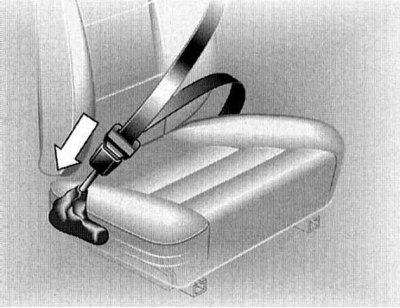
The belt tensioner ensures a much better fit of the belt to the body during a collision and allows you to securely hold it in the seat. In a split second, the belt buckle is pushed back under the pressure of the gas, simultaneously tightening the diagonal and lap belts. This ensures reliable protection against a person slipping under the lap belt.
Seat belts
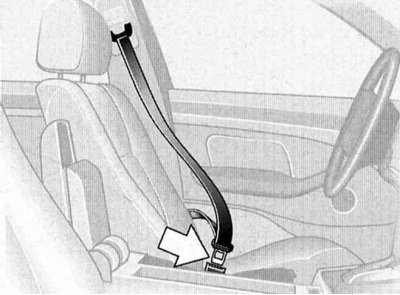
You must fasten your seat belts before every trip.
Fastening: when fastening the belt, the buckle should lock with an audible click.
Unfastening: press the red button and, holding the belt tape, guide it into the retractor.
Belt height adjustment
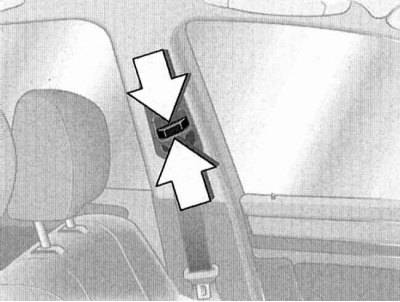
You can adjust the belt to your height by adjusting the upper attachment point.
To do this, move the button down or up.
The lock marked "CENTER" is intended only for the belt of the passenger sitting in the middle of the rear seat.
For your safety, please follow the instructions below for using the seat belt, otherwise it will not be able to fully perform its protective function. Do not forget to inform all your companions about the need to comply with the rules for using seat belts.
Only one person should wear a seat belt at a time. Infants and small children should not be held on the laps of adult passengers while the vehicle is moving. The belt should be tight and should fit snugly against the chest and waist without twisting, and there should be no hard or brittle objects in the pockets of clothing underneath it. The belt should not encircle the neck. It should not be pinched or rubbed against sharp edges.
The belt should fit as tightly as possible to the body, so clothing should not be too tight. Tighten the belt more often in the shoulder area. Otherwise, in a frontal collision, a loosely fitting lap belt can slide up the hips and injure the lower abdomen. Due to the increased gap between the belt and the body, the restraining effect of the belt is realized with a delay.
Pregnant women should always wear seat belts, making sure in particular that the lap belt covers the hips from below and does not press on the abdomen.
Child Safety Transport Systems*
For children under 12 years of age and less than 150 cm in height, specially approved safety transport systems must be used.
Small children up to 18 months can be transported in carrycots installed in the rear seat facing away from the direction of travel and secured with standard seat belts.
For each age group, the BMW workshop will offer appropriate child safety transport systems. When installing these systems, please follow the manufacturer's instructions.
Child restraint systems must not be installed in the front passenger seat, as this could result in injury if the airbag is deployed.
It is unacceptable to make changes to the design of child transport systems, otherwise they will not be able to fully perform their protective function.
Built-in child seats*
These two child seats, built into the outer rear seats and meeting the requirements of the United Nations Economic Commission for Europe Directive R-44, are intended for children aged 3.5 to 12 years (from 15 to 36 kg).
For children from 18 months to 3.5 years (from 9 to 18 kg) these seats should be used in combination with a special backrest and trauma table, which can be purchased from a BMW service center.
Seat extension:
Grasp the front of the rear seat and pull it up and slightly back as shown by the arrow. Then push the seat back until it clicks into place.
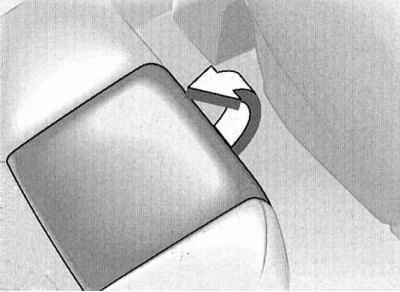
Lowering the seat:
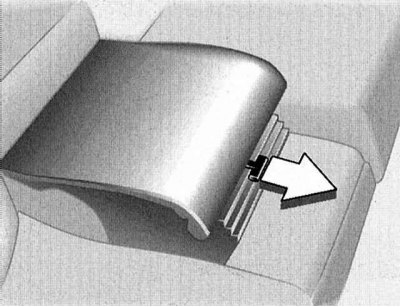
Grasp the loop and pull forward and down as shown by the arrow. Then push down on the seat from above until it clicks into place.
Built-in child seats should only be used if the vehicle has head restraints.
When adjusting the front seats, make sure that children's legs are not trapped.
Never leave children unattended in a vehicle, even if they are in child seats.
Follow the instructions for using seat belts as given earlier in this Section, otherwise they will not be able to perform their protective function.
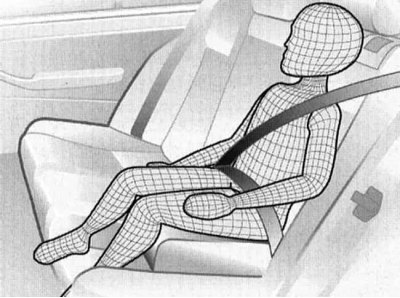
If the belts are damaged or after an accident, contact a BMW service centre to have the integrated child seat and, if necessary, other accessories replaced.
Locking Children in a Car
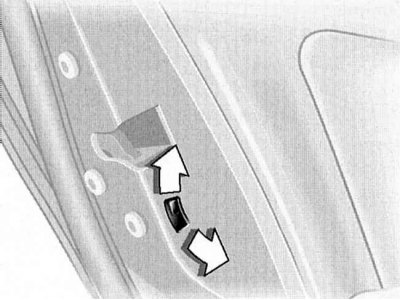
Slide the latch located on the rear door down. Now this door cannot be opened from the passenger compartment.
Inflatable airbags (Airbags)
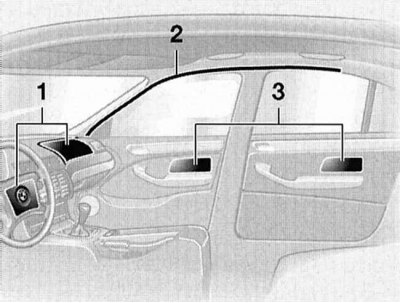
1. Front airbags for driver and passenger.
2. Upper airbags for head protection (above the front seats).
3. Side airbags (front and rear* seats).
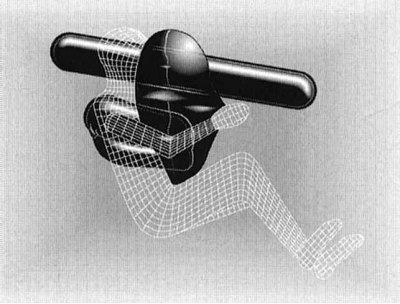
Inertial sensors continuously monitor the acceleration forces acting on the vehicle. If, as a result of a collision, the acceleration forces acting on the driver and passenger are such that the seat belts alone can no longer provide sufficient protection, the gas generators of the airbags for the driver and front passenger are triggered in parallel with each other. However, the airbag for the front passenger is only triggered if the sensor installed in the seat detects that someone is actually sitting on it.
In the event of a side impact, the head airbag and the front or rear* side airbags are deployed if necessary.
The NBCs, which are located under appropriately marked safety liners, deploy and fill with gas in a matter of milliseconds, tearing or squeezing out the safety liners in predetermined locations.
The rapid deployment, which is necessary for the normal functioning of the airbag, is accompanied by a priming pop and noise from inflation, which, however, are simply not perceived against the background of an accident. The gas required for inflating the airbag does not pose any danger and after some time evaporates along with the resulting smoke.
The whole process takes place in a split second.
Protective action
Front airbags protect the driver and front passenger in a frontal collision when the protective effect of seat belts alone is insufficient. Head and side airbags provide protection in side collisions. Side airbags protect the corresponding side parts of the chest.
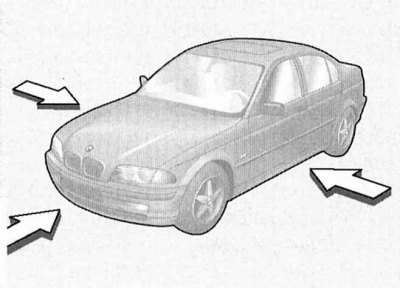
The illustration shows the main directions of impacts to which the airbags react.
Airbag warning light

The lamp signals that the airbag system is ready for operation after turning the ignition key to position 1.
The system is ready for operation: The indicator lamp lights up for a while and then goes out.
System is faulty: The indicator lamp does not light.
The control lamp lights up briefly, goes out and lights up again.
If the system malfunctions, there is a risk that it will not work in a collision, even if the accident is severe enough.
Contact a BMW service center immediately to have the system checked.
For your safety, please follow the instructions below regarding airbags, otherwise they will not be able to fully perform their protective function. Remember to inform all your fellow passengers of the need to follow the instructions regarding airbags.
The presence of airbags does not relieve you from the need to fasten your seat belt, since airbags are only one of the means of ensuring safety. In minor accidents, rollovers and impacts to the rear, airbags should not necessarily work. Only the seat belt will protect you.
Sit on the seat as you feel most comfortable, but as far away from the steering wheel, dashboard or door as possible.
Always hold the steering wheel by the rim. If the airbag is deployed, failure to do so may result in injury to the hands or forearms.
There must be no foreign objects between the airbag and the person it protects. The front passenger airbag trim must not be used as a shelf for things.
The safety trim of the steering wheel, the dashboard and the side trim of the front and rear doors, as well as the roof pillar and the edge of the headlining, must not be covered, covered or modified in any way.
It is not allowed to reinforce child safety systems in the front passenger seat. Children under 12 years of age and less than 150 cm tall are only allowed to be transported in the rear seat.
If the vehicle is equipped with side airbags in the rear compartment, make sure that the child seat is installed correctly and at the maximum distance from the door. Do not allow children to lean from the seat towards the airbag, as serious injuries may occur if the airbag deploys.
Even if all instructions are followed, under certain circumstances, injury to the face, hands, and forearms due to airbag deployment cannot be ruled out. In sensitive passengers, the ignition pop and noise of the airbag inflation process may cause short-term hearing loss.
The original material is located on the website «BMWman»
This article is available at russian, bulgarian, belarusian, ukrainian, serbian, croatian, romanian, polish, slovak, hungarian
Article verified: Sevastyanov Nikolay
Share information:
Previous articles
БМВ E46: Manual
Next articles
Similar articles on other types of BMW cars:
Security systems BMW 5 Series E39 (1995-2003)
AIRBAG security system BMW 5 Series E34 (1988-1996)
Ignition and injection systems — check BMW 7 Series E32 (1986-1994)
General information about security system elements BMW 7 Series E38 (1994-2001)
Checking electrical systems BMW X5 E53 (1999-2006)
Security systems BMW 5 Series E39 (1995-2003)
AIRBAG security system BMW 5 Series E34 (1988-1996)
Ignition and injection systems — check BMW 7 Series E32 (1986-1994)
General information about security system elements BMW 7 Series E38 (1994-2001)
Checking electrical systems BMW X5 E53 (1999-2006)
Link in different formats to this page
Visitor comments
No comments yet
- General information
- Manual
- Maintenance
- Power unit
- Engine repair
- Cooling system
- Power system (gasoline)
- Injection system (gasoline)
- Fuel system (diesel)
- Exhaust system
- Ignition system
- Charge and launch systems
- Transmission
- Car gearbox
- Clutch and drive shafts
- Chassis
- Brake system
- Suspension front and rear
- Steering
- Body
- Body care and repair
- Exterior
- Interior
- Electrical equipment
- Troubleshooting
- Lighting and signaling
- Equipment and devices
- Heater and air conditioner
- Electrical circuits
- General information
- Manual
- Repair on the road
- Weekly checks
- Maintenance
- Troubleshooting
- Power unit
- 4 cylinder engines
- 6 cylinder engines
- Engine overhaul
- Cooling and heating
- Fuel and exhaust system
- Starting and charging system
- Ignition system
- Transmission
- Clutch
- Mechanical gearbox
- Automatic gearbox
- Cardan and drive shafts
- Chassis
- Brake system
- Wheel suspension
- Steering
- Body
- Exterior
- Interior
- Electrical equipment
- Equipment and devices
- Electrical circuits
- General information
- Maintenance
- Power unit
- Engine repair
- Cooling system
- Ignition system
- Supply system
- Fuel injection system
- Exhaust system
- Transmission
- Clutch
- Car gearbox
- Front and rear axle
- Chassis
- Steering
- Brake system
- Body
- Exterior
- Interior
- Electrical equipment
- Heating system
- Equipment and devices
- Power devices
- Electrical circuits
- Power unit
- M10/M20 engine
- M40 engine
- Ignition system
- Lubrication system
- Cooling system
- Supply system
- Fuel injection
- Exhaust system
- Transmission
- Clutch
- Manual gearbox
- Front axle
- Rear axle
- Chassis
- Steering
- Brake system
- Body
- Exterior
- Interior
- Electrical equipment
- Heating system
- Equipment and devices
- Electrical circuits
- General information
- Specifications
- Operation and maintenance
- 4-cylinder engine
- Engine repair
- Cooling and lubrication system
- Supply system
- Ignition system
- 6-cylinder engine
- Engine repair
- Cooling and lubrication system
- Supply system
- Fuel injection system
- Ignition system
- Transmission
- Clutch
- 4-speed manual gearbox
- 5-speed manual gearbox
- Automatic gearbox
- Cardan and rear axle
- Chassis
- Steering
- Front suspension
- Rear suspension
- Brake system
- Electrical equipment
- Equipment and devices
- Electrical circuits