
Table of contents: Specification of motor oils ↓ Oil consumption ↓
- Home
- BMW 7 Series
- E32
- Power unit
- Lubrication system
- Motor oils
Motor oils (BMW 7 Series E32)
For BMW engines, it is necessary to use all-season motor oils. Their advantage is that the oil does not depend on the season and does not need to be replaced at the end of the winter or summer season. All-season oils are based on liquid seasonal oil (for example, with a viscosity of 15W). By adding thickening additives, the oil is stabilized in a hot state, so that it retains its lubricating properties in every operating mode.
The W designation in the SAE oil specification indicates that it can be used in winter.
Synthetic oils are all-season oils on a so-called synthetic base. Among other things, they have anti-friction additives, which reduce friction inside the engine. In addition, the scope of application extends up to the highest temperatures.
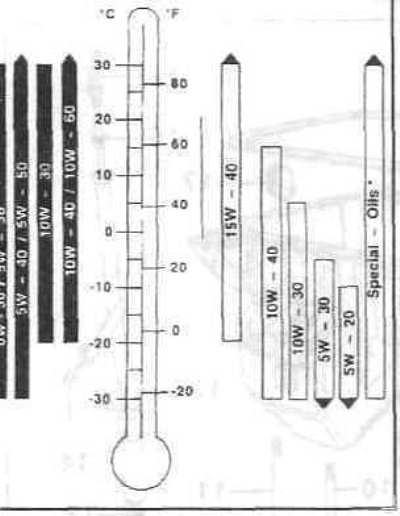
Application area/viscosity classes
Black stripes are for diesel engine oils, white stripes are for petrol engine oils.
Special oils 10W-X, 0W-X, 5W-X must have approval from BMW.
Since the application areas of oils with adjacent viscosity classes according to SAE overlap, short-term temperature fluctuations can be ignored. Mixing oils with different viscosity classes is allowed when adding oil, and the ambient temperature corresponds to the viscosity class of the oil being added.
The use of any additives in fuel or motor oil is not permitted.
Modern motor oils are alloyed oils, the properties of which are significantly improved by adding various chemical compounds to them. These additives (additives) improve corrosion protection, provide better oxidation resistance, including the tendency to form deposits in the engine crankcase, greater viscosity stability, and better washing and cleaning properties. Cleaning and dissolving additives not only counteract the formation of deposits in the engine, but are also capable of dissolving deposits and other contaminants in the oil and maintaining them in a constant suspended state, so when changing the oil, all contaminants are drained together with the old oil.
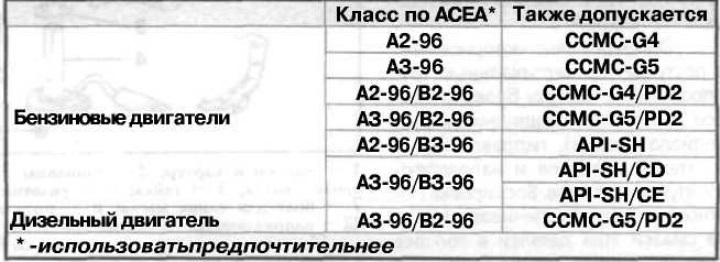
The quality of motor oil has been designated for several decades in accordance with the American API system (API — American Petroleum Institute). The designation consists of two letters. The first letter indicates the area of application: S (Service) — for gasoline engines or C (Commercial) — for diesel engines. The second letter corresponds to the quality of the oil — the further it is in the alphabet, the higher the quality. The highest quality oil for gasoline engines is designated SH, and for diesel engines — CE.
European motor oil manufacturers additionally use the "CCMC" specification. This specification takes into account the peculiarities of European engine production technology. Oils for gasoline engines, in accordance with their quality, have quality classes CCMC-64 and G5, oils for passenger car diesel engines can have the CCMC-PD1 specification or a higher CCMC-PD2 specification.
The European classification CCMS has been replaced by the ACEA specification (association of European Automobile Manufacturers), which defined the necessary checks and quality classes. Depending on their quality, oils for gasoline engines of passenger cars can have quality classes from ACEA A1-96 to ACEA AZ-96, oils for diesel engines have classes from B1-96 to BZ-96.
Motor oils for BMW 7 series cars
In combustion engines, oil consumption is understood as a certain amount of oil that is consumed during the combustion process. In no case should oil consumption be equated with oil leakage, which occurs due to leaks in the oil pan, valve cover, etc.
Normal oil consumption occurs due to the combustion of very small quantities of oil in the cylinders, due to the removal of combustion products and as a result of friction. In addition, oil is consumed at high temperatures and at high pressures, which are constantly present in the engine.
Oil consumption is affected by engine operating mode, driving style and manufacturing tolerances. The maximum permissible oil consumption is 1.5 l per 1000 km.
It is necessary to add oil if its level has dropped to the lower mark on the dipstick (to increase the oil level on the dipstick from the lower to the upper mark, about 1 liter of oil is required).
The original version is on the portal bmwman.ru
The W designation in the SAE oil specification indicates that it can be used in winter.
Synthetic oils are all-season oils on a so-called synthetic base. Among other things, they have anti-friction additives, which reduce friction inside the engine. In addition, the scope of application extends up to the highest temperatures.
Application area/viscosity classes
Black stripes are for diesel engine oils, white stripes are for petrol engine oils.
Special oils 10W-X, 0W-X, 5W-X must have approval from BMW.
Since the application areas of oils with adjacent viscosity classes according to SAE overlap, short-term temperature fluctuations can be ignored. Mixing oils with different viscosity classes is allowed when adding oil, and the ambient temperature corresponds to the viscosity class of the oil being added.
The use of any additives in fuel or motor oil is not permitted.
Specification of motor oils
Modern motor oils are alloyed oils, the properties of which are significantly improved by adding various chemical compounds to them. These additives (additives) improve corrosion protection, provide better oxidation resistance, including the tendency to form deposits in the engine crankcase, greater viscosity stability, and better washing and cleaning properties. Cleaning and dissolving additives not only counteract the formation of deposits in the engine, but are also capable of dissolving deposits and other contaminants in the oil and maintaining them in a constant suspended state, so when changing the oil, all contaminants are drained together with the old oil.
The quality of motor oil has been designated for several decades in accordance with the American API system (API — American Petroleum Institute). The designation consists of two letters. The first letter indicates the area of application: S (Service) — for gasoline engines or C (Commercial) — for diesel engines. The second letter corresponds to the quality of the oil — the further it is in the alphabet, the higher the quality. The highest quality oil for gasoline engines is designated SH, and for diesel engines — CE.
European motor oil manufacturers additionally use the "CCMC" specification. This specification takes into account the peculiarities of European engine production technology. Oils for gasoline engines, in accordance with their quality, have quality classes CCMC-64 and G5, oils for passenger car diesel engines can have the CCMC-PD1 specification or a higher CCMC-PD2 specification.
The European classification CCMS has been replaced by the ACEA specification (association of European Automobile Manufacturers), which defined the necessary checks and quality classes. Depending on their quality, oils for gasoline engines of passenger cars can have quality classes from ACEA A1-96 to ACEA AZ-96, oils for diesel engines have classes from B1-96 to BZ-96.
Note: Motor oils that are designated by manufacturers exclusively as oils for diesel engines are not suitable for petrol engines. There are oils that are suitable for both petrol and diesel engines. In this case, both specifications are indicated on the packaging (for example, CCMC-G5/PD2).
Motor oils for BMW 7 series cars
Oil consumption
In combustion engines, oil consumption is understood as a certain amount of oil that is consumed during the combustion process. In no case should oil consumption be equated with oil leakage, which occurs due to leaks in the oil pan, valve cover, etc.
Normal oil consumption occurs due to the combustion of very small quantities of oil in the cylinders, due to the removal of combustion products and as a result of friction. In addition, oil is consumed at high temperatures and at high pressures, which are constantly present in the engine.
Oil consumption is affected by engine operating mode, driving style and manufacturing tolerances. The maximum permissible oil consumption is 1.5 l per 1000 km.
It is necessary to add oil if its level has dropped to the lower mark on the dipstick (to increase the oil level on the dipstick from the lower to the upper mark, about 1 liter of oil is required).
The original version is on the portal bmwman.ru
This article is available at russian, bulgarian, belarusian, ukrainian, serbian, croatian, romanian, polish, slovak, hungarian
Article verified: Sevastyanov Nikolay
Share information:
Previous articles
БМВ E32: Lubrication system
Next articles
Similar articles on other types of BMW cars:
Application ranges/viscosity classes of motor oils BMW 3 Series E36 (1990-2000)
Removal and installation the windshield wiper motor BMW 3 Series E21 (1975-1983)
Specification of motor oils BMW 5 Series E34 (1988-1996)
Application areas / viscosity classes of motor oils BMW 5 Series E39 (1995-2003)
Servo motor (ATS 400/500 XDRIVE) BMW X3 E83 (2003-2010)
Checking the level and replacing transmission oils BMW X5 E53 (1999-2006)
Application ranges/viscosity classes of motor oils BMW 3 Series E36 (1990-2000)
Removal and installation the windshield wiper motor BMW 3 Series E21 (1975-1983)
Specification of motor oils BMW 5 Series E34 (1988-1996)
Application areas / viscosity classes of motor oils BMW 5 Series E39 (1995-2003)
Servo motor (ATS 400/500 XDRIVE) BMW X3 E83 (2003-2010)
Checking the level and replacing transmission oils BMW X5 E53 (1999-2006)
Link in different formats to this page
Visitor comments
No comments yet
- General information
- Introduction to guide
- Manual
- Maintenance
- Power unit
- Engine M60/1, M60/2 (petrol)
- M62 engine (petrol)
- M57 engine (diesel)
- M67 engine (diesel)
- Cooling system
- Fuel system (petrol)
- Fuel system (diesel)
- Exhaust system
- Ignition and control systems
- Charge and launch systems
- Transmission
- Clutch
- Mechanical gearbox
- Automatic gearbox
- Cardan and drive shafts
- Chassis
- Brake system
- Front suspension
- Rear suspension
- Steering
- Body
- Exterior
- Interior
- Electrical equipment
- Equipment and devices
- Lighting
- Heating and air conditioning
- Electrical circuits
- General information
- Care and maintenance
- Power unit
- Minor engine repair
- Engine overhaul
- Lubrication system
- Cooling system
- Ignition system
- Supply system
- Injection system (petrol)
- Injection system (diesel)
- Exhaust system
- Transmission
- Clutch
- Manual gearbox
- Automatic gearbox
- Cardan gear
- Rear axle and shafts
- Chassis
- Front suspension
- Rear suspension
- Steering
- Wheels and tires
- Brake system
- Body
- Body elements
- Electrical equipment
- Equipment and devices
- Electrical circuits