
Cars Mazda Cars Mitsubishi Cars Toyota Cars Chevrolet Cars AvtoVAZ Cars Kia Cars Nissan
English Русский
Български
Беларускі
Український
Српски
Hrvatski
Română
Polski
Slovenský
Magyar
| Articles | Contacts | Sitemap |   
BMWman.ru


3 series   5 series   7 series   BMW X3   BMW X5   BMW X6

E46 (1998-2006) E46 (1998-2006, petrol) E36 (1990-2000) E30 (1982-1994) E21 (1975-1983)
  • Home
  • BMW 3 Series
  • E46
  • General information
  • Maintenance
  • Replacing brake fluid

Replacing brake fluid (BMW 3 Series E46)

            0

To carry out the work you will need:
  • Open-end wrench for the air bleed nipple. For example, HAZET 1968-7.
  • Transparent plastic hose with an internal diameter of 6 mm and a container for collecting brake fluid.
  • About 1.0 liter of brake fluid.

Do not use DOT 5 brake fluid. Do not refill the system with used fluid.


Follow the rules for handling brake fluid, refer to Section Brake fluid - basic information and safety precautions.

Protect the environment, never pour out used oil or dispose of it with household waste. Local authorities should inform about the location of the nearest collection points for used materials.

Brake fluid absorbs moisture through the pores of the brake hoses and the ventilation holes of the fluid reservoir. As a result, the boiling point of the brake fluid decreases during operation. With a significant load on the brakes, this can lead to the formation of steam bubbles in the brake pipes, which reduces the effectiveness of the brakes. Therefore, it is necessary to replace the brake fluid every 2 years.

1. Follow the rules for handling brake fluid as described in Section Brake fluid - basic information and safety precautions.

At the service station, air from the brake hydraulic system is usually removed using a special device. The device supplies brake fluid to the reservoir under a pressure of 2.0 bar. This operation can be performed without using a special tool. In this case, air is removed from the brake system by rocking movements of the brake pedal. The operation is performed with the help of an assistant.


If air has penetrated into the ABS hydraulic unit, it is recommended to remove it at a service station. This occurs if there is a leak in the hydraulic unit or if one chamber of the brake fluid reservoir is empty or if you forgot to add fluid when removing air from the system.


2. Mark the fluid level on the reservoir. After replacing the fluid, restore the previous fluid level. This will prevent the reservoir from overflowing with fluid when replacing the brake pads.

3. Suck out the liquid from the tank to a level of 10 mm.
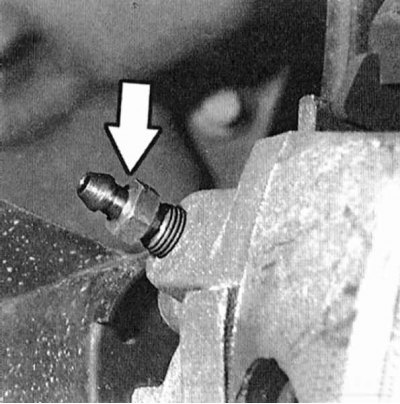
3. Suck out the liquid from the tank to a level of 10 mm.


4. Fill the reservoir with fresh brake fluid up to the MAX mark.

Carefully open the bleed nipples without unscrewing them. It is recommended to spray the nipples with rust solvent about two hours before opening. If any nipple does not unscrew, you must contact a service station.


Air removal sequence


1. Rear right support.

2. Rear left support.

3. Front right support.

4. Front left support.

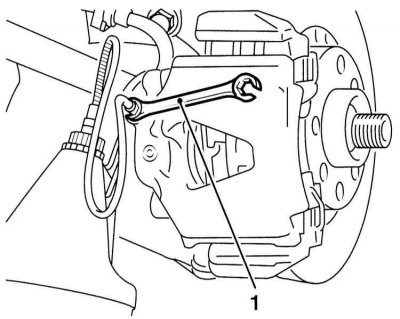
5. Attach a clean hose to the nipple of the right rear brake cylinder and place a suitable container underneath.

6. Ask an assistant to slowly press the brake pedal until you feel resistance.


6. Ask an assistant to slowly press the brake pedal until you feel resistance.


7. Keeping the brake pedal depressed, loosen the union with the open-end wrench "1" on the right rear caliper. Close the union when the pedal touches the floor. Ask the assistant to release the pedal.

8. Repeat the above procedure as many times as necessary to ensure that the liquid coming out is free of bubbles. Fresh liquid is recognizable by its light color.

9. Lightly tighten the fitting. The tightening torque depends on the thread diameter: a fitting with a diameter of 7 mm is tightened with a torque of 5 N·m, a fitting with a diameter of 11 mm with a torque of 15 N·m.

10. Similarly, in the order indicated above, pump out the brake fluid from the other calipers.

While removing air, add liquid to the reservoir. It should not be completely empty. Otherwise, air will enter the system.


11. After replacing the brake fluid, press the brake pedal and check its free travel. It should not exceed 1/3 of the total pedal travel.

12. Cars with manual transmission: Since the clutch drive operates on brake fluid, the fluid in the clutch hydraulic system is replaced in the manner described above.

13. Before replacing the brake fluid, fill the reservoir to the marked level.


14. Screw the lid onto the tank.
  • Are the brake hoses secured?
  • Is the brake hose secured in the holder?
  • Are the air bleed nipples tightened?
  • Is there enough brake fluid?

With the engine running, check for leaks. To do this, press the brake pedal with a force of 200–300 N (20–30 kg) for 10 s. The pedal should not weaken. Check all connections for leaks.

15. Finally, brake several times on a road with sparse traffic. At least once, perform full braking, which activates the ABS, in particular on the ground. The operation of the ABS is felt by the pulsations of the brake pedal.

(The original source of the article is on the website BMWMAN.ru)

This article is available at russian, bulgarian, belarusian, ukrainian, serbian, croatian, romanian, polish, slovak, hungarian
Article verified: Sevastyanov Nikolay

Share information:
Previous articles
БМВ E46: Maintenance
Next articles

Checking battery condition, care and charging
Checking the condition, replacing the brushes and adjusting the angle…
Wheel rotation and replacement
Checking seat belts
Visual inspection of the body and its bottom
Checking and replacing spark plugs
Checking the fuel system, replacing the fuel filter. Operation of a…
Lubrication of door hinges and locks
Replacing the remote control key battery


Similar articles on other types of BMW cars:
Replacing brake fluid BMW 5 Series E39 (1995-2003)
Replacing the front brake pads BMW 5 Series E12 (1972-1981)
Replacing brake fluid BMW 7 Series E32 (1986-1994)
Replacing brake fluid and bleeding the brake system BMW 7 Series E38 (1994-2001)
Replacing the fluid in the ABS/ASC brake system + T BMW X3 E83 (2003-2010)
Replacing brake fluid BMW X5 E53 (1999-2006)
Link in different formats to this page


Visitor comments

No comments yet


How much 20 + 16 =


BMW E46 (1998-2006) 
  • General information
  • Manual
  • Maintenance
  • Power unit
  • Engine repair
  • Cooling system
  • Power system (gasoline)
  • Injection system (gasoline)
  • Fuel system (diesel)
  • Exhaust system
  • Ignition system
  • Charge and launch systems
  • Transmission
  • Car gearbox
  • Clutch and drive shafts
  • Chassis
  • Brake system
  • Suspension front and rear
  • Steering
  • Body
  • Body care and repair
  • Exterior
  • Interior
  • Electrical equipment
  • Troubleshooting
  • Lighting and signaling
  • Equipment and devices
  • Heater and air conditioner
  • Electrical circuits
BMW E46 (1998-2006, petrol) 
  • General information
  • Manual
  • Repair on the road
  • Weekly checks
  • Maintenance
  • Troubleshooting
  • Power unit
  • 4 cylinder engines
  • 6 cylinder engines
  • Engine overhaul
  • Cooling and heating
  • Fuel and exhaust system
  • Starting and charging system
  • Ignition system
  • Transmission
  • Clutch
  • Mechanical gearbox
  • Automatic gearbox
  • Cardan and drive shafts
  • Chassis
  • Brake system
  • Wheel suspension
  • Steering
  • Body
  • Exterior
  • Interior
  • Electrical equipment
  • Equipment and devices
  • Electrical circuits
BMW E36 (1990-2000) 
  • General information
  • Maintenance
  • Power unit
  • Engine repair
  • Cooling system
  • Ignition system
  • Supply system
  • Fuel injection system
  • Exhaust system
  • Transmission
  • Clutch
  • Car gearbox
  • Front and rear axle
  • Chassis
  • Steering
  • Brake system
  • Body
  • Exterior
  • Interior
  • Electrical equipment
  • Heating system
  • Equipment and devices
  • Power devices
  • Electrical circuits
BMW E30 (1982-1994) 
  • Power unit
  • M10/M20 engine
  • M40 engine
  • Ignition system
  • Lubrication system
  • Cooling system
  • Supply system
  • Fuel injection
  • Exhaust system
  • Transmission
  • Clutch
  • Manual gearbox
  • Front axle
  • Rear axle
  • Chassis
  • Steering
  • Brake system
  • Body
  • Exterior
  • Interior
  • Electrical equipment
  • Heating system
  • Equipment and devices
  • Electrical circuits
BMW E21 (1975-1983) 
  • General information
  • Specifications
  • Operation and maintenance
  • 4-cylinder engine
  • Engine repair
  • Cooling and lubrication system
  • Supply system
  • Ignition system
  • 6-cylinder engine
  • Engine repair
  • Cooling and lubrication system
  • Supply system
  • Fuel injection system
  • Ignition system
  • Transmission
  • Clutch
  • 4-speed manual gearbox
  • 5-speed manual gearbox
  • Automatic gearbox
  • Cardan and rear axle
  • Chassis
  • Steering
  • Front suspension
  • Rear suspension
  • Brake system
  • Electrical equipment
  • Equipment and devices
  • Electrical circuits
BMWman.ru © 2017-2026 · Mobile version · News and articles · Sitemap: EN BG BY UA RS HR RO PL SK HU · Feedback · Site search
3er E21 · 3er E30 · 3er E36 · 3er E46 [petrol] · 3er E46 · 5er E12 · 5er E28 · 5er E34 · 5er E39 · 7er E32 · 7er E38 · X3 E83 · X5 E53 ·
This site uses cookies 🍪, without them some features simply would not work.