
- Home
- BMW 3 Series
- E46
- General information
- Maintenance
- Brake system checks
Brake system checks (BMW 3 Series E46)
Dust from lining wear that collects on brake components may contain asbestos, which is hazardous to health. Do not blow out this dust with compressed air or inhale it! Do not use gasoline-based solvents to remove dust. Dust should be washed off with a special brake system cleaner or methylated spirits into a drain container. After wiping the brake components with a damp cloth, keep the cloth and the contents of the drain container in a closed and labeled container. In the future, try to use asbestos-free components whenever possible.
In addition to checking at specified intervals, the brake system should be checked whenever the wheels are removed or when the system shows signs of malfunction. The following brake system checks are the most important of all the vehicle maintenance procedures you will perform to ensure safe driving.
Signs of a problem with the brake system
1. Disc brakes may have built-in friction lining wear indicators that signal that the lining wear has reached a critical level. In this case, the linings should be replaced immediately, otherwise the brake discs will be damaged and will require expensive repairs.
2. Any of the following symptoms may indicate a potential defect in the brake system:
- a) When you press the brake pedal, the car "pulls" to one side
- b) The brakes make scraping or squealing sounds when braking
- c) The brake pedal has excessive travel
- d) The brake pedal pulsates (this is normal only when the ABS system is working)
- e) Brake fluid leaks are observed (usually on the inside of a tire or wheel)
3. If you notice any of these signs, inspect the brake system immediately.
Brake lines and hoses
The brake system uses mostly steel brake lines, with the exception of flexible reinforced hoses at the front wheels and as connections at the rear axle. Regular inspection of all these lines is very important.
4. Park the car on a level surface and turn off the engine. Remove the wheel caps. Loosen, but do not remove, the lug nuts on all four wheels.
5. Jack up the vehicle and securely place it on supports.
6. Remove the wheels (refer to Section Wheel rotation and replacement).
7. Check all brake lines and hoses for cracks, abrasions in their outer coating, leaks, bulges and deformations. Check the brake hoses at the front and rear of the vehicle for signs of softening, cracks, deformations or wear due to friction with other components. Check all fittings for signs of leaks and make sure that all bolts and clamps on the brake hoses are securely fastened.
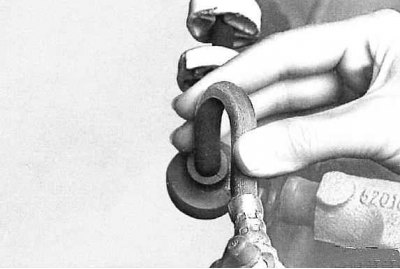
8. Bend the brake hose in both directions with your hands to check for damage. Do not twist the hoses. Follow the direction of the color line on the hose.
9. Turn the steering wheel to the right and left until it stops. The hoses should not touch the vehicle's structural elements.
10. If any fluid leaks or damage are found, they should be repaired immediately. For a more detailed description of the brake system repair procedure, refer to Chapter Brake system.
Checking the thickness of brake pads
When the brake pads of the front and rear brakes are worn out, the indicator on the instrument panel lights up. In this case, it is necessary to urgently replace the brake pads.
The operation of lifting and installing the vehicle on stands is associated with danger! Therefore, before carrying out the operation, read the Section Jacking and towing
11. Mark the position of the wheels relative to the hub with paint. This will allow you to install the balanced wheels in their original position during assembly. Loosen the wheel mounting bolts on the car standing on the ground. Raise the car, put it on stands and remove the wheels.
Disc brakes
12. Visually check the thickness of the pads without the metal plate, looking from above through the caliper.
13. Additionally, check the thickness of the outer pad from the side. The wear limit of the front and rear brake pads is reached when the pad thickness is 3 mm.
14. In case of doubt, remove the pads and measure the thickness with a caliper. When the wear limit is reached, the pads should be replaced. In this case, all four pads on one axle should be replaced, even if only one pad has reached the wear limit.
Based on experience, it is known that 1 mm of disc brake pad wear corresponds to 1000 km of mileage. This corresponds to unfavorable operating conditions. Under normal vehicle operation, the service life of the pads is significantly longer. With a pad thickness of 5.0 mm (without backing plate) the block can still be used for a mileage of 2000 km.
15. Check if the caliper has any signs of brake fluid leakage. If there is any leakage, immediately send the caliper for repair.
16. Visually inspect the brake discs from the inside and outside for scoring, corrosion damage and cracks. Replace the discs if necessary.
Parking brake
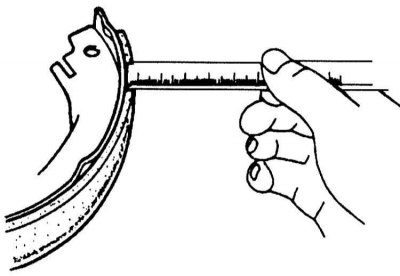
17. The parking brake pads can be visually inspected after removing the service brake disc. The wear limit has been reached when the pad thickness at its thinnest point is 1.5 mm.
18. If the wear limit is reached, the pads must be replaced. Be sure to replace all pads on one axle, refer to Section Removal and installation parking brake shoes.
19. Install the wheels so that the markings applied during removal match. Pre-lubricate the centering belt of the wheel disk on the hub with a thin layer of bearing grease. Do not lubricate the wheel mounting bolts. Rusty bolts must be replaced. Install the wheels and tighten the mounting bolts. Lower the car onto the wheels and tighten the bolts crosswise to a torque of 100 N·m.
Checking the operation of the parking brake
The parking brake is a drum brake with a cable drive. The drum is built into the rear brake discs. Since the wear of the parking brake pad is insignificant, corrosion damage or contamination of the brake pads may occur. Therefore, before checking the parking brake, it is recommended to run it in as follows:
20. Slowly apply the parking brake from 40 km/h on a deserted street or parking lot like this. Without changing speed, tighten the parking brake one more notch and drive another 400 m. Release the brake and let it cool.
The operation of lifting and installing the vehicle on stands is associated with danger! Therefore, before carrying out the operation, read the Section Jacking and towing.
21. Raise the rear of the vehicle and place it on stands. The wheels should be at least 2 cm above the ground.
22. Apply the parking brake one click and spin the rear wheels. The wheels should spin freely and the brakes should not work.
23. When the brake is applied 10 clicks, the wheels should be completely braked.
24. Otherwise, adjust the parking brake, refer to Section Adjusting the parking brake.
25. Lower the car onto its wheels.
This article is available at russian, bulgarian, belarusian, ukrainian, serbian, croatian, romanian, polish, slovak, hungarian
Article verified: Sevastyanov Nikolay
Share information:
Previous articles
БМВ E46: Maintenance
Next articles
Similar articles on other types of BMW cars:
Maintenance of the brake system BMW 5 Series E12 (1972-1981)
Diagnostics of brake system faults BMW 5 Series E34 (1988-1996)
Diagnostics of brake system faults BMW 7 Series E32 (1986-1994)
Checking the brake system and clutch BMW 7 Series E38 (1994-2001)
Brake system — equipment and tools BMW X3 E83 (2003-2010)
Checking the brake system BMW X5 E53 (1999-2006)
Maintenance of the brake system BMW 5 Series E12 (1972-1981)
Diagnostics of brake system faults BMW 5 Series E34 (1988-1996)
Diagnostics of brake system faults BMW 7 Series E32 (1986-1994)
Checking the brake system and clutch BMW 7 Series E38 (1994-2001)
Brake system — equipment and tools BMW X3 E83 (2003-2010)
Checking the brake system BMW X5 E53 (1999-2006)
Link in different formats to this page
Visitor comments
No comments yet
- General information
- Manual
- Maintenance
- Power unit
- Engine repair
- Cooling system
- Power system (gasoline)
- Injection system (gasoline)
- Fuel system (diesel)
- Exhaust system
- Ignition system
- Charge and launch systems
- Transmission
- Car gearbox
- Clutch and drive shafts
- Chassis
- Brake system
- Suspension front and rear
- Steering
- Body
- Body care and repair
- Exterior
- Interior
- Electrical equipment
- Troubleshooting
- Lighting and signaling
- Equipment and devices
- Heater and air conditioner
- Electrical circuits
- General information
- Manual
- Repair on the road
- Weekly checks
- Maintenance
- Troubleshooting
- Power unit
- 4 cylinder engines
- 6 cylinder engines
- Engine overhaul
- Cooling and heating
- Fuel and exhaust system
- Starting and charging system
- Ignition system
- Transmission
- Clutch
- Mechanical gearbox
- Automatic gearbox
- Cardan and drive shafts
- Chassis
- Brake system
- Wheel suspension
- Steering
- Body
- Exterior
- Interior
- Electrical equipment
- Equipment and devices
- Electrical circuits
- General information
- Maintenance
- Power unit
- Engine repair
- Cooling system
- Ignition system
- Supply system
- Fuel injection system
- Exhaust system
- Transmission
- Clutch
- Car gearbox
- Front and rear axle
- Chassis
- Steering
- Brake system
- Body
- Exterior
- Interior
- Electrical equipment
- Heating system
- Equipment and devices
- Power devices
- Electrical circuits
- Power unit
- M10/M20 engine
- M40 engine
- Ignition system
- Lubrication system
- Cooling system
- Supply system
- Fuel injection
- Exhaust system
- Transmission
- Clutch
- Manual gearbox
- Front axle
- Rear axle
- Chassis
- Steering
- Brake system
- Body
- Exterior
- Interior
- Electrical equipment
- Heating system
- Equipment and devices
- Electrical circuits
- General information
- Specifications
- Operation and maintenance
- 4-cylinder engine
- Engine repair
- Cooling and lubrication system
- Supply system
- Ignition system
- 6-cylinder engine
- Engine repair
- Cooling and lubrication system
- Supply system
- Fuel injection system
- Ignition system
- Transmission
- Clutch
- 4-speed manual gearbox
- 5-speed manual gearbox
- Automatic gearbox
- Cardan and rear axle
- Chassis
- Steering
- Front suspension
- Rear suspension
- Brake system
- Electrical equipment
- Equipment and devices
- Electrical circuits