
Table of contents: External inspection of oil leaks ↓ Compression check ↓
- Home
- BMW 3 Series
- E30
- Power unit
- M40 engine
- Engine maintenance work
Engine maintenance work (BMW 3 Series E30)
External inspection of oil leaks
In case of oil spillage in the engine and increased oil consumption, determine the places of its leakage. To do this, check the engine in the following places:
- Open the filler cap and check the gasket for cracks or damage.
- Crankcase ventilation: ventilation hoses from the crankcase to the camshaft housing and from the camshaft housing to the air manifold housing.
- Cylinder head cover gasket.
- Cylinder head gasket.
- Location of connection of the ignition distributor flange.
- Oil filter gasket: between the oil filter and the flange.
- Oil drain plug (gasket).
- Oil pan gasket.
- Connecting the engine to the gearbox (flywheel or gearbox shaft gasket).
Since the leaking oil is spread over a large surface area of the engine, leaks are not visible at first glance. When searching for a leak, it is recommended to:
- Wash the engine. Spray the engine with a suitable cleaner and after a short time of action rinse with clean water. First cover the ignition distributor and generator with plastic bags.
- Sprinkle talc on the joints and gaskets on the engine.
- Check the oil level and top up if necessary.
- Take a test drive. Since the oil liquefies on a warm engine and penetrates through leaks faster, drive at least 30 km on the highway.
- Inspect the engine with a portable lamp, locate the leaks and eliminate them.
Compression check
The results of the compression test allow us to draw conclusions about the condition of the engine. It is the test that allows us to draw conclusions about the wear of the valves or pistons (piston rings). In addition, the test results allow you to determine whether the engine can be repaired by replacing individual parts or whether it requires a major overhaul. A compression gauge (pressure gauge) is required for testing.
Note: Diesel engines require a pressure gauge with a larger measuring range.
The difference in compression of individual cylinders should not exceed 1.0 bar (diesel engine: 1.5 bar). Exceeding these values is a sign of valve defects, wear of piston rings or cylinder working surfaces. When the wear limit is reached, the engine is subject to major repairs or replacement.
Compression on petrol engines should be at least 10-11 bar, and on diesel engines – at least 20 bar.
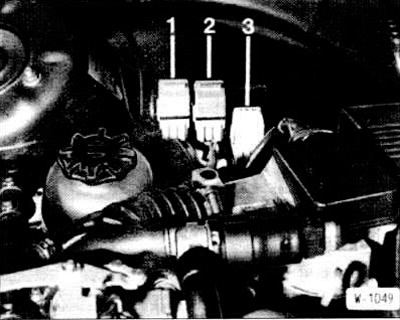
To check compression, a gasoline engine must be warmed up to operating temperature, and a diesel engine must be cold.
Turn off the ignition.
Model 318i with K-Jetronic: Remove the fuel pump relay.
Models 325e, 325i, 325 i CAT: remove the main relay "3" DME. so that fuel is not injected during the test. Also shown in the figure: "1" fuel pump relay; "2" lambda probe heating relay.
Note: On the 325\ model without a catalytic converter, the fuel pump relay is located on the relay block "2", relay block "1" is free.
316i models produced since September 19885, 318i models produced since September 1987: Remove the cover at the bulkhead under the windshield wiper and pull the main relay located there out of its socket. The main relay is located on the right side.
Remove all spark plug tips. There are special pliers for this, for example, from HAZET 1849. But these pliers can only be used to grasp the metal bushings of the tips.
Blow out the spark plug recesses in the cylinder head with compressed air and use a special spark plug wrench to remove all the spark plugs.
Turn the engine over a few revolutions with the starter to remove carbon deposits.
Caution: The gearbox is in neutral position, the handbrake is applied.
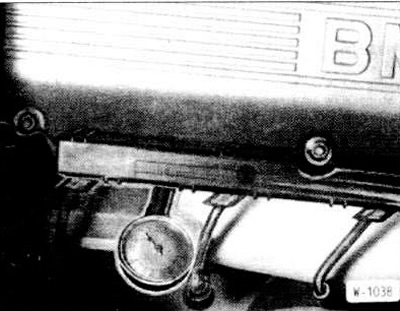
Connect the compression tester to the spark plug hole in accordance with its operating instructions.
The assistant must press the gas pedal all the way down and keep his foot on the pedal in this position throughout the entire test.
Crank the engine approximately 8 revolutions until the reading on the gauge scale stops increasing.
Check the compression in all cylinders sequentially and compare with the specified value.
Finally, screw in the spark plugs and connect the spark plug wires.
Connect the connector of the transistor ignition switching unit.
Install fuel pump relay or main relay. Diesel engine
Model 324d: Press the high pressure fuel pump release lever forward.
Model 324td: Remove main relay.
Disconnect the electrical wires from the glow plugs and unscrew the spark plugs with the appropriate wrench head.
Instead of glow plugs, screw in a compression measuring device.
After checking, screw in and tighten the glow plugs to 25 Nm. Coat the threads of the glow plugs with copper paste "CRC" beforehand.
Connect the wires to the glow plugs with a tightening torque of 5 Nm.
Return the high pressure fuel pump shut-off lever to the rear position or insert the main relay.
This article is available at russian, bulgarian, belarusian, ukrainian, serbian, croatian, romanian, polish, slovak, hungarian
Article verified: Polikarpov Saveliy
Share information:
Previous articles
БМВ E30: M40 engine
Next articles
Similar articles on other types of BMW cars:
Maintenance work BMW 5 Series E34 (1988-1996)
Maintenance with engine oil change BMW 5 Series E39 (1995-2003)
Starting the engine from an auxiliary battery BMW 7 Series E32 (1986-1994)
Starting the engine from an external power source BMW X3 E83 (2003-2010)
Carrying out maintenance work BMW X5 E53 (1999-2006)
Maintenance work BMW 5 Series E34 (1988-1996)
Maintenance with engine oil change BMW 5 Series E39 (1995-2003)
Starting the engine from an auxiliary battery BMW 7 Series E32 (1986-1994)
Starting the engine from an external power source BMW X3 E83 (2003-2010)
Carrying out maintenance work BMW X5 E53 (1999-2006)
Link in different formats to this page
Visitor comments
No comments yet
- General information
- Manual
- Maintenance
- Power unit
- Engine repair
- Cooling system
- Power system (gasoline)
- Injection system (gasoline)
- Fuel system (diesel)
- Exhaust system
- Ignition system
- Charge and launch systems
- Transmission
- Car gearbox
- Clutch and drive shafts
- Chassis
- Brake system
- Suspension front and rear
- Steering
- Body
- Body care and repair
- Exterior
- Interior
- Electrical equipment
- Troubleshooting
- Lighting and signaling
- Equipment and devices
- Heater and air conditioner
- Electrical circuits
- General information
- Manual
- Repair on the road
- Weekly checks
- Maintenance
- Troubleshooting
- Power unit
- 4 cylinder engines
- 6 cylinder engines
- Engine overhaul
- Cooling and heating
- Fuel and exhaust system
- Starting and charging system
- Ignition system
- Transmission
- Clutch
- Mechanical gearbox
- Automatic gearbox
- Cardan and drive shafts
- Chassis
- Brake system
- Wheel suspension
- Steering
- Body
- Exterior
- Interior
- Electrical equipment
- Equipment and devices
- Electrical circuits
- General information
- Maintenance
- Power unit
- Engine repair
- Cooling system
- Ignition system
- Supply system
- Fuel injection system
- Exhaust system
- Transmission
- Clutch
- Car gearbox
- Front and rear axle
- Chassis
- Steering
- Brake system
- Body
- Exterior
- Interior
- Electrical equipment
- Heating system
- Equipment and devices
- Power devices
- Electrical circuits
- Power unit
- M10/M20 engine
- M40 engine
- Ignition system
- Lubrication system
- Cooling system
- Supply system
- Fuel injection
- Exhaust system
- Transmission
- Clutch
- Manual gearbox
- Front axle
- Rear axle
- Chassis
- Steering
- Brake system
- Body
- Exterior
- Interior
- Electrical equipment
- Heating system
- Equipment and devices
- Electrical circuits
- General information
- Specifications
- Operation and maintenance
- 4-cylinder engine
- Engine repair
- Cooling and lubrication system
- Supply system
- Ignition system
- 6-cylinder engine
- Engine repair
- Cooling and lubrication system
- Supply system
- Fuel injection system
- Ignition system
- Transmission
- Clutch
- 4-speed manual gearbox
- 5-speed manual gearbox
- Automatic gearbox
- Cardan and rear axle
- Chassis
- Steering
- Front suspension
- Rear suspension
- Brake system
- Electrical equipment
- Equipment and devices
- Electrical circuits