
Cars Mazda Cars Mitsubishi Cars Toyota Cars Chevrolet Cars AvtoVAZ Cars Kia Cars Nissan
English Русский
Български
Беларускі
Український
Српски
Hrvatski
Română
Polski
Slovenský
Magyar
| Articles | Contacts | Sitemap |   
BMWman.ru


3 series   5 series   7 series   BMW X3   BMW X5   BMW X6

E38 (1994-2001) E32 (1986-1994)
  • Home
  • BMW 7 Series
  • E38
  • General information
  • Maintenance
  • Checking the condition of the tires and their inflation pressure

Checking the condition of the tires and their inflation pressure (BMW 7 Series E38)

            0

The tyres and rims suitable for use on the vehicle, as well as the tyre inflation pressure, are indicated on a plate attached to the B-pillar on the driver's side.


Examples and possible causes of tire wear
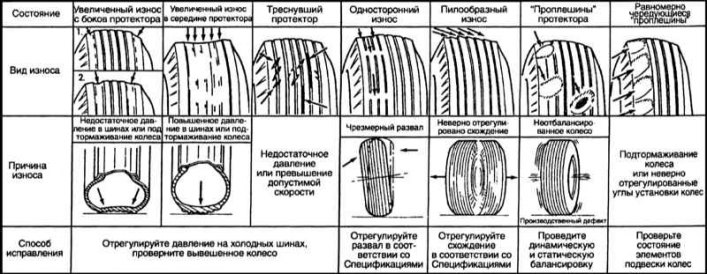


Examples and possible causes of tire wear


1. When driving in a sporty manner, it is recommended to increase the tire pressure by 0.3 atm, based on the base value for different load conditions.

2. Winter tires usually have a pressure of 0.2 atm higher than summer tires. You should take into account the recommendations of winter tire manufacturers, and also remember that such tires have a speed limit.

3. Regularly checking your tires will help you avoid the hassle of being stopped on the road due to a flat tire. In addition, such checks provide valuable information about possible problems with the steering and suspension before serious damage occurs.

4. The tires used on the vehicles in question are equipped with built-in tread wear indicator strips that become exposed when the tread depth decreases to 1.6 mm. When the indicator appears, the tires are considered worn. In most cases, it is recommended to replace tires with a tread depth of less than 2 mm. Tread depth can also be determined using a simple and inexpensive device known as a tread depth gauge.


5. Pay attention to any unusual tread wear. Tread defects such as cavities, bulges, flattening and more severe wear on one side indicate a violation of the wheel alignment angles and/or wheel balancing. If any of these defects are detected, contact a tire repair shop to have them corrected (see illustration Examples and possible causes of tire wear).

6. Check your tires carefully for cuts, punctures, and stuck nails or tacks. Sometimes, after a tire has been punctured by a nail, it will hold its pressure for a while or deflate very slowly. If you suspect that you have such a "slow puncture," first check the tire inflation valve for leaks. Then inspect the tread for any foreign objects stuck in it or previously repaired punctures that have started to let air through again. You can verify the presence of a puncture by wetting the suspected area with soapy water. If there is a puncture, the solution will start to bubble. If the puncture is not too big, the tire can be repaired at any tire shop.

7. Carefully inspect the inside sidewalls of the tires for signs of brake fluid leakage. If any, have the brake system checked immediately.

8. Maintaining the correct tire pressure increases their life, helps save fuel and improves overall driving comfort. A pressure gauge is required to check the pressure.

9. Always check tire pressure when tires are cold (i.e. before traveling by car). If you check the pressure on warm or heated tires, this will lead to overestimation of the pressure gauge readings due to thermal expansion of the tires. In this case, you should not lower the pressure, because after the tire cools down, it will be lower than normal.


10. To check the inflation pressure of the tire, remove the protective cap from the valve, then press the pressure gauge nozzle firmly against the inflation valve and read the reading of the device - it must comply with the requirements of the Specifications (see chapter Suspension and steering). Don't forget to put the protective cap back in place to prevent dirt and moisture from getting into the valve. Check the pressure in all tires, not forgetting the spare tire, and inflate them if necessary.

11. If the front wheels are significantly worn, it is recommended to swap them with the rear wheels.

(This article is based on data from the website www.bmwman.ru)

This article is available at russian, bulgarian, belarusian, ukrainian, serbian, croatian, romanian, polish, slovak, hungarian
Article verified: Polikarpov Saveliy

Share information:
Previous articles
БМВ E38: Maintenance
Next articles

Replacing the coolant
Replacing the air cleaner filter element
Replacing the cabin filter (ventilation system)
Replacing spark plugs
Replacing brake fluid and bleeding the brake system
Checking and caring for your battery
Checking the condition of the auxiliary drive belt
Checking the condition of the windshield wipers and adjusting the…
Final drive oil change
Checking the thickness of the driven clutch disc


Similar articles on other types of BMW cars:
Checking the condition of tires and pressure in them. Designation of… BMW 3 Series E46 (1998-2006)
Checking the technical condition of connecting rod and piston group… BMW 3 Series E21 (1975-1983)
Checking the condition of the tires and their pressure BMW 5 Series E28 (1981-1988)
Checking tire inflation pressure BMW 5 Series E39 (1995-2003)
Checking engine oil pressure BMW X3 E83 (2003-2010)
Checking the condition of the tires BMW X5 E53 (1999-2006)
Link in different formats to this page


Visitor comments

No comments yet


How much 33 + 35 =


BMW E38 (1994-2001) 
  • General information
  • Introduction to guide
  • Manual
  • Maintenance
  • Power unit
  • Engine M60/1, M60/2 (petrol)
  • M62 engine (petrol)
  • M57 engine (diesel)
  • M67 engine (diesel)
  • Cooling system
  • Fuel system (petrol)
  • Fuel system (diesel)
  • Exhaust system
  • Ignition and control systems
  • Charge and launch systems
  • Transmission
  • Clutch
  • Mechanical gearbox
  • Automatic gearbox
  • Cardan and drive shafts
  • Chassis
  • Brake system
  • Front suspension
  • Rear suspension
  • Steering
  • Body
  • Exterior
  • Interior
  • Electrical equipment
  • Equipment and devices
  • Lighting
  • Heating and air conditioning
  • Electrical circuits
BMW E32 (1986-1994) 
  • General information
  • Care and maintenance
  • Power unit
  • Minor engine repair
  • Engine overhaul
  • Lubrication system
  • Cooling system
  • Ignition system
  • Supply system
  • Injection system (petrol)
  • Injection system (diesel)
  • Exhaust system
  • Transmission
  • Clutch
  • Manual gearbox
  • Automatic gearbox
  • Cardan gear
  • Rear axle and shafts
  • Chassis
  • Front suspension
  • Rear suspension
  • Steering
  • Wheels and tires
  • Brake system
  • Body
  • Body elements
  • Electrical equipment
  • Equipment and devices
  • Electrical circuits
BMWman.ru © 2017-2026 · Mobile version · News and articles · Sitemap: EN BG BY UA RS HR RO PL SK HU · Feedback · Site search
3er E21 · 3er E30 · 3er E36 · 3er E46 [petrol] · 3er E46 · 5er E12 · 5er E28 · 5er E34 · 5er E39 · 7er E32 · 7er E38 · X3 E83 · X5 E53 ·
This site uses cookies 🍪, without them some features simply would not work.