
Cars Mazda Cars Mitsubishi Cars Toyota Cars Chevrolet Cars AvtoVAZ Cars Kia Cars Nissan
English Русский
Български
Беларускі
Український
Српски
Hrvatski
Română
Polski
Slovenský
Magyar
| Articles | Contacts | Sitemap |   
BMWman.ru


3 series   5 series   7 series   BMW X3   BMW X5   BMW X6

E39 (1995-2003) E34 (1988-1996) E28 (1981-1988) E12 (1972-1981)
  • Home
  • BMW 5 Series
  • E28
  • General information
  • Maintenance
  • Checking the condition of the tires and their pressure

Checking the condition of the tires and their pressure (BMW 5 Series E28)

            0

Weekly or every 400 km (whichever comes first).


Regularly checking your tires will help you avoid the hassle of being stopped on the road due to a flat tire. In addition, such checks provide valuable information about possible problems with the steering and suspension before serious damage occurs.
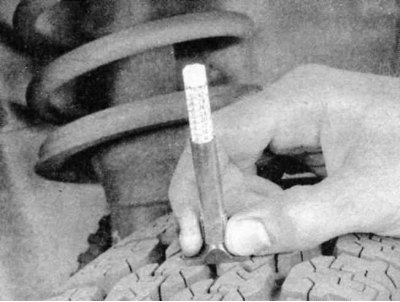
Regularly checking your tires will help you avoid the hassle of being stopped on the road due to a…


The tires are equipped with built-in tread wear indicator strips that are exposed when the tread depth decreases to 1.6 mm, after which the tires are considered worn. This value represents the minimum permissible tread depth; in most cases, it is recommended to replace tires with a tread depth of 2 mm or less. Tread depth can also be determined using a simple and inexpensive device known as a tread depth gauge.

Pay attention to any unusual tread wear. Tread defects such as cavities, bulges, flattening and more severe wear on one side indicate a violation of the front wheel alignment angles and/or wheel balancing. If any of these defects are detected, contact a tire repair shop for correction.
Pay attention to any unusual tread wear. Tread defects such as cavities, bulges, flattening and…


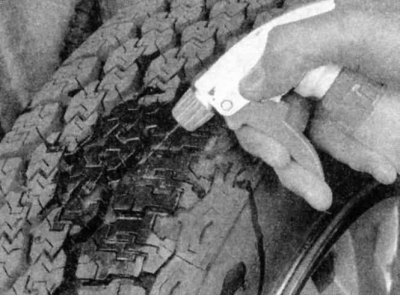
Check the tire carefully for cuts, punctures, and stuck nails or tacks. Sometimes, after a nail has punctured the tire, it will hold pressure for a while or deflate very slowly.


Check the tire carefully for cuts, punctures, and stuck nails or tacks. Sometimes, after a nail has…


If you suspect a "slow puncture," first check the valve nipple for leaks. Then inspect the tread for any foreign objects lodged in it or previously repaired punctures that have begun to leak air again. If you suspect a puncture, you can verify its presence by wetting the suspected area with soapy water. If there is a leak, the solution will begin to bubble. If the puncture is not too large, the tire can usually be repaired at any tire shop.

Carefully inspect the inside sidewalls of the tires for signs of brake fluid leakage. If any, have the brake system checked immediately.

Maintaining the correct tire pressure increases the life of your tires, helps save fuel, and improves overall ride quality. A special pressure gauge is required to check the pressure.

Always keep an accurate pressure gauge in your glove compartment. Gauges built into air hose nozzles at service stations are often inaccurate.


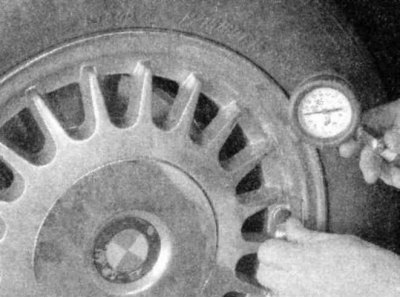
Always check tire pressure when tires are cold (i.e. before traveling by car). Checking the pressure on warm or hot tires will result in overestimation of the pressure gauge readings due to thermal expansion of the tires. In this case, you should never lower the pressure, because after the tire cools down, it will be lower than normal.


Always check tire pressure when tires are cold (i.e. before traveling by car). Checking the…


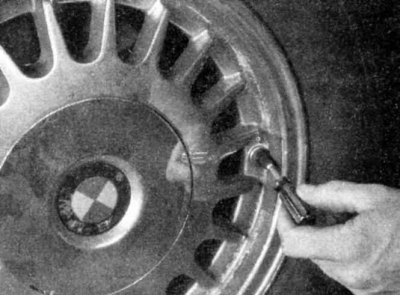
Unscrew the protective cap from the inflation valve protruding from the wheel disk or from the hub cap, then press the pressure gauge nozzle firmly onto the valve. Read the readings of the device and compare them with the recommended values Table of sizes and adjustment data at the end of the manual. To extend the life of your tires, check your tire pressure at least once a week with an accurate gauge (don't forget about the spare tire!). Remember to replace the protective cap to prevent dirt and moisture from entering the valve mechanism. Check the pressure in all four tires and inflate them to the recommended pressure if necessary.

Don't forget to maintain the required pressure in the spare tire.

Examples of typical tire tread wear


Lateral wear


Insufficient pressure (wear on both sides)
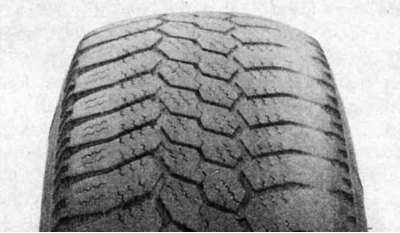
Insufficient pressure (wear on both sides)


Underinflation causes the tire to overheat while driving due to excessive deflection, which means the tread is not pressed sufficiently against the road surface. This leads to loss of traction and excessive tread wear, not to mention the risk of tire failure due to overheating.


Check and adjust pressure.

Incorrect wheel alignment (wear on one side)

Repair or replace suspension parts.

Too sharp turns

Slow down!

Central wear


Excessive pressure
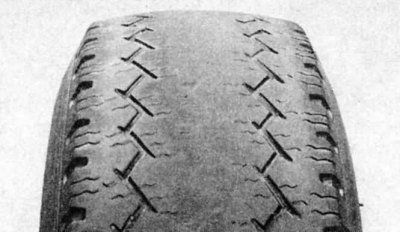
Excessive pressure


Over-inflation of the tyre results in accelerated wear of the centre tread, reduced traction, rougher handling and increased risk of tread damage.

Check and adjust pressure.

If you had to inflate your tires to the pressure specified for this purpose in order to transport heavy loads, Table of sizes and adjustment data at the end of the Manual for pressure values, do not forget to release it after this when switching to normal operating mode.

Uneven wear
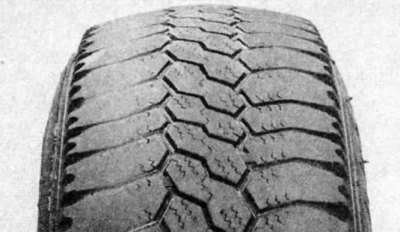


Uneven wear


The tires of the front wheels may wear out unevenly as a result of incorrect adjustment of the wheel alignment angles. You can check and adjust the installation angles for a reasonable fee in most tire repair shops.


Incorrect camber or runout

Repair or replace suspension parts.

Suspension defect

Repair or replace suspension parts.

The wheels are out of balance

Balance the wheels.

Front wheel alignment is incorrectly set

Adjust the front wheel alignment angles.

Frayed edges of the tread pattern, which is a sign of wear, are best detected by touch.

This article is available at russian, bulgarian, belarusian, ukrainian, serbian, croatian, romanian, polish, slovak, hungarian
Article verified: Zhuravleva Isolda

Share information:
Previous articles
БМВ E28: Maintenance
Next articles

Checking fluid levels
General information about the setup
Routine car maintenance
Schedule of current maintenance
On-board diagnostics system — operating principle and fault codes
Changing engine oil and oil filter
Checking the power steering fluid level
Checking the Automatic Transmission Fluid Level
Wheel rotation
Checking the condition and replacing the engine compartment hoses


Similar articles on other types of BMW cars:
Checking the condition of tires and pressure in them. Designation of… BMW 3 Series E46 (1998-2006)
Checking the technical condition of connecting rod and piston group… BMW 3 Series E21 (1975-1983)
Checking the condition of the tires and their inflation pressure BMW 7 Series E38 (1994-2001)
Checking oil pressure BMW 7 Series E32 (1986-1994)
Checking engine oil pressure BMW X3 E83 (2003-2010)
Checking the condition of the tires BMW X5 E53 (1999-2006)
Link in different formats to this page


Visitor comments

No comments yet


How much 43 + 37 =


BMW E39 (1995-2003) 
  • General information
  • Governing bodies
  • Manual
  • Maintenance
  • Power unit
  • Engine repair
  • Lubrication system
  • Cooling system
  • Ignition system
  • Supply system
  • Injection system (gasoline)
  • Injection system (diesel)
  • Exhaust system
  • Transmission
  • Clutch
  • Car gearbox
  • Front axle
  • Rear axle
  • Chassis
  • Steering
  • Brake system
  • Wheels and tires
  • Body
  • Interior
  • Exterior
  • Heating system
  • Electrical equipment
  • Equipment and devices
  • Power devices
  • Windscreen wipers
  • Electrical circuits
BMW E34 (1988-1996) 
  • General information
  • Manual
  • Maintenance
  • Power unit
  • Engine repair
  • Ignition system
  • Engine lubrication system
  • Cooling system
  • Fuel system (gasoline)
  • Fuel system (diesel)
  • Exhaust system
  • Transmission
  • Clutch
  • Car gearbox
  • Chassis
  • Front and rear suspension
  • Steering
  • Brake system
  • Body
  • Exterior
  • Interior
  • Electrical equipment
  • Heating system
  • Equipment and devices
  • Power devices
  • Electrical circuits
BMW E28 (1981-1988) 
  • General information
  • Manual
  • Maintenance
  • Power unit
  • Engine in a car
  • Engine overhaul
  • Cooling system
  • Supply system
  • Ignition system
  • Control system
  • Transmission
  • Clutch
  • Manual gearbox
  • Automatic gearbox
  • Transmission line
  • Chassis
  • Steering
  • Front suspension
  • Rear suspension
  • Brake system
  • Body
  • Body elements
  • Car care and painting
  • Electrical equipment
  • Heater and air conditioner
  • Equipment and devices
  • Starter and generator
  • Electrical circuits
BMW E12 (1972-1981) 
  • General information
  • Operation and maintenance
  • Specifications
  • Power unit
  • Engine repair
  • Cooling and lubrication system
  • Supply system
  • Ecotronic power supply system
  • Fuel injection system
  • Ignition system
  • Transmission
  • Clutch
  • Gearbox BMW 242/4
  • Gearbox Getrag 262/8
  • Gearbox Getrag 265/6
  • Automatic gearbox
  • Cardan gear
  • Rear axle
  • Chassis
  • Steering
  • Front suspension
  • Rear suspension
  • Brake system
  • Electrical equipment
  • Equipment and devices
  • Electrical circuits
BMWman.ru © 2017-2026 · Mobile version · News and articles · Sitemap: EN BG BY UA RS HR RO PL SK HU · Feedback · Site search
3er E21 · 3er E30 · 3er E36 · 3er E46 [petrol] · 3er E46 · 5er E12 · 5er E28 · 5er E34 · 5er E39 · 7er E32 · 7er E38 · X3 E83 · X5 E53 ·
This site uses cookies 🍪, without them some features simply would not work.