
Table of contents: Information about diagnostic devices ↓ Adapter for matching K and L…↓ Connecting a PC for Car Diagnostics ↓ General description of the OBD…↓ Pin assignment of the 20-pin…↓ Information sensors ↓ Executive devices ↓ Reading fault codes ↓ Method for reading flashing codes…↓ Clear OBD memory ↓ Error codes ↓
- Home
- BMW 5 Series
- E28
- General information
- Maintenance
- On-board diagnostics system — operating principle and fault codes
On-board diagnostics system — operating principle and fault codes (BMW 5 Series E28)
Information about diagnostic devices
The proper functioning of injection system components and exhaust gas toxicity reduction is checked using a universal digital meter (multimeter) (see illustration below). Using a digital meter is preferable for several reasons. Firstly, it is quite difficult to measure the value of an analog meter (sometimes it's impossible), determine the result of the reading with an accuracy of up to hundredths and thousandths, while when examining circuits that include electronic components, such accuracy becomes especially important. The second, no less important, reason is the fact that the internal circuit of the digital multimeter has a fairly high impedance (the internal resistance of the device is 10 mOhm). Since the voltmeter is connected to the circuit being tested in parallel, the accuracy of the measurement is higher, the smaller the current that passes through the device itself. This factor is not significant when measuring relatively high voltage values (9÷12 V), but it becomes decisive when diagnosing elements that produce low-voltage signals, such as, for example, a lambda probe, where we are talking about measuring fractions of a volt.
Parallel monitoring of signal parameters, resistances and voltages in all control circuits is possible using splitter, connected in series to the engine control unit connector. In this case, with the engine turned off, running, or while the car is moving, the parameters of the signals at the terminals of the splitter are measured, from which a conclusion is made about possible defects.
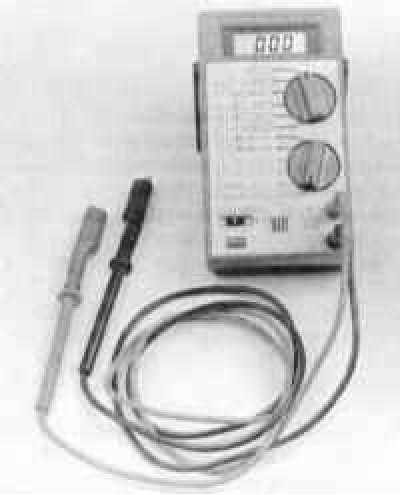
The use of a high-impedance digital multimeter in diagnostics of the systems under consideration significantly increases the accuracy of the measurements taken
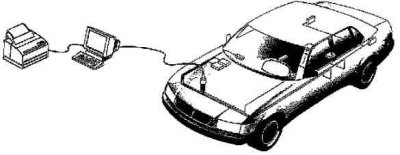
For diagnostics of electronic systems of the engine, automatic transmission, ABS, SRS special diagnostic scanners or BMW testers can be used DIS, MoDIC (programmable from PC). In addition, scanners and specialized diagnostic analyzers can be used for this purpose, for example CS 1000, Bosch FSA 560, KTS 300 (HAMMER), Sun 2013, or a regular personal computer with a special adapter, cable and installed OBD browser program (for example, the Bosch ESI [tronic] program in Russian, the Car Scanner program.
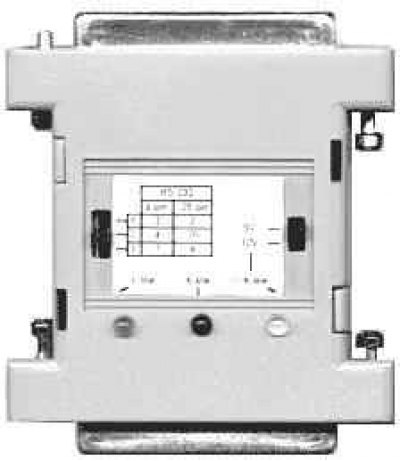
Universal KL-line adapter, serves to match signals of the RS-232 port and ISO-9141 (K-line) and ALDL interfaces. Various cables required for diagnostics of a specific car brand can be connected to the adapter connectors. Switches and indicator elements installed in the adapter allow you to select the necessary operating modes and roughly evaluate the operation of the output lines. Thus, the glow of the green LED marked L-line indicates the connection of the L line to the car body. The glow of the red LED marked K-line indicates the high potential that is present at this moment on the K line. When the connection with the car is established, the blinking of the indicators may be imperceptible to the eye due to the high exchange rate. Connection to the computer is made directly to the 25-pin COM port or using the "RS-232 Cable 25 pin - 9 pin" to the 9-pin COM port.
Some scanners, in addition to the usual diagnostic operations, allow, when connected to a personal computer, to print out the basic diagrams of electrical equipment stored in the memory of the control unit (if pledged), program the anti-theft system, monitor signals in the car circuits in real time.
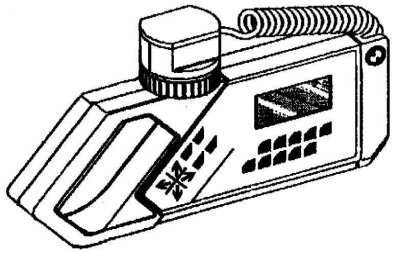
To diagnose electronic control systems of a car, hand-held scanners MoDIC, KTS 300 (Bosch) or a personal computer can be used.
Adapter for matching K and L diagnostic lines with PC COM port
Reading of fault codes recorded in the memory of the self-diagnostic system on some models can also be done using the "check engine" indicator on the dashboard.
Connecting a PC for Car Diagnostics
For diagnostics, devices from ToolRama, Inc. can also be used, for example. (3500 NW Boca Raton Blvd., Boca Raton, Florida, 33431, USA 1 877 866 5726 - 561 750 4511 - 561 338 8447 FAX) with cartridges for a specific car model.
All tester cartridges can be used in the scanner as well. In this case, the functions will be limited to reading and clearing memory only.
- r000 tester with T051A (B or C) cartridge or P000 scanner with T041 cartridge,
- universal cable N000,
- connector N001.
The scanner only reads the fault memory and clears the fault memory. The tester can additionally activate and display current data.
The OBD II cartridge performs the following functions:
- Read and clear OBD II trouble codes. Display oxygen sensor test results.
- Continuous monitoring of ignition systems, injection systems and components.
- Displays a list of current data and recorded intermittent failures:
- Absolute pressure in the intake manifold;
- Oxygen sensor voltage;
- Engine coolant temperature;
- Estimated engine load;
- Car speed;
- Fuel quality;
- Air flow (by mass);
- Ignition timing;
- Throttle position;
- Intake air temperature.
You can find more information about the devices on the websites programatools.com, bosch.de.
General description of the OBD self-diagnosis system
The OBD system includes several diagnostic devices that monitor individual parameters of the toxicity reduction systems and record detected failures in the on-board processor memory in the form of individual fault codes. The system also checks sensors and actuators, monitors vehicle maintenance cycles, and provides the ability to memorize even short-term failures during operation and clear the memory block.
Some of the models described in this Manual are equipped with an on-board diagnostics system. The main element of the system is the on-board processor, more often called the electronic control module (ECM) or the powertrain control module (PCM). The PCM is the brain of the engine management system. Initial data comes to the module from various information sensors and other electronic components (switches, relays, etc.).
Based on the analysis of data received from information sensors, and in accordance with the basic parameters stored in the processor memory, the RCM generates commands to operate various control relays and actuators, thereby adjusting the engine operating parameters and ensuring maximum efficiency with minimal fuel consumption.
Reading the OBD processor memory data is performed using a special scanner connected to the 20-pin diagnostic connector located on the left in the engine compartment.
The black, 20-pin X 1532 diagnostic connector is located in the left rear of the engine compartment, to the right of the shock absorber dome (arrow). M30 engine shown
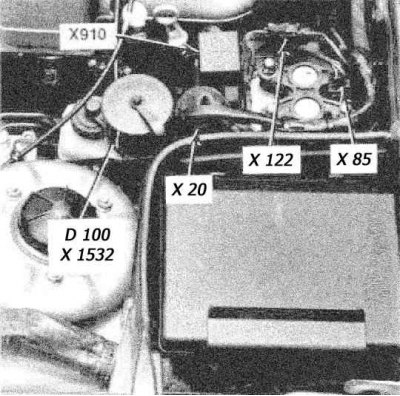
D100 - Diagnostic connector
X20 - 20-pin SW connector
X85 - 3-pin SW connector
X122- 2-pin SW connector
X1532 - 20-pin SW connector
X910 - Connector
In principle, reading the fault codes stored in the memory of the self-diagnostic system can be done using the "Check Engine" lamp (refer to the section Reading fault codes).
Pin assignment of the 20-pin diagnostic connector
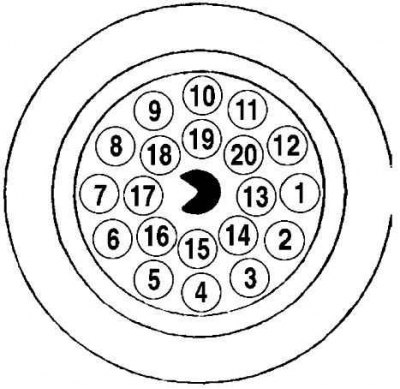
1 - Engine speed signal
4 - Temperature sensor voltage
7 - Service Interval Indicator Reset - Instrument Cluster
11 - Starter - ignition switch (12V at start)
12 - Generator charge indicator (pin 61, D)
14 - Ignition switch (contact 30). Always under voltage
15 - Diagnostics start line L (RxD data reception)
16 - Ignition switch (contact 15). Under voltage in the Run and Start positions
17 - Diagnostic data line K (TxD II - data transmission)
18 - DME program selection voltage
19 - Housing (contact 31)
20 - Diagnostic data line K (TxD - data transfer)
Information sensors
Oxygen sensors (lambda probes) - The sensor generates a signal, the amplitude of which depends on the difference in oxygen content (O2) in the engine exhaust gases and the outside air before and after the catalytic converter.
Crankshaft position sensor (CPS) - The sensor informs the PCM about the position of the crankshaft and engine speed. This information is used by the processor when determining the fuel injection moments and setting the ignition timing.
Piston Position Sensor (CYP) - Based on the analysis of signals received from the sensor, the RCM calculates the position of the piston of the first cylinder and uses this information to determine the timing and sequence of fuel injection into the engine combustion chambers.
TDC sensor - The signals generated by the sensor are used by the PCM to determine the ignition timing settings at the moment of engine start.
Engine Coolant Temperature (ECT) Sensor - Based on the information received from the sensor, the ECM/PCM makes the necessary adjustments to the air-fuel mixture composition and ignition timing, and also monitors the operation of the EGR system.
Intake Air Temperature (IAT) Sensor - The PCM uses the information received from the IAT sensor to make fuel flow adjustments, set the ignition timing and control the operation of the EGR system.
Throttle Position Sensor (TPS) - The sensor is located on the throttle body and is connected to the throttle shaft. Based on the amplitude of the signal emitted by the TPS, the PCM determines the throttle opening angle (controlled by the driver using the gas pedal) and accordingly adjusts the fuel supply to the combustion chamber intake ports. Sensor failure or loosening of its fastening leads to injection interruptions and disturbances in the stability of idle speed.
Absolute pressure sensor in the pipeline (MAP) - The sensor monitors variations in the vacuum depth in the intake manifold associated with changes in crankshaft speed and engine load and converts the information received into an amplitude signal. The PCM uses the information supplied by the MAP and IAT sensors for fine adjustments to fuel delivery.
Atmospheric pressure sensor - The sensor generates an amplitude signal proportional to changes in atmospheric pressure, which is used by the PCM to determine the duration of fuel injection moments. The sensor is built into the PCM module and is not subject to individual maintenance.
Knock sensor - The sensor reacts to changes in the vibration level associated with detonations in the engine. Based on the information received from the sensor, the PCM makes the appropriate adjustment of the ignition advance angle.
Vehicle Speed Sensor (VSS) - As its name suggests, the sensor informs the processor about the current speed of the vehicle.
EGR valve opening value sensor - The sensor notifies the PCM of the amount of displacement of the EGR valve plunger. The received information is then used by the processor to control the operation of the exhaust gas recirculation system.
Fuel tank pressure sensor - The sensor is a component of the fuel vapor trapping system (EVAP) and serves to monitor the pressure of gasoline vapors in the tank. Based on the information received from the sensor, the PCM issues commands to operate the electromagnetic valves for purging the system.
Power Steering Pressure Switch (PSP) - Based on the information received from the PSP switch sensor, the PCM increases the idle speed by activating the IAC sensor in order to compensate for the increasing loads on the engine associated with the operation of the power steering during maneuvers.
Transmission sensors - In addition to the data received from the VSS, the PCM also receives information from sensors located inside or connected to the transmission. These sensors include: (a) the secondary (main) shaft speed sensor and (b) the intermediate shaft speed sensor.
Air Conditioner Clutch Control Switch Sensor - When power is supplied from the battery to the electromagnetic valve of the K/V compressor, the corresponding information signal is sent to the PCM, which evaluates it as evidence of an increase in the load on the engine and adjusts its idle speed accordingly.
Executive devices
PGM-FI Main Relay (fuel pump relay) - The PCM activates the fuel pump relay when the ignition key is turned to the START or RUN position. When the ignition is turned on, the relay is activated to increase the pressure in the fuel system. More detailed information on the main relay is provided in Chapter Power supply system.
Fuel injectors - The PCM ensures individual activation of each injector in accordance with the established ignition sequence. In addition, the module controls the duration of the injector opening, determined by the width of the control pulse, measured in milliseconds and determining the amount of fuel injected into the cylinder. More detailed information on the operating principle of the injection system, replacement and maintenance of injectors is given in Chapter Power supply system.
Ignition Control Module (ICM) - The module controls the operation of the ignition coil, determining the required basic advance based on the commands generated by the PCM. All vehicle models discussed in this Manual use an ICM built into the ignition distributor, for more details see Chapter Ignition system.
Idle Air Control Valve (IAC) - The IAC valve controls the amount of air bypassed through the throttle valve when the latter is closed or in the idle position. The PCM controls the opening of the valve and the formation of the resulting air flow.
Carbon adsorber purge solenoid valve - The valve is an integral part of the fuel evaporative emission (EVAP) system and, when triggered by the PCM, releases the fuel vapors accumulated in the adsorber into the intake manifold for the purpose of burning them during normal engine operation.
Carbon adsorber purge control solenoid - The solenoid is used by the PCM when the OBD-II system checks for proper operation of the EVAP system.
Reading fault codes
If a fault is detected that is repeated in two consecutive trips, the PCM issues a command to turn on the "Check Engine" warning lamp, also called the malfunction indicator, built into the instrument cluster. The lamp will remain lit until the memory of the self-diagnostic system is cleared of the codes of detected faults stored in it. Reading fault codes in the OBD system can be done in various ways. The main method is reading using the devices described above, connected to the DLC connector of the OBD system. Other methods are not available on all models. The flashing code can be read from the "Check Engine" lamp.
Without starting the engine, turn on the ignition - the "Check Engine" indicator light should light up, otherwise it should be replaced.
On early models, if there is a fault, the indicator lamp will flash several times for 1 second and go out before coming on continuously. The number of flashes of the lamp (from 1 to 4) corresponds to the fault code (list below).
Method for reading flashing codes from the "Check engine" lamp (possible on some models)
Flashing code output diagram for the control lamp
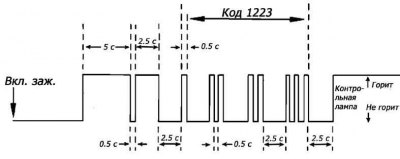
Turn on the ignition. Fully depress and release the accelerator pedal five times within five seconds. If the processor memory contains codes of previous malfunctions, they will begin to be sequentially displayed by the "Check Engine" indicator lamp on the vehicle's dashboard. Read the flashing code.
The lamp lights up for 5 seconds, lights up again for 2.5 seconds after 0.5 seconds, and a code is issued after an interval of 2.5 seconds. The value of each code digit corresponds to the number of flashes with an interval of 0.5 seconds. The most significant digits of the code are issued first, and the ones are issued last. The intervals between code digits are 2.5 seconds. After the code is issued, the lamp remains lit. Repeat the procedure to read subsequent codes. If the first code issued is 1444, 2444 or 4444, no faults have been recorded.
Codes 1000 or 2000, given by one or two flashes and a long pause, followed by a constant lamp glow, indicate the end of the code output.
Starting the engine automatically interrupts access to the diagnostic system.
Clear OBD memory
When a fault code is entered into the PCM memory, the "Check Engine" indicator light on the vehicle's instrument panel lights up. The code remains stored in the module's memory.
To clear the ECM memory, connect a scanner to the system and select the CLEARING COEDS function in its menu (Removing codes). Next, follow the instructions displayed on the device, or immediately remove the EFI fuse from its socket in the fuse box for 30 seconds.
Alternatively, clearing the system memory can be done by removing the fuse link (main fuse of the on-board electrical system), installed near the positive terminal of the battery (you can also simply disconnect the positive cable from the battery).
It should be noted that clearing the OBD memory by disconnecting the negative battery cable will erase the engine settings and disrupt the stability of its speed for a short time after the initial start.
If your car stereo system is equipped with a security code, make sure you have the correct combination to activate the audio system before disconnecting the battery!
Disconnecting the battery also erases your receiver's favorite radio station settings.
To avoid damaging the ECM, disconnect and connect it only with the ignition off!
Make sure that the system memory is cleared before installing new emission control components on the engine. If the fault memory is not cleared before starting the system after replacing a failed information sensor, the PCM will enter a new fault code. Clearing the memory allows the processor to reconfigure to the new parameters. However, in the first 50 to 20 minutes after the initial start of the engine, some disruption of the stability of its speed may occur.
Error codes
Motronic 1.1, 1.2, 1.3 – failure lamp flashes
| 1 | Air flow sensor |
| 2 | Lambda probe |
| 3 | Coolant temperature sensor |
| 4 | Throttle Closed Position Switch |
Motronic 1.1, 1.2, 1.3
| 1 | Electronic control unit |
| 3 | Fuel Pump Relay Circuit |
| 5 | Idle Speed Control Valve Circuit |
| 7 | Air flow meter |
| 10 | Mixture quality control, lambda sensor |
| 15 | Failure indicator light |
| 16 | Injectors cylinders 1, 3, 5 |
| 17 | Injectors for cylinders 2, 4, 6 |
| 23 | Heating of the lambda probe or its relay |
| 28 | Lambda probe circuit |
| 29 | Engine speed sensor |
| 33 | Kick-down valve |
| 37 | Power supply of the electronic control unit is higher than 16V |
| 43 | CO adjustment potentiometer |
| 44 | Air temperature sensor |
| 45 | Coolant temperature sensor |
| 51 | Ignition timing offset |
| 52 | Throttle Position Limit Switch |
| 53 | Throttle Position Limit Switch |
| 54 | AT rotation converter lock |
| 100 | Ignition booster |
| 101 | Engine failure |
Diagnostic codes for DME 1.7 (518i) systems, read using a tester
| 1 | Fuel pump relay or its circuit to the control unit (terminal 1) |
| 3 | Open circuit, short circuit in injectors 1 and 3 |
| 8 | Short circuit of the "Check engine" warning lamp circuit |
| 12 | Open circuit, short circuit in the throttle potentiometer circuit |
| 16 | Camshaft position sensor. Signal disappears at 2500 rpm. |
| 29 | Short circuit in the idle control circuit (terminal 29) |
| 32 | Open circuit, short circuit in injectors 2 and 4 |
| 36 | Open circuit, short circuit in the fuel tank ventilation valve circuit |
| 37 | Open circuit, short circuit of the lambda probe heating circuit (terminal 37) |
| 41 | Open circuit, short circuit in the air flow meter circuit |
| 54 | The control unit supply voltage is below 9V or above 16V |
| 70 | Open circuit, short circuit of the lambda probe circuit |
| 73 | Incorrect vehicle speed sensor signal |
| 77 | Open circuit, short circuit in the intake air temperature sensor circuit |
| 78 | Open circuit, short circuit in the coolant temperature sensor circuit |
| 85 | Air conditioning compressor. Open circuit at terminal 86 and short circuit at terminal 85 |
| 100 | Lost connection of ignition output signal from final stage |
| 200 | Internal memory defect of the control unit |
| 201 | Too rich or too lean mixture in the last 8 seconds |
Diagnostic codes for DME 3.1 systems (520i, 525), read using a tester
| 0 | Unspecified fault in the memory unit |
| 1 | Fuel pump relay or its circuit to the control unit (terminal 1) |
| 2 | Open circuit, short circuit of the idle speed actuator (closed) or its circuit to the control unit (terminal 2) |
| 3 | Open circuit, short circuit in the injector 1 circuit to the control unit (terminal 3) |
| 4 | Open circuit, short circuit in the injector 3 circuit to the control unit (terminal 4) |
| 5 | Open circuit, short circuit in the injector 2 circuit to the control unit (terminal 5) |
| 6 | Open or short circuit in injector circuits |
| 8 | Open or short circuit of the "Check engine" warning lamp circuit |
| 12 | Open or short circuit in the throttle potentiometer circuit |
| 16 | Camshaft Position Sensor Signal |
| 18 | Short circuit to the housing or positive terminal 18 of the control unit |
| 19 | Short circuit to the housing or positive terminal 19 of the control unit |
| 23 | Open circuit of ignition coil output of cylinder 2 (terminal 23) |
| 24 | Open circuit of ignition coil output of cylinder 3 (terminal 24) |
| 25 | Open circuit of ignition coil output of cylinder 1 (terminal 25) |
| 26 | The control unit supply voltage is lower than the battery voltage (with the engine off) |
| 29 | Short circuit in the idle speed actuator circuit (open), (terminal 29) |
| 31 | Open circuit, short circuit in the injector 5 circuit to the control unit (terminal 31) |
| 32 | Open circuit, short circuit in the injector 6 circuit to the control unit (terminal 32) |
| 33 | Open circuit, short circuit in the injector 4 circuit to the control unit (terminal 33) |
| 34 | Open circuit, short circuit of component circuits to the control unit |
| 36 | Open circuit, short circuit in the fuel tank ventilation valve circuit |
| 37 | Open circuit, short circuit in the lambda probe heating circuit |
| 41 | Open circuit, short circuit in the air mass meter circuit |
| 46 | Short circuit to the housing or positive terminal 46 of the control unit |
| 48 | Air conditioning compressor does not turn off at speeds below 8 km/h |
| 50 | Open circuit of ignition coil output of cylinder 4 (terminal 50) |
| 51 | Open circuit of the ignition coil output of cylinder 6 (terminal 51) |
| 52 | Open circuit of ignition coil output of cylinder 5 (terminal 52) |
| 54 | The control unit supply voltage is below 10V or above 14V |
| 55 | Open circuit in ignition circuits |
| 64 | Ignition advance circuit - short circuit to the body of terminal 64 of the control unit |
| 67 | No signal from the crankshaft speed/position sensor, Ignition and injection are off |
| 70 | Open circuit, short circuit of the lambda probe circuit |
| 73 | Vehicle speed sensor |
| 77 | Open circuit, short circuit in the intake air temperature sensor circuit |
| 78 | Open circuit, short circuit in the coolant temperature sensor circuit |
| 81 | Anti-theft alarm triggered after engine start |
| 85 | Air conditioning compressor operates after engine start, while no switch signal was received |
| 100 | Short circuit to the housing or positive terminal 100 of the control unit |
| 200 | Internal defect of RAM or ROM/EPROM of the control unit |
| 201 | Internal fault memory defect |
| 202 | Emission control systems out of control |
Diagnostic codes for Motronic M3.3 (540i) systems
| 1211 | Engine control unit |
| 1212 | Lambda probe 2 |
| 1213 | Lambda probe signal control limits 2 exceeded |
| 1215 | Air mass/air flow meter |
| 1216 | Throttle potentiometer |
| 1221 | Lambda probe 1 |
| 1222 | Lambda probe signal control limits 1 exceeded |
| 1223 | Coolant temperature sensor |
| 1224 | Intake air temperature sensor |
| 1225 | Knock Sensor 1 |
| 1226 | Knock Sensor 2 |
| 1227 | Knock Sensor 3 |
| 1228 | Knock Sensor 4 |
| 1231 | Supply voltage |
| 1232 | Throttle Closed Position Switch |
| 1233 | Fully Open Throttle Position Switch |
| 1237 | Air Conditioning Pump Relay |
| 1243 | No engine speed sensor signal |
| 1244 | Camshaft position sensor |
| 1247 | Connection to the engine control unit housing |
| 1251 | Injector cylinder 1 |
| 1252 | Injector cylinder 5 |
| 1253 | Cylinder 4 injector |
| 1254 | Cylinder 8 injector |
| 1255 | Cylinder 6 injector |
| 1256 | Injector cylinder 3 |
| 1257 | Cylinder 7 injector |
| 1258 | Injector cylinder 2 |
| 1261 | Fuel pump relay |
| 1262 | Idle speed control valve. |
| 1263 | Evaporative Canister Purge Valve |
| 1264 | Lambda probe heating relay |
| 1265 | Short circuit in the fault indicator lamp circuit |
| 1267 | Air pump |
| 1271 | Ignition coil cylinder 1 |
| 1272 | Ignition coil cylinder 5 |
| 1273 | Ignition coil cylinder 4 |
| 1274 | Ignition coil cylinder 8 |
| 1275 | Ignition coil cylinder 6 |
| 1276 | Ignition coil cylinder 3 |
| 1277 | Ignition coil cylinder 7 |
| 1278 | Ignition coil cylinder 2 |
| 1281 | Low voltage supply to the engine control unit |
| 1282 | Engine control unit memory fault |
| 1283 | Connecting the injector to the body |
| 1286 | Knock control circuit |
| 1444 | No registered faults |
Automatic transmission diagnostic codes stored in the control unit memory
| 1 | Transmission relay |
| 2 | EPROM memory checksum |
| 3 | Kick-down switch |
| 4 | Program switch |
| 5 | Accelerator pedal signal, throttle signal |
| 6 | Solenoid valve solenoid valve 1 |
| 7 | Solenoid valve solenoid valve 2 |
| 8 | Solenoid valve 1, Solenoid valve 2 |
| 9 | P/N shift solenoid blocked |
| 10 | Solenoid valve 1, switching solenoid P/ blocked |
| 11 | Solenoid valve 2, P/N switching solenoid blocked |
| 12 | Solenoid valve 1, solenoid valve 2, switching solenoid P/ blocked |
| 13 | Rotary Converter Clutch Solenoid Valve |
| 14 | Solenoid valve 1, solenoid valve of the rotation converter clutch |
| 15 | Solenoid valve 2, solenoid valve of the rotation converter clutch |
| 16 | Solenoid valve 1, solenoid valve 2, solenoid valve of the rotation converter clutch |
| 17 | P/N shift solenoid blocked, torque converter clutch solenoid valve |
| 18 | Solenoid valve 1, P/N shift solenoid blocked, torque converter clutch solenoid valve |
| 19 | Solenoid valve 2, P/N shift solenoid blocked, torque converter clutch solenoid valve |
| 20 | Supply voltage of the solenoid valve and pressure regulator (DR) |
| 21 | Engine RPM Reference Signal (1 per crankshaft revolution) |
| 22 | Pressure regulator |
| 23 | Interference with ignition timing adjustment |
| 24 | Output RPM Sensor, Downshift Blocked |
| 25 | Overrev protection |
| 26 | Injection signal (ti) |
| 27 | Output speed sensor (DZF) or rotation converter |
| 28 | Malfunction indicator (except GS 1.2) |
| 29 | Program checksum |
| 30 | Battery supply voltage |
| 31 | Selector lever position |
Automatic transmission diagnostic codes not stored in the control unit memory, determined during monitoring
| 200 | Kick-down switching is missing |
| 201 | Switching only kick - down |
| 202 | S program is missing |
| 203 | M program is missing |
| 204 | Program switching does not occur |
| 205 | No engine intervention |
| 206 | Incorrect display of faults |
| 207 | Shifts only under full load (no EML) |
| 300 | Diagnostic line failure |
| 301 | Control unit supply voltage deviation |
| 302 | Selector lever position |
| 303 | The position of the selector lever is not detected |
Automatic Cabin Air Conditioner Diagnostic Codes
| 01 | Right temperature control knob |
| 04 | Right heating sensor |
| 07 | Evaporator sensor |
| 10 | Outside air temperature sensor |
| 13 | Interior sensor |
| 16 | Interior Fan Sensor |
| 22 | Additional fan relay (Clutch relay KV - DME) |
| 25 | Left temperature control knob |
| 28 | Left heating sensor |
| 31 | Air flow control |
| 32 | Air flow selector lever to the feet |
| 34 | Air mixing control |
| 38 | Additional water pump relay |
| 40 | Left water valve |
| 44 | Relay KV/Stage 1 additional fan |
| 46 | Right water valve |
| 47 | Clutch relay KV DME/EML |
| 48 | Rear window heating relay |
| 52 | Fresh air flap motor |
| 55 | Air circulating damper motor |
| 58 | Left ventilation flap motor |
| 61 | Right mixed air flap motor |
| 64 | Left mixed air flap motor |
| 67 | Rear Cabin Flap Motor |
| 70 | Left footwell air flow flap motor |
| 73 | Motor of the right air flow flap to the feet |
| 76 | Defrost flap motor |
| 79 | Right ventilation flap motor |
This article is available at russian, bulgarian, belarusian, ukrainian, serbian, croatian, romanian, polish, slovak, hungarian
Article verified: Zhuravleva Isolda
Share information:
Previous articles
БМВ E28: Maintenance
Next articles
Similar articles on other types of BMW cars:
Ignition system fault diagnostics BMW 3 Series E30 (1982-1994)
Ignition system fault diagnostics BMW 3 Series E36 (1990-2000)
Engine fault diagnostics BMW 7 Series E32 (1986-1994)
Car fault diagnostics BMW 7 Series E38 (1994-2001)
On-board diagnostic system (OBD) socket BMW X3 E83 (2003-2010)
Diagnostics of brake system faults BMW X5 E53 (1999-2006)
Ignition system fault diagnostics BMW 3 Series E30 (1982-1994)
Ignition system fault diagnostics BMW 3 Series E36 (1990-2000)
Engine fault diagnostics BMW 7 Series E32 (1986-1994)
Car fault diagnostics BMW 7 Series E38 (1994-2001)
On-board diagnostic system (OBD) socket BMW X3 E83 (2003-2010)
Diagnostics of brake system faults BMW X5 E53 (1999-2006)
Link in different formats to this page
Visitor comments
No comments yet
- General information
- Governing bodies
- Manual
- Maintenance
- Power unit
- Engine repair
- Lubrication system
- Cooling system
- Ignition system
- Supply system
- Injection system (gasoline)
- Injection system (diesel)
- Exhaust system
- Transmission
- Clutch
- Car gearbox
- Front axle
- Rear axle
- Chassis
- Steering
- Brake system
- Wheels and tires
- Body
- Interior
- Exterior
- Heating system
- Electrical equipment
- Equipment and devices
- Power devices
- Windscreen wipers
- Electrical circuits
- General information
- Manual
- Maintenance
- Power unit
- Engine repair
- Ignition system
- Engine lubrication system
- Cooling system
- Fuel system (gasoline)
- Fuel system (diesel)
- Exhaust system
- Transmission
- Clutch
- Car gearbox
- Chassis
- Front and rear suspension
- Steering
- Brake system
- Body
- Exterior
- Interior
- Electrical equipment
- Heating system
- Equipment and devices
- Power devices
- Electrical circuits
- General information
- Manual
- Maintenance
- Power unit
- Engine in a car
- Engine overhaul
- Cooling system
- Supply system
- Ignition system
- Control system
- Transmission
- Clutch
- Manual gearbox
- Automatic gearbox
- Transmission line
- Chassis
- Steering
- Front suspension
- Rear suspension
- Brake system
- Body
- Body elements
- Car care and painting
- Electrical equipment
- Heater and air conditioner
- Equipment and devices
- Starter and generator
- Electrical circuits
- General information
- Operation and maintenance
- Specifications
- Power unit
- Engine repair
- Cooling and lubrication system
- Supply system
- Ecotronic power supply system
- Fuel injection system
- Ignition system
- Transmission
- Clutch
- Gearbox BMW 242/4
- Gearbox Getrag 262/8
- Gearbox Getrag 265/6
- Automatic gearbox
- Cardan gear
- Rear axle
- Chassis
- Steering
- Front suspension
- Rear suspension
- Brake system
- Electrical equipment
- Equipment and devices
- Electrical circuits