
Cars Mazda Cars Mitsubishi Cars Toyota Cars Chevrolet Cars AvtoVAZ Cars Kia Cars Nissan
English Русский
Български
Беларускі
Український
Српски
Hrvatski
Română
Polski
Slovenský
Magyar
| Articles | Contacts | Sitemap |   
BMWman.ru


3 series   5 series   7 series   BMW X3   BMW X5   BMW X6

E46 (1998-2006) E46 (1998-2006, petrol) E36 (1990-2000) E30 (1982-1994) E21 (1975-1983)
  • Home
  • BMW 3 Series
  • E36
  • Power unit
  • Supply system
  • Operating principle of the Motronic DME M1.7 system (four-cylinder engine)

Operating principle of the Motronic DME M1.7 system (four-cylinder engine) (BMW 3 Series E36)

            0

Fuel is supplied by an electric fuel pump from the fuel tank through the fuel filter to the distribution pipe and then to the valve injectors. A pressure regulator in the distribution pipe ensures a constant pressure of 3.0 bar (320i from January 1995, 325i: 3.5 bar). The injectors are electrically controlled and perform pulse fuel injection. The injectors have semi-sequential control, i.e. during one revolution of the crankshaft, simultaneous injection is performed by two injectors, namely alternately by injectors of cylinders 1-3 or by injectors of cylinders 2-4.

Air is sucked in by the engine through the air filter and air intake pipe and is measured by the air flow meter. The air flow meter housing contains a flap that is deflected by the air passing through it at a certain angle. The angular position of the flap serves as a measure of the amount of air passing through. Information about the amount of air passing through is transmitted to the control unit from the potentiometer.

The control unit regulates the injection time and thus the amount of fuel injected according to the measured air mass. With a longer opening time of the injector, more fuel can be injected. Additional sensitive elements and sensors ensure that the required amount of fuel is supplied even in extreme driving situations.
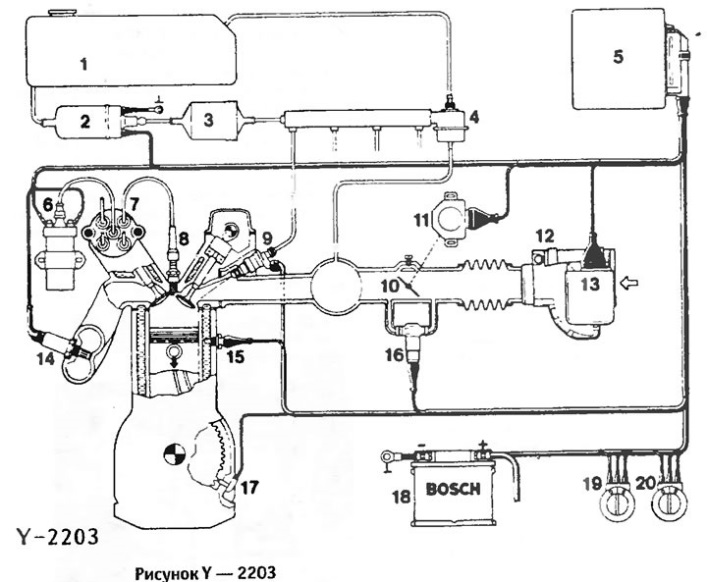
1. Fuel tank

1. Fuel tank
2. Fuel pump
3. Fuel filter
4. Fuel pressure regulator
5. Electronic control unit
6. Ignition coil
7. High-voltage ignition distributor
8. Spark plug
9. Nozzle
10. Throttle valve
11. Throttle switch
12. Air flow meter
13. Potentiometer and air temperature sensor
14. Lambda probe
15. Temperature sensor
16. Idle speed control
17. Inductive pulse sensor
18. Battery
19. Ignition switch
20. Air conditioner switch


The throttle switch is located directly on the throttle axis. It sends signals to the control unit about the throttle position in idle mode and the full load position. This primarily controls the forced running mode: as long as the throttle switch contact is closed and at the same time the engine speed exceeds a certain value, the control unit blocks the fuel supply to the engine.


The fuel pump relay is located in the relay box in the left rear of the engine compartment. It supplies power to the fuel pump. When the pulses from the speed sensor stop coming in with the ignition on (when the engine stalls) the control circuit interrupts the power supply.

The current position of the engine crankshaft and the number of revolutions are determined by 2 inductive sensors: The speed and reference mark sensor is located in the mount on the crankshaft belt pulley, the cylinder recognition sensor is an inductive loop on the ignition wire of cylinder 4.

Lambda probe (oxygen sensor) measures the oxygen content in the exhaust gas flow on vehicles equipped with a regulated catalytic converter and transmits a corresponding electrical signal to the control unit. Based on this information, the control unit changes the composition of the intake air-fuel mixture to ensure optimal combustion of the exhaust gases in the catalytic converter.

The idle speed controller regulates the amount of air in the idle mode in the throttle valve area. This ensures a stable speed regardless of whether additional consumers such as the power steering or the air conditioning compressor are connected. The idle speed controller is controlled by the electronic control unit of the fuel injection system.

The coolant temperature sensor measures engine temperature, which has a major impact on fuel consumption.

The activated carbon container accumulates fuel vapors from the fuel tank. When the engine is running, these vapors are supplied in portions through the fuel tank ventilation valve to the engine, thereby reducing the emission of harmful substances and saving fuel.

This article is available at russian, bulgarian, belarusian, ukrainian, serbian, croatian, romanian, polish, slovak, hungarian
Article verified: Chebotarev Vladislav

Share information:
Previous articles
БМВ E36: Supply system
Next articles

Fuel injection device for gasoline engines
Removal and installation the air filter housing/air intake hose
Checking the fuel gauge
Removal the right fuel level sensor with the fuel pump
Removal and installation the fuel level sensor
Motronic DME M3.1 system on six-cylinder engines
Fault Accumulator
Safety rules for working with fuel injection devices
Checking the idle speed and CO content
Adjusting the throttle cable


Similar articles on other types of BMW cars:
Operating principle of the Motronic DME M1.1 and M1.7 system BMW 5 Series E34 (1988-1996)
On-board diagnostics system — operating principle and fault codes BMW 5 Series E28 (1981-1988)
Operating principles of the gasoline engine control system BMW 7 Series E38 (1994-2001)
Diagnostics of engine cooling system faults BMW 7 Series E32 (1986-1994)
Exhaust system assembly (Engine M54 and N52 K) BMW X3 E83 (2003-2010)
Engine crankcase ventilation system BMW X5 E53 (1999-2006)
Link in different formats to this page


Visitor comments

No comments yet


How much 49 + 25 =


BMW E46 (1998-2006) 
  • General information
  • Manual
  • Maintenance
  • Power unit
  • Engine repair
  • Cooling system
  • Power system (gasoline)
  • Injection system (gasoline)
  • Fuel system (diesel)
  • Exhaust system
  • Ignition system
  • Charge and launch systems
  • Transmission
  • Car gearbox
  • Clutch and drive shafts
  • Chassis
  • Brake system
  • Suspension front and rear
  • Steering
  • Body
  • Body care and repair
  • Exterior
  • Interior
  • Electrical equipment
  • Troubleshooting
  • Lighting and signaling
  • Equipment and devices
  • Heater and air conditioner
  • Electrical circuits
BMW E46 (1998-2006, petrol) 
  • General information
  • Manual
  • Repair on the road
  • Weekly checks
  • Maintenance
  • Troubleshooting
  • Power unit
  • 4 cylinder engines
  • 6 cylinder engines
  • Engine overhaul
  • Cooling and heating
  • Fuel and exhaust system
  • Starting and charging system
  • Ignition system
  • Transmission
  • Clutch
  • Mechanical gearbox
  • Automatic gearbox
  • Cardan and drive shafts
  • Chassis
  • Brake system
  • Wheel suspension
  • Steering
  • Body
  • Exterior
  • Interior
  • Electrical equipment
  • Equipment and devices
  • Electrical circuits
BMW E36 (1990-2000) 
  • General information
  • Maintenance
  • Power unit
  • Engine repair
  • Cooling system
  • Ignition system
  • Supply system
  • Fuel injection system
  • Exhaust system
  • Transmission
  • Clutch
  • Car gearbox
  • Front and rear axle
  • Chassis
  • Steering
  • Brake system
  • Body
  • Exterior
  • Interior
  • Electrical equipment
  • Heating system
  • Equipment and devices
  • Power devices
  • Electrical circuits
BMW E30 (1982-1994) 
  • Power unit
  • M10/M20 engine
  • M40 engine
  • Ignition system
  • Lubrication system
  • Cooling system
  • Supply system
  • Fuel injection
  • Exhaust system
  • Transmission
  • Clutch
  • Manual gearbox
  • Front axle
  • Rear axle
  • Chassis
  • Steering
  • Brake system
  • Body
  • Exterior
  • Interior
  • Electrical equipment
  • Heating system
  • Equipment and devices
  • Electrical circuits
BMW E21 (1975-1983) 
  • General information
  • Specifications
  • Operation and maintenance
  • 4-cylinder engine
  • Engine repair
  • Cooling and lubrication system
  • Supply system
  • Ignition system
  • 6-cylinder engine
  • Engine repair
  • Cooling and lubrication system
  • Supply system
  • Fuel injection system
  • Ignition system
  • Transmission
  • Clutch
  • 4-speed manual gearbox
  • 5-speed manual gearbox
  • Automatic gearbox
  • Cardan and rear axle
  • Chassis
  • Steering
  • Front suspension
  • Rear suspension
  • Brake system
  • Electrical equipment
  • Equipment and devices
  • Electrical circuits
BMWman.ru © 2017-2026 · Mobile version · News and articles · Sitemap: EN BG BY UA RS HR RO PL SK HU · Feedback · Site search
3er E21 · 3er E30 · 3er E36 · 3er E46 [petrol] · 3er E46 · 5er E12 · 5er E28 · 5er E34 · 5er E39 · 7er E32 · 7er E38 · X3 E83 · X5 E53 ·
This site uses cookies 🍪, without them some features simply would not work.