
When the engine is hot, place a thick cloth on the expansion tank before opening it to prevent hot liquid and vapors from escaping, which could cause a burn. The cap can only be opened when the liquid temperature is below +90°C.
1. Check the coolant level.
2. Check that all hose connections are dry. Wipe them if necessary.
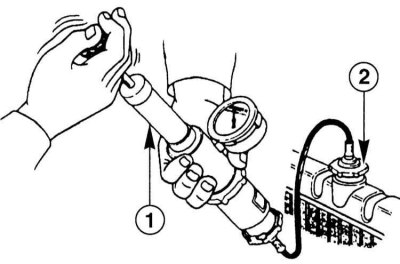
3. Install the pressure testing tool "1" on the filler neck of the radiator. Create a pressure of 1.5 bar with the hand pump of the tool and wait 2 minutes.
4. The pressure created may drop to no more than 0.1 bar within 2 minutes. If the pressure drops further, identify the leak in the system. When the pressure increases, the liquid flows out through the leak. Seal the leak.
5. If the pressure drops without fluid loss, the leak may be in the engine, such as a faulty cylinder head gasket or a crack in the housing.
6. If the pressure is maintained, although coolant is lost while the vehicle is moving, start the engine and let it idle. Use a hand pump to create pressure of about 1 bar and visually inspect the radiator. Localize the leak and seal it.
7. Stop the engine. Slowly unscrew the connecting element, relieving the pressure in the cooling system.
Checking the plug valve
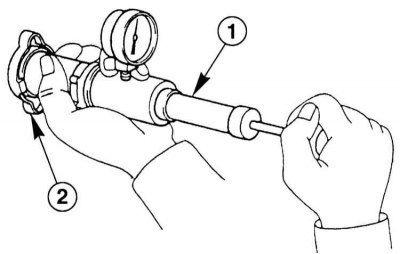
8. Screw plug "2" onto testing tool "1".
9. Create pressure with the hand pump of the tool. The plug must be airtight. The safety valve in the plug should open only under pressure 1.0 bar (Models 320d: 1.4 bar). Otherwise, replace the plug.
10. Create a vacuum in the cork. With a vacuum 0.1 bar the vacuum valve in the radiator cap should open.
11. If the rubber ring in the plug is damaged, replace it. Screw the plug back on.